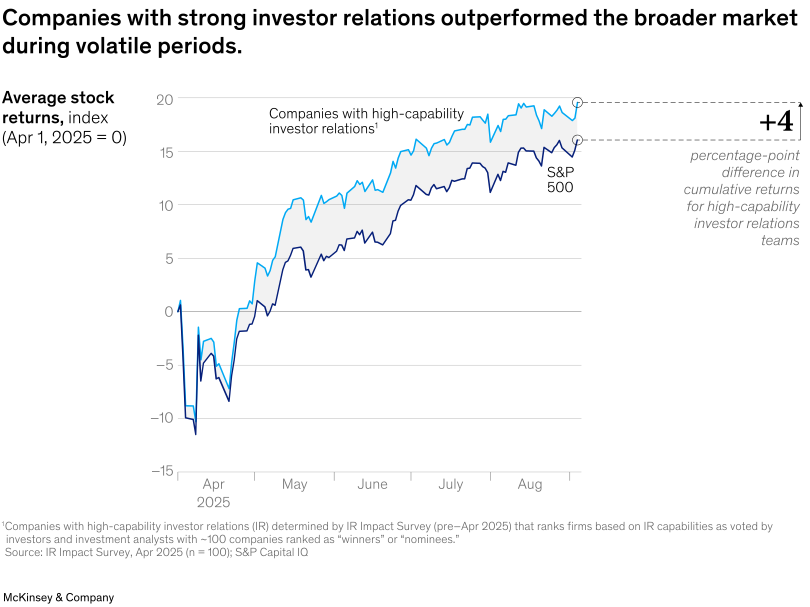
Investor relations is especially critical for life sciences companies because long R&D cycles, high capital intensity, and scientific risk can strain market confidence. Clear, credible engagement, however, helps investors trust a company’s ability to execute, making short-term volatility more manageable for leadership, say McKinsey’s Andy West, Bart Van de Vyver, Greg Graves, Jennifer Heller, Laura Furstenthal, Ryan Davies, and coauthors. Companies with strong investor relations show better stock market performance compared with the broader market, including during periods of volatility. Ultimately, investor relations is a strategic capability that enables resilience, disciplined capital allocation, and sustained innovation..
Image description:
A line chart compares the average stock returns (indexed to April 1, 2025) of companies with high-capability investor relations against the S&P 500 during a volatile market period from April to August 2025. Both groups start at the same index level, with initial fluctuations in early April resulting in a brief dip below zero for both lines. Throughout the period, companies with strong investor relations (shown by an upper, lighter blue line) consistently outperform the S&P 500 (shown by a lower, darker blue line), with the divergence most notable from mid-May onward. By August 2025, the cumulative return for companies with high-capability investor relations stands 4 percentage points higher than that of the S&P 500. Annotations highlight this difference, underscoring the lasting performance gap that emerges and persists through the summer months. The underlying data are based on an investor relations impact survey of approximately 100 companies, as well as financial data from S&P Capital IQ.
Note: This image description was completed with the assistance of Writer, a gen AI tool.
Source: IR Impact Survey, Apr 2025 (n = 100); S&P Capital IQ
End of image description.