Nearly 60 percent of the global population lack access to essential health services. This challenge is compounded by the healthcare worker shortage, which the World Health Organization projects could reach at least ten million workers by 2030. Closing the workforce gap could eliminate 7 percent of the disease burden and add $1.1 trillion to the economy, say Senior Partner Pooja Kumar and coauthors. However, the shortage and the improvement potential are unevenly distributed. Africa, for example, has 17 percent of the world’s population but more than 70 percent of the opportunity to reduce disease burden. The continent accounts for 52 percent of the worker shortage but less than 20 percent of the GDP opportunity.
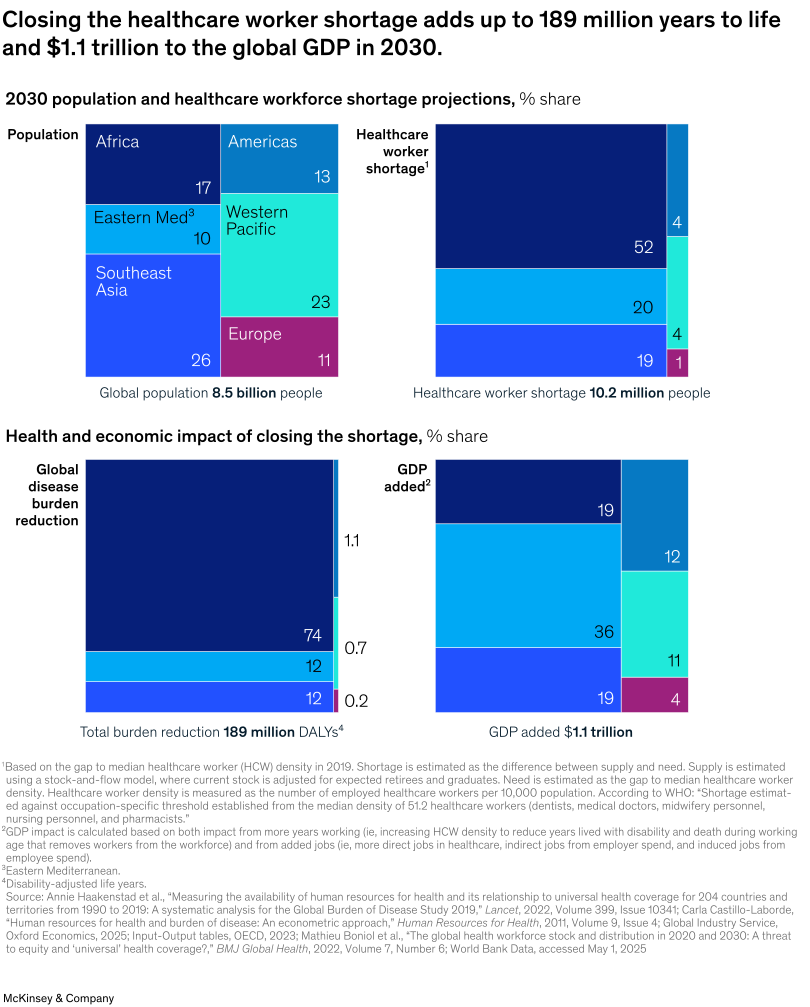
Image description:
A group of four 100% area tree map cubes show the 2030 population and healthcare workforce shortage projections, and the health and economic impact of closing the shortage. The first chart shows the percentage share of the global population of 8.5 billion people, with 17% in Africa, 13% in the Americas, 10% in the Eastern Mediterranean, 26% in Southeast Asia, 23% for the Western Pacific, and 11% in Europe. The second chart shows the percentage share of the healthcare worker shortage of 10.2 million people, with 52% in Africa, 20% in the Eastern Mediterranean, 19% in Southeast Asia, 4% in the Americas, 4% in Western Pacific, and 1% in Europe. The third and fourth charts show the percentage share of the health and economic impact of closing the shortage. The third bar chart shows the global disease burden reduction of 189 million disability-adjusted life years, with 74% in Africa, 12% in the Eastern Mediterranean, 12% in Southeast Asia, and 1% or less for the Americas, Europe, and the Western Pacific. The fourth chart shows the share of GDP added for $1.1 trillion, with 19% in Africa, 12% in the Americas, 36% in the Eastern Mediterranean, 19% in Southeast Asia, and 4% in Europe, and 11% for the Western Pacific.
Note: This image description was completed with the assistance of Writer, a gen AI tool.
Source: Annie Haakenstad et al., “Measuring the availability of human resources for health and its relationship to universal health coverage for 204 countries and territories from 1990 to 2019: A systematic analysis for the Global Burden of Disease Study 2019,” Lancet, 2022, Volume 399, Issue 10341; Carla Castillo-Laborde, “Human resources for health and burden of disease: An econometric approach,” Human Resources for Health, 2011, Volume 9, Issue 4; Global Industry Service, Oxford Economics, 2025; Input-Output tables, OECD, 2023; Mathieu Boniol et al., “The global health workforce stock and distribution in 2020 and 2030: A threat to equity and ‘universal’ health coverage?,” BMJ Global Health, 2022, Volume 7, Number 6; World Bank Data, accessed May 1, 2025.
End of image description.
To read the report, see “Heartbeat of health: Reimagining the healthcare workforce of the future,” May 14, 2025.