This week, our charts focus on productivity—from achieving successful transformations to advanced-manufacturing projects and more.
Europe faces a pivotal productivity challenge, note Senior Partner Ruth Heuss and coauthors. Over the past 25 years, labor productivity growth per hour has fallen by two-thirds, leaving Europe 33 percentage points behind the United States. In an increasingly winner-takes-all world, recovery demands a bold mindset shift: targeted investments, rapid technology adoption, and next-generation operational excellence. By combining innovation with strong leadership and workforce upskilling, European businesses can regain momentum. With decisive action, they can turn today’s lag into renewed competitiveness—boosting productivity for long-term prosperity while preserving Europe’s social contract.
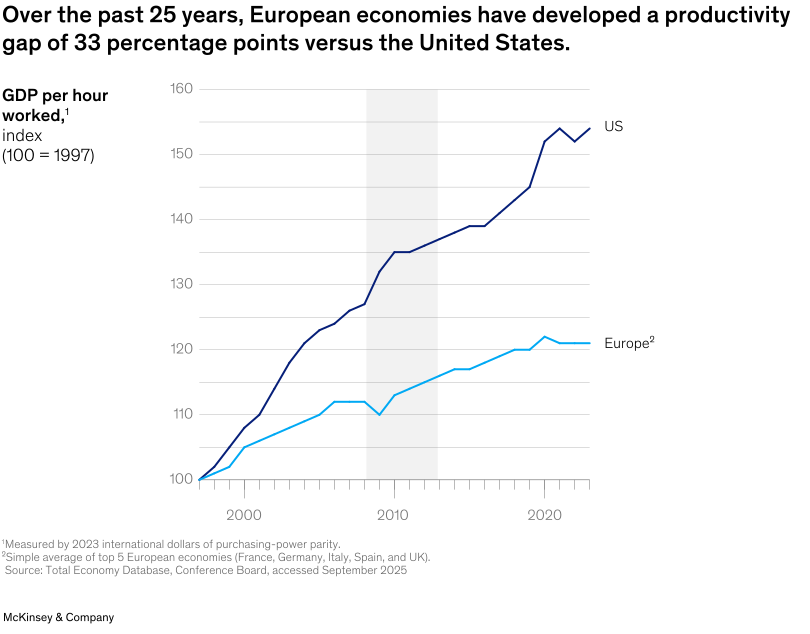
Image description:
A line chart illustrates the GDP per hour worked in the US and Europe from 1997 to 2023. The chart uses an index with 1997 set at 100 and shows that the US and Europe started with the same GDP per hour worked in 1997. Over the next 25 years, the US’s GDP per hour worked rose steadily, reaching nearly 155 by 2023, while Europe’s GDP per hour worked increased at a slower rate, reaching ~120 by 2023. The data represents the simple average of the top 5 European economies (France, Germany, Italy, Spain, and the UK).
Note: This image description was completed with the assistance of Writer, a gen AI tool.
Source: Total Economy Database: Output, Labor and Labor Productivity, The Conference Board.
End of image description.
To read the article, see “To unleash productivity growth in Europe, rewire your operations,” September 18, 2025.