US energy demand is expected to climb in the next decade, driven in part by data center load growth and electrification. Senior Partner Adam Barth and colleagues find that next-generation geothermal energy, when deployed as a grid resource competing with other technologies in the United States, has the capacity to increase steadily from 1 gigawatt this year to more than 80 gigawatts by 2050. Under conditions in which sustainability becomes a global priority, geothermal capacity could reach close to 110 gigawatts.
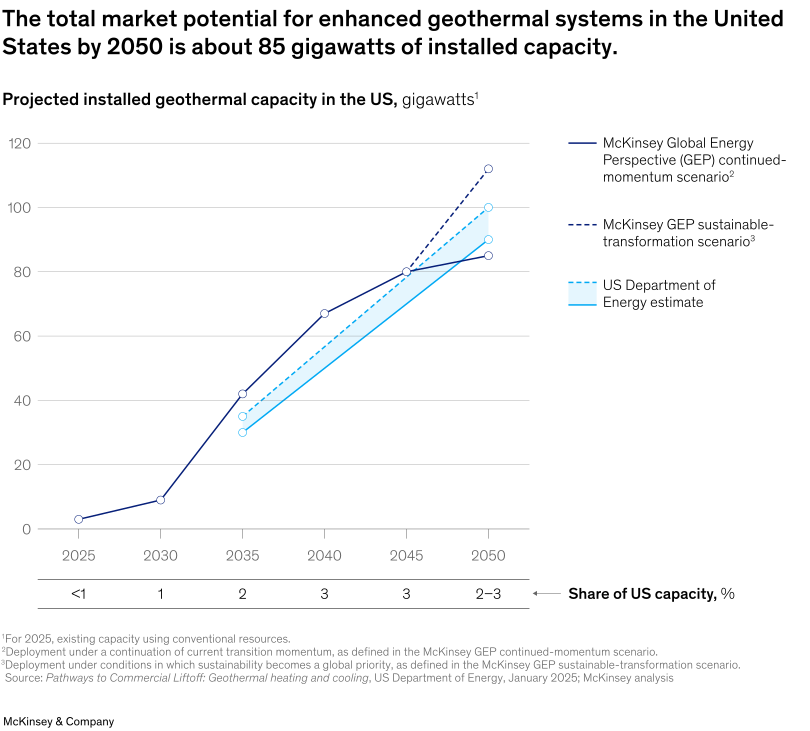
Image description.
A line chart illustrates the projected installed geothermal capacity in the US from 2025 to 2050. The chart displays three lines representing different scenarios: the McKinsey Global Energy Perspective (GEP) continued-momentum scenario, the McKinsey GEP sustainable-transformation scenario, and the US Department of Energy estimate. The McKinsey GEP continued-momentum scenario projects a steady increase in installed capacity from less than 1 gigawatt in 2025 to around 85 gigawatts by 2045, before slightly decreasing to approximately 80 gigawatts by 2050. In contrast, the McKinsey GEP sustainable-transformation scenario and the US Department of Energy estimate both show a continuous upward trend, with the former reaching around 110 gigawatts and the latter reaching around 100 gigawatts by 2050. The chart also includes a secondary axis showing the share of US capacity, which is expected to reach 2–3% by 2050.
Source: Pathways to Commercial Liftoff: Geothermal heating and cooling, US Department of Energy, January 2025; McKinsey analysis.
Note: This image description was completed with the assistance of Writer, a gen AI tool.
End of image description.
To read the article, see “Is geothermal energy ready to make its mark in the US power mix?,” July 17, 2025.