Although electric-vehicle sales have eased from their peak, battery technology continues to advance rapidly. While global trends point to market oversaturation, McKinsey analysis by Senior Partner Martin Linder and colleagues identifies distinct regional opportunities. Their review of the global market examined three demand scenarios—fading momentum, steady growth (base case), and acceleration. In the base case, global demand is projected to climb from roughly 1,970 gigawatt-hours (GWh) in 2025 to about 3,910 GWh by 2030. To seize regional opportunities, companies must anticipate demand shifts, develop a clear view of evolving regional supply–demand dynamics, and quickly secure reliable and cost-effective supply.
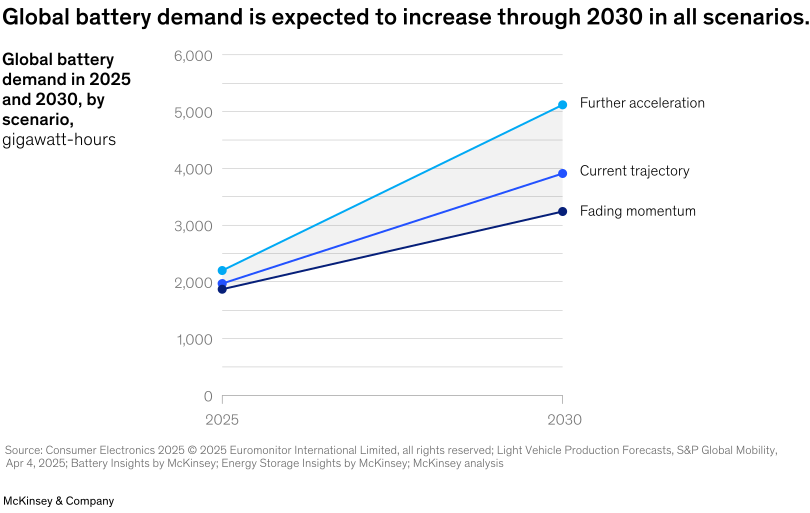
Image description:
A line chart illustrates the global battery demand in 2025 and projected for 2030 across 3 different scenarios: further acceleration, current trajectory, and fading momentum. The y-axis represents global battery demand in gigawatt-hours (GWh), ranging from 0 to 6,000, while the x-axis displays the years 2025 and 2030. In 2025, the demand is ~2,000 GWh across all scenarios. By 2030, the demand varies significantly: under the fading-momentum scenario, it reaches ~3,300 GWh; under the current-trajectory scenario, it reaches ~4,000 GWh; and under the further-acceleration scenario, it increases to ~5,200 GWh.
Note: This image description was completed with the assistance of Writer, a gen AI tool.
Source: Consumer Electronics 2025 © 2025 Euromonitor International Limited, all rights reserved; Light Vehicle Production Forecast, S&P Global Mobility, Apr 4, 2025; McKinsey Battery Insights; McKinsey Energy Storage Insights; vehicle specifications per McKinsey analysis.
End of image description.
To read the article, see “The hidden trends in battery supply and demand: A regional analysis,” August 26, 2025.