Expanding secondary aluminum production is crucial to achieving net-zero emissions goals, given that recycling aluminum uses significantly less energy than primary production. A large portion of aluminum scrap comes from postconsumer sources, but much of it ends up in mixed scrap pools, where it later becomes downcycled and high-value alloys are left unrecovered, explain Partner Peter Spiller and colleagues. To tap the recycled aluminum market, addressing collection and sorting bottlenecks could help to recover more high-value alloys and boost recycling rates.
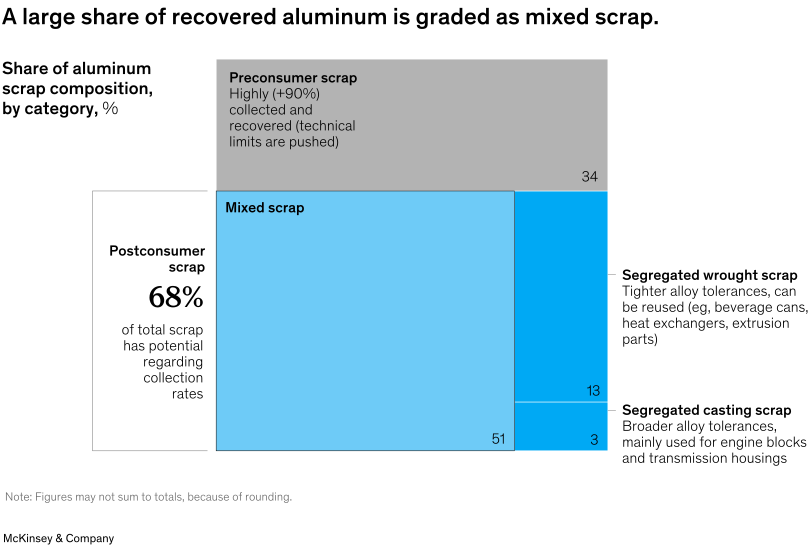
Image description:
A tree map chart illustrates the share of aluminum scrap composition by category. The chart is divided into three categories: preconsumer scrap (which is highly collected and recovered), mixed scrap, and segregated scrap. Preconsumer scrap accounts for 34% of the total, while mixed scrap makes up 51%. Segregated scrap is further divided into two subcategories: segregated wrought scrap (tighter alloy tolerances; can be reused) at 13% and segregated casting scrap (broader alloy tolerances, mostly used for engine blocks and transmission housing) at 3%. An annotation on the left side of the chart notes that postconsumer scrap accounts for 68% of the total scrap, with potential regarding collection rates. Note: This image description was completed with the assistance of Writer, a gen AI tool.
End of image description.
To read the article, see “Cleaning up mixed scrap: Decarbonizing aluminum through circularity,” July 24, 2025.