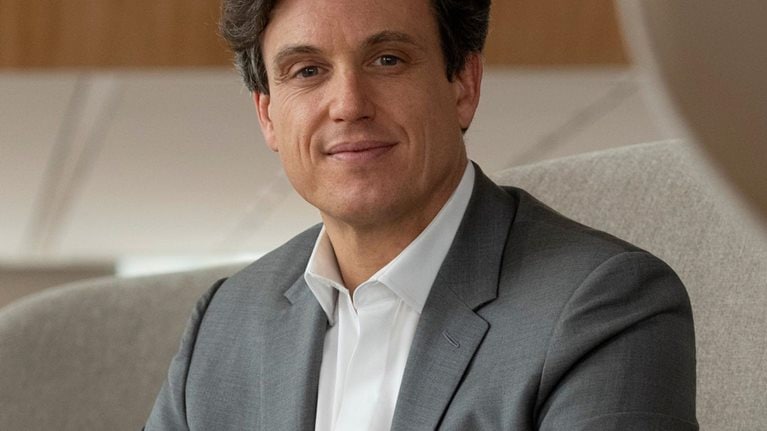
Boerse Stuttgart Group operates exchanges in Germany, Sweden, and Switzerland, a pan-European securities brokerage and the largest digital assets and crypto business of all European exchange groups. CEO Dr. Matthias Voelkel sees Europe as having what it takes to compete, and lead, in a rapidly changing global economy. Voelkel recently sat down with McKinsey senior partner and former managing partner for Europe, Massimo Giordano, for the second episode of our Europe on the move podcast series, where he shared how stronger capital markets, next-generation digital financial infrastructure, and greater investment in innovation can help Europe unlock growth, scale what’s working, and build lasting competitiveness.
The following transcript has been edited for clarity and length.
Signs of Europe upping its game
Massimo Giordano: We are here today, in Berlin, with Dr. Matthias Voelkel, the CEO of Boerse Stuttgart Group, as part of our series on lifting Europe’s ambitions. Thank you for joining, Matthias. Let’s start with a question around you and Europe. What type of European are you?
Dr. Matthias Voelkel: I’m a passionate European, emotionally and rationally. Europe is apparently the future in a growing, more competitive world, right? Having said that, it doesn’t mean that national identities are no longer important. I think they’re an add-on. Secondly, I’m also an ambitious European. We were talking about the books on the shelves in the background, and I saw one called The Passion for Excellence. And I think Europe needs to up its game.
The potential of a European capital markets union
Massimo Giordano: Based on your experience, what is required for Europe to strengthen its capital markets?
Dr. Matthias Voelkel: First of all, it's important to understand that a strong European capital market is of the essence. I think for too long, Europeans—and some countries in particular—have completely neglected the importance of a strong capital market. Now there is innovation across the globe, new technologies, all of these developments.
And bleeding-edge innovation or breakout growth is not something you finance via a bank balance sheet, as we both know. For that, you need a strong capital market, and that includes private equity (PE) and venture capital. That’s the first thing Europe needs to understand, and I think is beginning to understand, which is good.
It’s important to understand that a strong European capital market is of the essence.
Secondly, what does it take to strengthen the European capital market? Compared to the United States, Europe’s capital market is much weaker, smaller, and more fragmented. Although the US capital market is roughly three times bigger than Europe’s, its economy is not, and is roughly the same size, depending on how you look at Europe.
So why is the US capital market three times larger than ours? Because there’s a lot of private participation in the US capital market. Many US citizens are investors through private pensions, 401(k)s, and various other investment schemes.
That is an area where Europe is lagging behind. Too few Europeans are invested in the capital market, which reduces its size relative to the United States. We need to increase the participation of European private investors to provide the capital to finance growth, innovation, and make our economy bigger and stronger.
To state the obvious, there is also fragmentation. The European capital market is not really a single capital market; it is a collection of many European national capital markets. And that is something we need to address as well. Call it the capital markets union.
In the past, there was a lot of talk about a European capital market union, but it never really happened. Now there is the political will and pressure to make it happen, so it is much higher on the EU agenda, which is good.
Creating a unified European capital market must also include upgrading Europe’s capital market infrastructure. Our infrastructure is fragmented into national silos, which is, of course, cumbersome and costly. Post-trade settlement costs are generally much higher in Europe than in the United States. And that is an area we, as a European capital markets group, are trying to help improve.
Reversing European capital outflows
Massimo Giordano: Matthias, as you know very well, we lose a lot of assets every year to other markets from our families, our companies, and our foundations. So what, in your opinion, can we do to help reverse the outflow of some of those assets?
Dr. Matthias Voelkel: So where does capital go? Capital goes where there are attractive returns. Although there’s a lot of capital outflow from Europe to Asia, there’s also a lot to the United States, where it goes into growth companies. The United States is a more business-friendly environment, particularly for growth companies.
And if we want to change that, we need to create attractive conditions for start-ups, scale-ups, and mature companies to invest. That’s the first thing, because a business-friendly environment and growing companies will attract capital inflows.
The second thing is, once again, the capital market. Because a strong capital market is also a pull trigger. We’ve seen roughly 40 European unicorns move their headquarters from Europe to the United States because of more favorable regulatory conditions and a stronger capital market.
When you want to launch an IPO, you go where there’s a strong capital market, and the US capital market is currently stronger than the various European ones.
Subscribe to the Europe on the move podcast
Crypto is here to stay
Massimo Giordano: There is a lot of debate around crypto. What’s your view around crypto and how Europe is doing in this emerging area?
Dr. Matthias Voelkel: First of all, there is crypto per se, and then crypto as part of a broader metatrend toward digital assets. With crypto per se, we’re talking about the technology, cryptocurrencies, et cetera. This is also a future technology and a growth engine, right?
And in Europe, again, we need to ensure that we create the underlying infrastructure. If you look at crypto players across the globe, you have a lot of them thriving in Asia and in the United States, as well as some European players, including ourselves. Among the traditional European exchange groups, we’ve built the largest crypto business.
So I think we know what we’re talking about, and crypto is here to stay. There is also growing interest and demand when it comes to private investors. Some 30 million to 50 million Europeans are already invested in crypto, and many more want to invest.
And we’re not only talking about investment via crypto native players. We’re also talking about investment via traditional banks. We conduct a lot of surveys, and one of them asked investors, “What do you want?” One answer was clearly “We want crypto, and by the way, we want crypto from our banks.” So that’s a key trend, as well as an infrastructure trend.
Crypto, the technology, is part of the broader, more strategic digital asset discussion. When we talk about digital assets, we’re talking about the infrastructure of the future. Classic electronic capital markets have already started to transform into digital capital markets.
By digital capital markets, I mean issuance and settlement on the blockchain, meaning settlement against digital money. And with digital money, we’re talking about stablecoins and central bank digital currencies.
This is all highly strategic, because we’re talking about the critical market infrastructure of the future. And I think recent years have shown us how important it is not to be totally dependent on other parts of the world.
The future of tokenized assets
Massimo Giordano: You’ve mentioned stablecoin and tokenized assets. There is some movement here in Europe, with a new consortium and several other initiatives. What’s your view around stablecoins and tokenized assets in general?
Dr. Matthias Voelkel: Tokenized assets will be the future. It won’t happen overnight, and it won’t happen for all asset classes at the same time. But there are asset classes already on their way toward digitization, such as funds, money market funds, and other structured retail products. That’s an area we are particularly focused on, but also in other asset classes, which are a clear growth case.
Tokenized assets will be the future.
Secondly, the cash lag with all these transactions will be in digital money, which means we’re talking about stablecoins. And 99 percent of all stablecoins globally are denominated in US dollars. So while there’s been a lot of talk about global de-dollarization, which is true, when it comes to digital and stablecoins, it’s dollarization.
And Europe must act if it doesn’t want to be on the receiving end of this development. So the consortia you mentioned, like Qivalis, are very laudable. And certain European banks, like SocGen, have also issued their own stablecoins. We are a great fan of these European stablecoin initiatives. And the digital settlement platform we’ve been building runs against euros, central bank money, and also stablecoins, which we are embracing.
The big bets worth making on European markets
Massimo Giordano: Overall, what, in your opinion, are the big bets in European financial markets?
Dr. Matthias Voelkel: The big bets we should all be making? First of all, I think it’s an infrastructure bet. We need to ensure that we not only build the most innovative digital infrastructure, but that we also, to some degree, run it as Europeans. Of course, that doesn’t mean we should shut ourselves off from the rest of the world.
The source of Europe’s wealth is trade, so I’m not in favor of protectionism. But on the other hand, I’m also against naivete. So we need to build this digital infrastructure, which can be a perfect way—in addition to the 28th regime and other regulatory pushes—to overcome the current fragmentation. We need European infrastructure, particularly on the post-trade side of things.
Another big bet is the capital markets more broadly. You mentioned the scale-up funds. We do indeed have this major challenge when it comes to transforming start-ups into unicorns. This is where the transition suddenly breaks in Europe. So we need to create the infrastructure and attract banks, venture capital, and the PE firms to ensure scale-up.
Another very important element is the private pension system and insurance companies. At the end of the day, it’s all about asset allocation. So we need to gear our entire system toward the allocation of assets to growth asset classes, to capital markets, to support growing companies and to scale up start-ups.
Unleashing Europe’s culture of innovation
Massimo Giordano: Let’s close on a positive note. I’m very optimistic that even if we have a lot of problems to solve, there is positivity. What is a source of excellence in Europe that you are particularly proud of and want to share with our audience?
Dr. Matthias Voelkel: First of all, I like your optimistic attitude, because when I look at Europe, I am also optimistic. But I think this optimism needs to be combined with realism. If optimism becomes complacency, as it has been for too long, that’s not good. You need to be very “no nonsense” when it comes to analysis. So we need to tackle everything on our plate.
On the other hand, I’m very optimistic. Look at our history and what Europe has contributed to the world in terms of business, technology, and culture. Europe has what it takes; we just need to unleash it. What makes me particularly optimistic is our culture of innovation, which is evident in our excellent universities and start-ups.
Look at our history and what Europe has contributed to the world in terms of business, technology, and culture.
So it’s a mindset thing, and we need to ensure that this innovation isn’t small-scale, introverted, and geared only toward Europe. We need to imagine what Europe can once again contribute to the future and the progress of this world. If we make this link between our innovative power without thinking too small, then I share your optimism.
Massimo Giordano: Thank you very much, Matthias. It has been an honor and a big pleasure having you with us today.
Dr. Matthias Voelkel: Likewise. Thank you, Massimo.
.jpg?cq=50&mw=767&car=16:9&cpy=Center)