




Over the past year or so, the issue of sovereign AI has moved from a policy concept to a strategic priority. Many governments are investing heavily in local compute and data center infrastructure. Hyperscalers are rolling out “sovereign regions.” Regulators are tightening rules around data control. Yet despite this activity, most nations and regional entities remain in the early stages of building the capabilities required to turn sovereign ambitions into reality.
A new global McKinsey survey of 300 executives, investors, and government officials underscores both the urgency and the opportunity: 71 percent characterize sovereign AI as an “existential concern” or “strategic imperative” to their organizational goals (Exhibit 1). The next phase of the AI era may well hinge on how effectively countries, companies, and investors translate that intent into action.
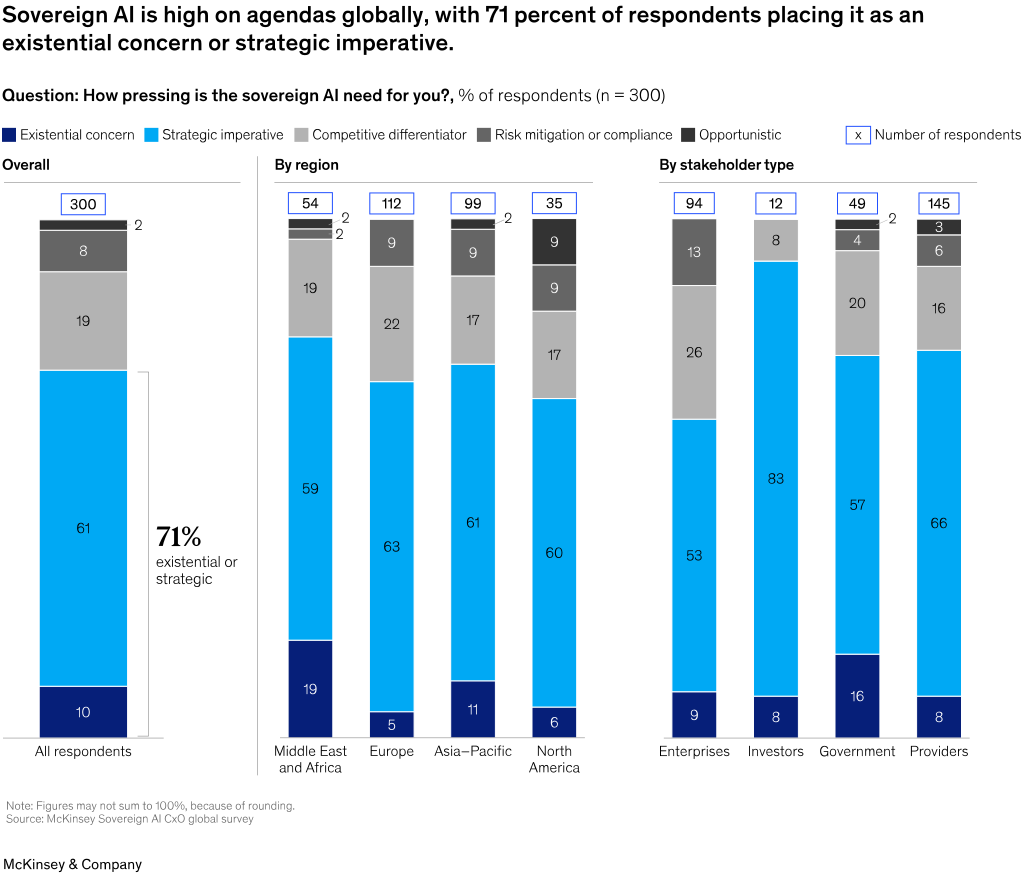
Three forces are converging to put sovereignty at the center of the AI discussion:
- Competitiveness and value capture: By 2030, global AI spending could reach $1.3 trillion to $1.5 trillion,1 McKinsey research has found, generating as much as $4.4 trillion in annual economic value from gen AI alone. Access to compute, data, and models is becoming a new basis of national and industrial competitiveness.
- Geopolitical and regulatory pressure: Evolving geopolitical landscapes and stringent laws on data (US Cloud Act) and AI systems (EU AI Act) as well as regional localization mandates are prompting governments to reassess how much of their digital backbones depend on foreign infrastructure. Sovereignty is shifting from a compliance issue to an autonomy imperative.
- Localization and cultural identity: AI models increasingly reflect and shape the societies they serve. National leaders are recognizing that their languages, histories, and values must be represented in the systems they build. This marks a step change from the cloud, for which data was largely treated as an input. With AI, data is becoming a strategic asset.
What is sovereign AI?
In general, sovereign AI refers to building and running AI systems with a measure of independence regarding data, technology, operations, and legal structures. For governments, this might mean focusing on national security and domestic economic agendas. Enterprise leaders, by contrast, might emphasize operational or technological autonomy.
The following four dimensions typically help define the spectrum of sovereignty:
- Territorial: where data and compute physically reside
- Operational: who manages and secures data and compute
- Technological: who owns the underlying stack and intellectual property
- Legal: which jurisdiction governs access and compliance
It also is important to understand the difference between sovereign AI and sovereign cloud. While the latter is primarily concerned with where data is stored, sovereign AI encompasses how intelligence is created, trained, and deployed. It spans infrastructure, models, and applications—making it broader in scope and deeper in strategic significance.
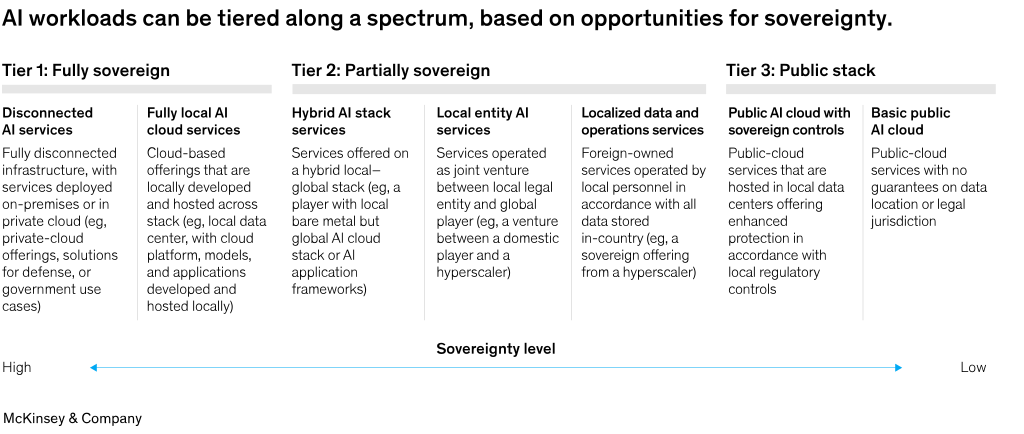
These dimensions open the market to new participants along a spectrum of potential sovereign AI offerings. Alongside hyperscalers’ sovereign offerings, local and regional providers are emerging with solutions that blend national trust with technical capability (Exhibit 2).
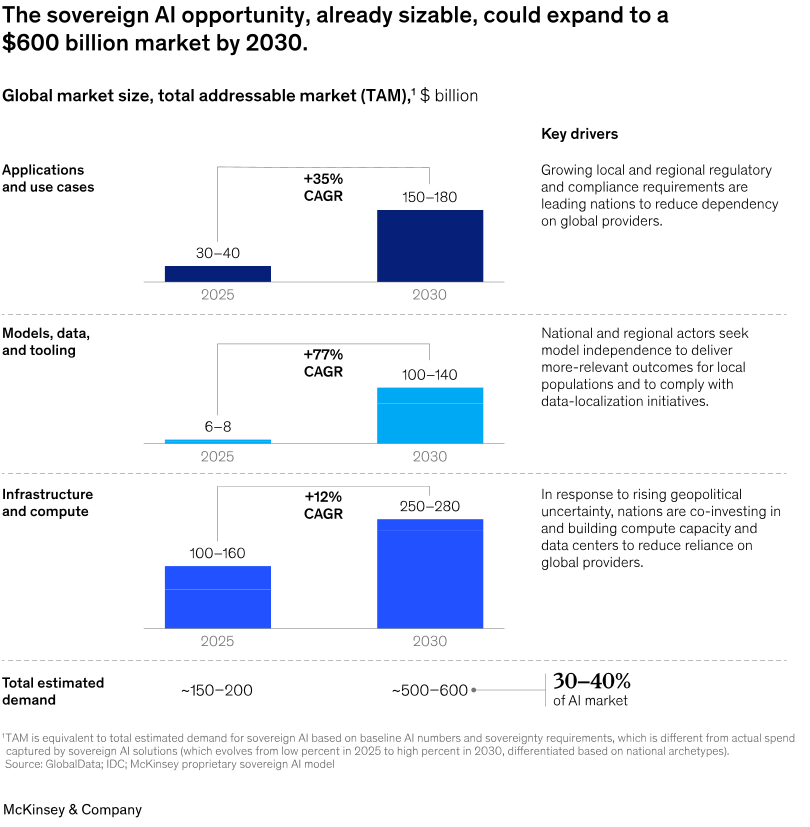
McKinsey analysis suggests sovereign AI could represent a market of $600 billion by 2030.2 This is driven by use cases in the public sector and regulated industries, which could drive up to 40 percent of AI workloads to sovereign environments (Exhibit 3).
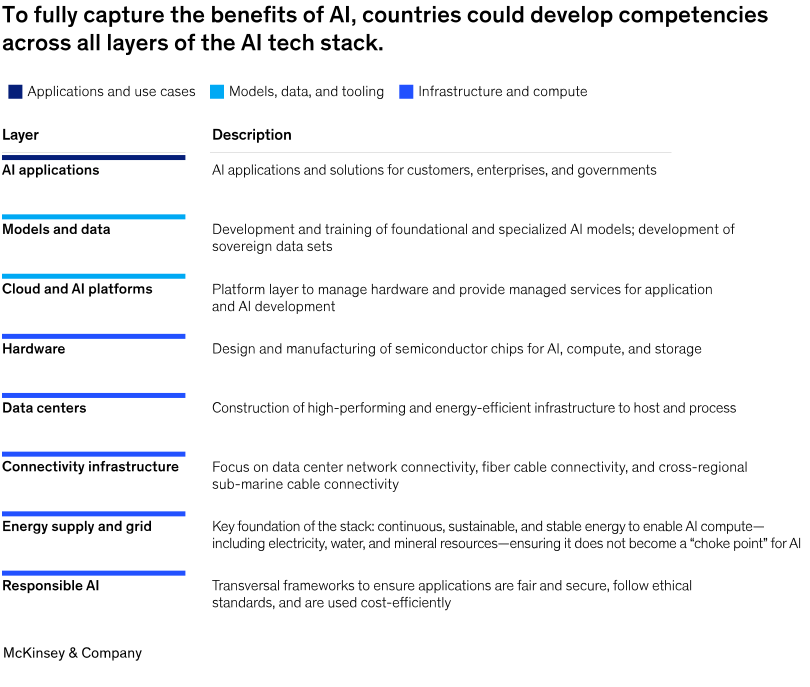
However, only about 30 countries today host in-country compute infrastructure capable of supporting advanced AI workloads.3 Many lack not only hardware but also supporting capabilities—local model development, applications, energy systems, and governance frameworks optimized for AI (Exhibit 4).
The opportunity extends beyond infrastructure. Sovereign AI can spur local innovation ecosystems, strengthen resilience, and create new sources of high-value growth.
Building a sovereign AI ecosystem
As noted above, achieving sovereignty is not a single policy decision; it is an ecosystem effort that connects multiple layers—energy, compute, data, models, and applications—into one coherent system.
Moving toward greater sovereignty also comes with trade-offs: Localized models may not achieve the performance levels of frontier models, and local and regional AI cloud providers may not match hyperscalers’ breadth of services and economies of scale. There also are significant costs and capital requirements involved in creating local and sovereign AI infrastructures.
This is why a sovereign AI ecosystem should be viewed in an integrated way, with adequate consideration for the trade-offs required by different decisions and local realities. AI sovereignty is a complicated proposition, encompassing a variety of stakeholders, both domestic and global in nature. Not all aspects of the AI stack will necessarily be sovereign.
Four stakeholder groups play pivotal roles:
- Enterprises and public institutions: These players can enhance compliance, operational control, and innovation by migrating to sovereign AI platforms or developing their own trusted stacks. They have a critical role in driving demand to develop new offerings. It will require procurement and architecture guidelines to adopt sovereign offers.
- Technology providers: Both hyperscalers and local players can expand market share by offering credible sovereign AI solutions, accelerating go-to-market efforts, and forming partnerships that balance performance with independence.
- Governments: National and regional governments can act as investors and orchestrators, and public sector institutions can build elements of the stack domestically, create clear regulatory frameworks, and foster public–private partnerships that translate infrastructure into capability. Beyond hardware and software, this could also include orchestrating data ecosystems.
- Investors: As sovereign AI emerges as a new frontier, investment opportunities range from data centers and chips to local foundation models and software services.
Success will depend on coordination across these four stakeholder groups. The countries and regions that most effectively align policy, technology, and investment will move fastest from ambition to execution.
From vision to advantage
Sovereign AI is fast becoming a competitiveness imperative—for countries seeking resilience and for industries aiming to secure trusted access to AI capabilities. Our research reveals broad agreement on its importance but uneven readiness on how to deliver it. The coming years will likely define two paths: one for countries that build robust, locally anchored AI ecosystems and another for those that depend on external infrastructure.
The path forward is not isolationist. The most successful sovereign AI strategies will combine local control with global collaboration, ensuring that systems remain interoperable, secure, and inclusive. For now, one question captures the moment: In an AI-driven world, how much of your intelligence will you truly own?
McKinsey’s forthcoming report on sovereign AI will explore what it takes to build these ecosystems at scale: the levers, investment models, and partnership structures that can turn national ambition into enduring advantage.
Ali Ustun is a senior partner in McKinsey’s Doha office; Arnaud Tournesac is a partner in the Paris office; Luca Bennici is a partner in the Dubai office, where Newfel Drahmoune is a consultant; and Kaavini Takkar is an associate partner in the Seattle office.
The authors wish to thank Adarsh Chawla, Antonis Vasilakis, Gijs Leenders, Ibrahim Naqvi, Leo Isaac-Dognin, Melanie Krawina, and Raquel Marques for their contributions to this blog post.
1 Based on $600 billion to $800 billion on applications and models (GlobalData; IDC) and $700 billion on infrastructure (McKinsey capital expenditures model).
2 McKinsey sovereign AI model.
3 Oxford Internet Institute.