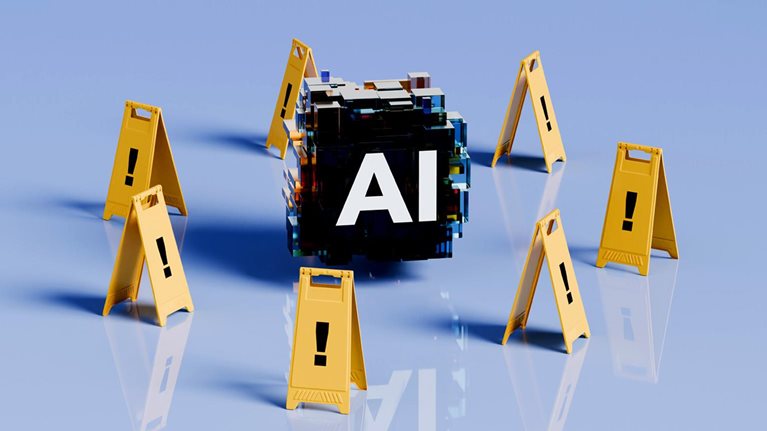
The way AI is trained and used is evolving every day. Unfortunately, cyberattacks are advancing in tandem, raising the bar for AI products that are brought to market today. On this episode of the At the Edge podcast, Cisco’s President and Chief Product Officer Jeetu Patel speaks to McKinsey Senior Partner Lareina Yee about how companies can secure their AI systems to protect enterprise data and consumers—and how to use AI to predict and quickly respond to cyberattacks.
The following transcript has been edited for clarity and length.
Building products that build value
Lareina Yee: Jeetu, as the chief product officer at Cisco, you’re both a disruptor and an innovator. What has been your leadership approach over the past couple of years?
Jeetu Patel: We tell people we want to operate as the world’s largest start-up, but that requires operating at speed with scale. So far, that has worked. When change happens, the people at the top tend to get the credit, but the people on the ground are the ones more receptive to the change and are doing the hard work to make it happen. I never imagined we’d be able to move as quickly as we have, and I’m really proud of the team.
Lareina Yee: How do you think about prioritization and managing a diverse growth portfolio?
Jeetu Patel: One of Cisco’s advantages is its breadth. We have a broad portfolio of infrastructure technology, from networking to compute to security to data platforms to observability. But if you don’t integrate that portfolio well, then breadth becomes a liability. A few years ago, each part of our portfolio was siloed. Our CEO and I realized that we needed to create an integrated platform that compounds the value of every current capability with every additional capability we add.
Subscribe to the At the Edge podcast
The definition of a platform in a classical sense has three parts. First, people who already own a Cisco product should not have a large overhead cost to adopt a new technology. Second, every new product coming to market should be valuable in itself and add—and create—value to the products consumers already own from Cisco.
You have to think from the customer’s point of view and work backward, rather than using your lens and pushing it onto the customer.
For example, when I buy a new iPhone, I’m not comparing the features of the new phone to another competitor’s phone. I just decide if and when to upgrade because I already have a Mac, an iPad, Apple TV, and AirPods, and all of these things are part of the ecosystem that continues to accrete value. Cisco works the same way. You don’t have to buy everything from us all at once, but the magic happens when you buy two things together.
The third dimension of a platform, which is important, is to operate as an ecosystem with players outside your organization, even if they compete with you. Today, staying insular doesn’t work. You have to think from the customer’s point of view and work backward, rather than using your lens and pushing it onto the customer. Then you can establish trust with the customer and assure them that Cisco is here to be a custodian of their success rather than just a transaction.
The hurdles hindering AI’s full potential
Lareina Yee: How are companies approaching AI infrastructure to ensure customers get the full value from AI?
Jeetu Patel: The true moment of consumerization happened when OpenAI came out with ChatGPT in November of 2022. That was the first phase. Intelligent chatbots answered questions for us, largely to drive individual productivity. We’re now in the second phase: Agents can conduct tasks and perform jobs almost fully autonomously. The primary driver is automating workflows rather than just automating individual productivity. The third phase, which will come over time, is physical AI and robotics. I expect we’ll see varying levels of introduction of the third phase.
In terms of agentic workflow, you have to deeply understand the constraints and impediments that might hold the AI back, then provide solutions to those constraints. There are three main constraints. The first is an infrastructure constraint. There’s not enough power, compute capacity, or network bandwidth in the world to meet the needs of AI. The reason OpenAI has approximately 700 million weekly active users and not 1.4 billion today is not because there’s not enough demand for 1.4 billion people. It’s because they don’t have enough infrastructure to serve 1.4 billion people.
The second constraint is what we call a “trust deficit.” If people don’t trust these systems, they won’t use them. Right now, there’s a fair amount of apprehension around these systems. People wonder if their privacy is at risk, for example. Additionally, the models that these systems are built on tend to be unpredictable because they are nondeterministic. We’re trying to build predictable, deterministic systems in enterprises on top of these nondeterministic models. So, when they don’t work the way we expect them to, how can we put appropriate guardrails on these applications without requiring a developer to rebuild the entire security stack?
The third constraint is the data gap. Most customers think of their data as a moat, but they don’t know how to organize it and put it in a pipeline so AI can harness the full potential of it. Cisco helps customers alleviate constraints in all three areas.
Lareina Yee: Some of these constraints have dependencies outside of businesses. They point to bigger issues, such as a strain on our natural resources, and they require an enormous amount of innovation to get this flywheel going.
So let’s take the first one: infrastructure. McKinsey data suggests that data center demand could grow around 30 percent a year, and 70 percent of that growth will be for AI-driven data centers. Compared to traditional data centers, AI-driven data centers are physically different structures with different technology. How are you helping to build these structures quickly and at scale?
Jeetu Patel: Much of the constraint around building data centers is because of power constraints and data sovereignty requirements. Countries are also becoming more nationalistic. As data center build-outs happen around the world, most countries think about the ability to generate tokens as directly proportionate to economic prosperity and national security. Token generation is the currency of the future. So the ability for token generation will become concentrated wherever there’s power.
Many gigawatts of capacity will be built out over the next few years, and if American technology is used for those build-outs worldwide, then America will continue to maintain the lead. As we go into this race, American and Chinese companies will be competing. Even if America has a slight lead now, we should never stop being paranoid, because China is progressing very quickly with infrastructure, algorithms, and data.
Rethinking AI infrastructure and security
Lareina Yee: The network is the unsung hero. What needs to happen at the network layer?
Jeetu Patel: There are two major workloads that are important to understand. There’s the training workload, which trains large models on data, and there’s the inferencing workload, which interprets questions that are asked and gives an answer.
The training side is GPU [graphics processing unit] constrained, especially for large models. The more data you feed these models, the better they get. We haven’t reached the ceiling yet for scaling laws. There continues to be more data that these models need to be fed so they can perform better. But that’s a very capital-intensive process for training these models.
The network is important because when the GPU remains idle, it’s like burning money. So energy-efficient, low-latency, high-performance networking is the heartbeat of an AI training workload. As demand increases, you need to have the appropriate infrastructure to support it, the appropriate safety and security controls, and the right level of data cleansing and hygiene so you can feed these models with the data.
Lareina Yee: Many consumers wonder if their personal data, questions, and thoughts are secure when they’re using AI. How are you thinking about that?
Jeetu Patel: One of the big advantages that Cisco has is that we build our own silicon application-specific integrated circuits [ASICs] for the network. We have our own systems, hardware, operating system, security platform, observability platform, and data platform. We tie everything together with our technologies and with third parties.
In terms of security, the bad news is that the adversaries, the bad actors in security, are getting more sophisticated, so attacks are getting more sophisticated, and they’re happening at a higher volume than we’ve ever seen before. The only way you can have an effective response to those attacks is to make sure cyberdefense is happening at machine scale—human scale alone is not sufficient anymore. Second, you have to secure the AI itself. Can you validate that the models you’re using are algorithmically going to work the way you want them to work? When they don’t, can you put the effective guardrails in place so they can? We built a technology called AI Defense that helps with both dimensions.
The only way you can have an effective response to those attacks is to make sure cyberdefense is happening at machine scale—human scale alone is not sufficient anymore.
You also have to keep in mind that the architecture that was built for the internet pre-AI has to completely change. The scale of proportions is different. The data centers will get redesigned to have a different layer of security, and they’ll have to be hyperdistributed because a perimeter-based model no longer works. Imagine if you had a cow path that was paved into a road. Now you want to drive a car at 140 miles per hour. You can’t. You need expressways like the Autobahn.
That’s where this perspective of rethinking infrastructure, security, and the data architecture is important. Without it, we won’t be able to harness the full potential of AI. In my mind, there will only be two kinds of companies in the world: the ones that are dexterous with the use of AI or the ones that struggle for relevance.
Lareina Yee: There’s so much to understand from an engineering perspective before you even get to a product perspective. How are you all moving faster to get there?
Jeetu Patel: The speed right now is unprecedented. The way in which we engage with each other and the way in which we use AI for our internal workflows have to be completely different. Before, a developer could review 10,000 lines of code in a few weeks; now, you might do that within an hour with AI.
AI has to infiltrate every workflow within Cisco, whether it be for a legal person approving a contract, a product marketer writing a messaging document, a salesperson preparing for a customer, or an engineer writing a piece of code. We must use it in ways that fundamentally reimagine workflows.
Number one: Can AI be used to do things that humans don’t have time to do? Of course. That’s an easy one. Number two: Can AI do things slightly better than humans? And number three: Can AI do things that humans have no chance of doing? If we consider those three angles, then all the capacity humans have can be spent on doing things they can do better than AI. And that’s how we can elevate ourselves to a higher order.
Using observability as an oracle
Lareina Yee: Tell me your perspective on data, particularly observability.
Jeetu Patel: Historically, these models have been trained on data that is publicly available on the internet. It turns out, though, that most of the growth in data is happening with proprietary machine-generated data. As more agents enter organizations, there will be more of this machine-generated data based on the problems the agent is solving.
Collecting all that data shows you: one, whether the system is working the way you want it to work; two, you can detect a breach from a security standpoint; and three, you can observe your network and your entire estate and determine if your GPU is performing the way you want it to. That entire observability process is done through machine data. That same machine data, if you can use it and harness its full potential with an AI model, can allow you to correlate machine data with human data and come up with insights you couldn’t have come up with before.
For example, you detect a one-degree change in temperature in your network switch or a device on your network. It may seem anomalous, but it could bring down your entire network. You’d have to deal with that problem in a different way. You’d have to redirect some traffic and be more proactive in how you fix it. More importantly, you’d have to figure out a way to ensure it never happens again.
These models and the way AI is being used will help us predict events in our environments. So rather than reacting to an outage that occurs, you can predict an outage occurring and prevent it from happening in the first place. That all happens when the power of machine data is correlated with human data in an AI model. And that’s what Cisco does.
Lareina Yee: In some ways, for the consumer, this example is similar to what we’re seeing in terms of personalization at scale. Instead of a call-center agent reacting to your complaint or your question, they can use AI to get ahead of the issue and help you avoid the challenge or reroute. That’s a huge paradigm shift for all of us.
With this innovation, what are some mistakes you’ve made, and how have you turned them around?
Jeetu Patel: When there is a lot of enthusiasm about a new technology that comes out, oftentimes people can get exuberant prematurely. With AI, it might be easy to build a prototype, but it’s difficult to build a complete, full-fledged, finished application that yields productive business outcomes. The only way to do that is by repetition and experimentation and by continuously staying at it and learning.
Whoever is the first to harness the full potential of AI from a technology perspective will be the one with the durable advantage in the market as well.
I always tell our teams, “Get 1.27 percent better every day. Because in a year that’ll compound to you being 100 times better.” It’s important to have that growth mindset. Large companies tend to be good at running a certain number of experiments, but they never go all in when something works. For us, we’re going all in on coding. We have 27,000 engineers, but we have enough work to keep 270,000 engineers busy. We’re not short on vision, but we’re short on execution resources. So we want every individual to be ten to 50 times more productive.
We’re nowhere near that yet. We’ve made a lot of progress, but I always tell the team, “Always be slightly dissatisfied. You need to move faster.” Because speed really matters. Whoever is the first to harness the full potential of AI from a technology perspective will be the one with the durable advantage in the market as well.
The next generation of AI natives
Lareina Yee: Each day, people are worried about AI affecting their jobs. What are your thoughts on that?
Jeetu Patel: This is one of the reasons why people don’t experiment with AI. I think it’s important for leaders to communicate that to the team. I tell my team, “Don’t worry about AI taking your job, but definitely worry about someone who’s using AI better than you taking your job.” If someone can do a job better than you, I should demand more from you for the sake of our shareholders. Today, would you ever give a job to someone who didn’t know how to get on the internet? No. In five years, why would we think any differently of someone who doesn’t use AI daily?
Don’t worry about AI taking your job, but definitely worry about someone who’s using AI better than you taking your job.
Now, some companies are deciding not to hire for entry-level positions. I think that is one of the most misinformed decisions a company can make. Entry-level people oftentimes bring in the new ideas. If you look at how a 20-year-old and a 30-year-old use AI, it’s dramatically different. A 30-year-old thinks of AI as Google on steroids. A 20-year-old thinks of AI as a companion. They consider it a brainstorming partner. They’re asking it questions. It’s not a transactional relationship.
There’s a different instinct when someone has used AI during their school days. The more time goes on, the more AI natives we’ll see. The people born today are never going to have seen the world without AI. They will live life in a very different way than you and I do. We have an opportunity to learn from them. That talent is important to inject into your organization so you can raise the bar.
Lareina Yee: What do you think is more essential for a future engineer: imagination or empathy?
Jeetu Patel: I don’t know that those are competing objectives. I think they’ll both be important. Imagination creates the upper boundary for your accomplishments. Most of our limitations are not because of our physical ability but our imagination.
Empathy is more important today than ever before as you build these products. The thing humans do better than AI is make correct decisions with incomplete data. Humans have a gut feeling. I think we underestimate that gut feeling. It’s such an important thing.
I urge people not to be overly concerned about what happens if they lose their job. The only thing you can do is create so much value that it only makes sense for you to be there. The way to do that is to embrace the change rather than fight it. I’ve learned not to fight a megatrend. Always use it as a tailwind. Learn this in your day to day. I think you’ll find it creates an escape velocity for individuals and companies.