Shareholder activism has always posed a challenge for CEOs and boards, particularly in the United States. An activist hedge fund seeks to force change by building a stake, publishing a letter, nominating directors, and demanding a sale or breakup. The CEO and board then play defense against the public attack.
This scenario still occurs, but it’s not the full extent of shareholder activism today, which is now more global, more strategic, and often less public. Activists are not only pursuing board seats or governance changes; they are challenging the core architecture of corporate value creation, including portfolio shape, capital allocation, and leadership effectiveness.
McKinsey’s research has shown that activist campaigns tend to generate a sustained increase in shareholder returns, though the picture is nuanced, and that gains do not always endure after an activist campaign ends. McKinsey’s new proprietary research demonstrates that companies with weaker TSR see the greatest TSR improvement following a campaign. Taken together, these findings suggest that leaders should assess activist demands in the context of their company’s circumstances and performance. And as activism spreads beyond the United States, including to Japan and South Korea, this imperative increasingly applies to CEOs and boards worldwide.
In this article, we share our latest research on when activism can create value. We then explore five ways activism is changing, and the actions—including an annual diagnostic exercise—CEOs and boards can take to identify and address vulnerabilities before activists do.
Shareholder activism can create value, but only under some circumstances
Activists can create value. Prior McKinsey research found that activist campaigns tend to stop a downward performance trajectory and correspond with excess returns that persist for at least 36 months after campaign announcement. Our later work added an important caveat: After activists exit, value creation is more uneven. In a review of almost 170 activist campaigns worldwide, three-year excess TSR after an activist exit was negative in about 40 percent of companies that had generated positive returns while the activist held its stake; only 23 percent continued to generate positive returns over the three-year period after exit.
Our most recent research adds a further nuance: Companies with weaker precampaign TSR experience the greatest improvement in excess TSR following activist intervention (Exhibit 1).
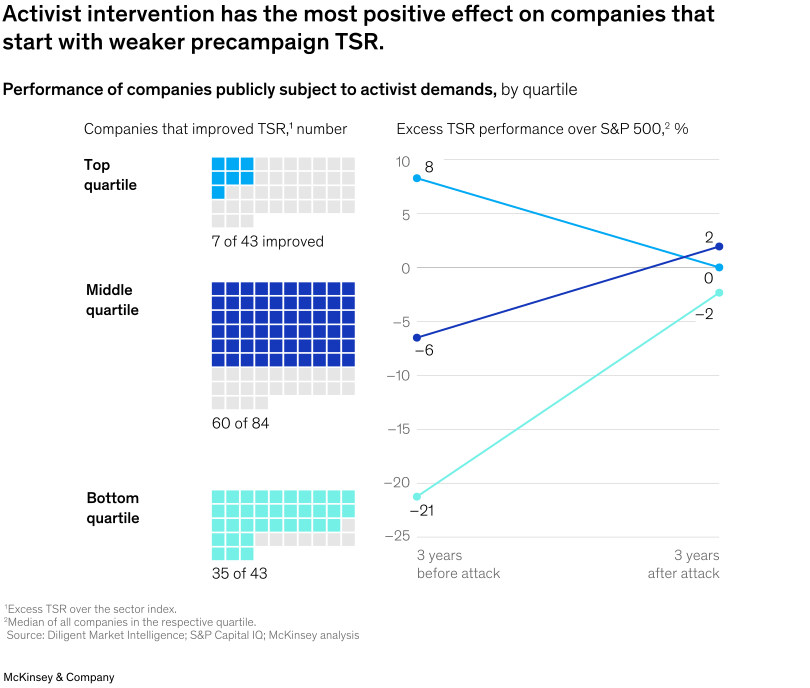
Activists rarely target fundamentally bad companies. More often, they target businesses with sound underlying economics that are nevertheless underperforming, leading to lower market valuations. Activists build significant stakes and then press for operational, strategic, or portfolio changes they believe can improve results and increase the company’s value. When they are right, both they and other shareholders benefit.
Activism is often most effective when it exposes a real performance weakness, such as misallocated capital, weak margins, or a balance sheet that is inconsistent with the company’s strategy. It is less predictably beneficial when it pushes an already strong-performing company toward financial engineering or strategic disruption without a clear link to improved fundamentals.
For boards, the first question is whether the activist has identified genuine weaknesses in the company’s performance or strategy. If so, the board should act, even if it does not accept the activist’s exact recommendation. If the activist’s concerns are unfounded, the board must be able to explain, with evidence, why its own plan is more likely to create durable value.
Shareholder activism is changing, and companies need to change with it
The most important conclusion for boards and CEOs is not just that activism is becoming more globally prevalent, but that it has become an ongoing test of whether a company’s value creation plan is credible. Leaders can therefore treat activism as a boardroom discipline, not simply a call for defensive action when a campaign arises. Boards that regularly take an unvarnished, activist-like view of their own performance, strategy, and operations stand the best chance of addressing vulnerabilities before an activist does.
To understand why thinking like an activist has become a leadership imperative, consider five ways shareholder activism has evolved in recent years.
Activists are moving deeper into corporate strategy
The popular image of activism is that it’s about board seats, buybacks, and proxy fights. Those issues remain relevant, but the activist agenda increasingly addresses operational and portfolio choices that influence performance and company value.
M&A is now a leading activist demand, possibly reflecting a belief that corporate actions can unlock value more rapidly than operational interventions can (Exhibit 2). Activists are pressing companies to divest noncore assets, pursue carve-outs, and separate businesses they believe would be worth more on their own, reflecting investor preferences for more-focused companies. Boards, in turn, are engaging earlier with activists and increasingly considering M&A and portfolio changes as part of negotiated responses to shareholder concerns.
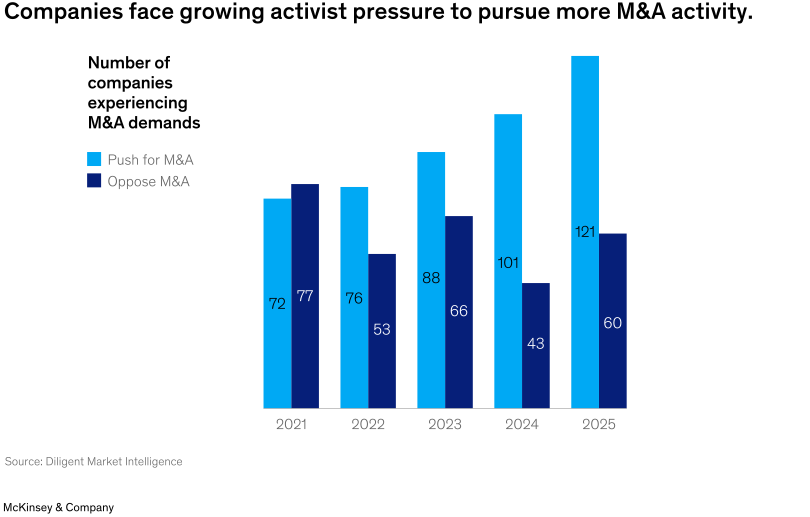
As activists focus more on corporate strategy, management teams can explain why the portfolio belongs together, why the company is the natural owner of its businesses, how capital is allocated, where performance falls short, and what they are doing to improve it. They can also explain why the company’s strategy offers a better path to long-term value creation than the alternatives an activist might propose.
CEOs can also regularly review the company’s strategy, portfolio, capital allocation, and performance with their senior teams and boards, looking for the same vulnerabilities an activist might identify and addressing them before they become the focus of a campaign.
Activists are putting greater pressure on corporate leadership
Activists are challenging CEO performance, succession plans, board composition, incentive design, and management accountability, and their campaigns are increasingly followed by leadership changes.
Barclays found that 32 US CEOs resigned in 2025 within one year of an activist campaign, surpassing the previous record of 27 in 2024 and representing a 60 percent increase compared with the four-year average.1 Citi reported a similar pattern in North America: CEO departures following activism rose 43 percent year over year in 2025 and were 87 percent above the prior three-year average, while median S&P 500 CEO tenure fell to 5.3 years from a prior three-year average of 6.6 years.
Activists are also increasingly securing board seats for candidates with significant public-company experience. In 2025, 31 percent of independent directors appointed in activist situations had public-company CEO or CFO experience, and 60 percent had served as public-company directors—both five-year highs—according to Barclays.
CEOs and boards can get ahead of scrutiny by critically assessing their own value creation plans and leadership teams, addressing vulnerabilities before an activist does.
Campaigns today may start privately
Boards have traditionally experienced activism as public events that often begin with a letter, a white paper, a proxy contest, or a media campaign. But increasingly, the campaign starts earlier and may never become fully public, giving boards not just the opportunity but the obligation to respond earlier.
In this newer pattern, an activist may spend six to 12 months researching the company and developing its case, consulting with market experts, meeting privately with management, and talking with institutional investors. Only then may the activist decide whether to launch a public campaign.
This changes the board’s preparedness requirement. The question is not merely “How do we win a public fight?” It is “How do we know whether a private critique is valid, whether other shareholders agree, and whether our own plan is stronger?”
A company may be in an activist situation before the market knows it. The first meeting with an activist is therefore not a courtesy call. It is often a live test of management’s confidence, board alignment, shareholder understanding, and the credibility of the company’s value creation strategy.
High costs raise the stakes of getting ahead of challenges
We estimate that activist campaigns can involve $30 million to $50 million in incremental expenses; significant distraction for management and directors; substantial demands on finance, investor relations, and legal functions; and potential damage to the brand, employee morale, customers, suppliers, and recruiting.
If activism leads to productive change, the cost can seem worth it. But the best approach is for boards and CEOs to preemptively evaluate their companies as an activist might and take action on anything that could trigger a campaign.
Companies in more places are experiencing shareholder activism
The United States accounts for half of shareholder activist campaigns globally, but activism is spreading in other regions (Exhibit 3). Once relatively sporadic in Asia, shareholder activism is becoming a more persistent feature of the region’s capital markets.
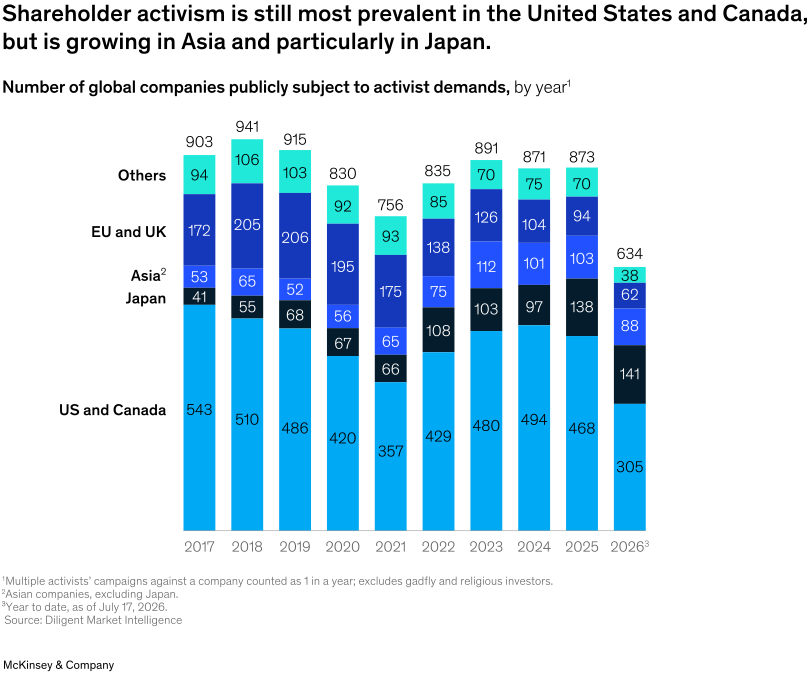
Japan is now the most important non-US market for activism, accounting for 22 percent of global activity in H1 2026.2 The rise in activity reflects long-standing concerns about Japanese corporate governance and capital efficiency, as well as growing pressure from regulators and investors for reform. The Tokyo Stock Exchange has also pushed listed companies to pay greater attention to their return on capital and corporate value. Activists are pressing companies on many of the same issues, including how they allocate capital and improve shareholder returns.
There is also more shareholder activism in South Korea. A record 60 Korea-based companies faced activist demands in the first quarter of 2026, matching the total for all of 2025.3 Those campaigns included 134 separate demands, nearly as many as the 142 recorded in all of 2025. Policy reform, stronger minority-shareholder protections, the government’s Corporate Value-Up Program, and rising retail-investor participation are creating an environment more conducive to shareholder activism.
Actions to get ahead of shareholder activism
The best defense against activist campaigns is to have a value creation plan that can withstand activist-level scrutiny. Companies can stress-test that plan by conducting an annual “activism diagnostic,” in which management takes an activist’s perspective on the company’s strategy and performance.
Management can identify the three to five arguments an activist would be most likely to make, the evidence that could make those arguments persuasive to shareholders, and the alternatives an activist might propose. The board and management can then assess which arguments warrant action and where the company’s own plan offers a stronger path to value creation.
To make the exercise concrete, the board can select three high-potential leaders and ask each to write an activist–investor letter attacking the company’s current strategy. The exercise forces leaders to adopt an outsider’s perspective, identify where value may be left on the table, and pressure-test assumptions management may be taking for granted.
The annual diagnostic offers a concentrated opportunity to consider whether the company is taking actions that can address common sources of activist scrutiny. These actions can strengthen the company regardless of whether an activist campaign materializes. Five actions are particularly important:
- Make capital allocation decisions dynamic. Activists are more likely to gain shareholder support when a company cannot clearly explain how and why it allocates capital. Boards should ensure capital flows to the best risk-adjusted return opportunities rather than simply to the largest or most established businesses. They should be willing to stop underperforming investments, reallocate capital, or return excess cash. Companies should also clearly communicate these choices and the trade-offs behind them.
- Pressure-test the portfolio. If a company owns multiple businesses, the board can ensure investors understand why they create more value together than apart and why the company remains the natural owner of each one. If the case is weak, boards can consider changes to the portfolio or ownership of individual businesses before an activist makes the case publicly.
- Identify and address operating weaknesses. Operating underperformance is one of the easiest activist critiques to understand and one of the hardest to rebut without concrete evidence. Companies need to benchmark performance against the right competitive set and show investors how they compare. Comparing only against weaker peers may make performance look strong, but it leaves companies vulnerable to more demanding comparisons. Where margins, working capital, capital productivity, R&D returns, or segment performance lag, CEOs should be able to propose operating solutions with clear milestones and clear executive ownership—and make progress visible to investors.
-
Treat board and leadership composition as part of the value story. Board leadership should be dynamic, with composition evolving to reflect the capabilities a company needs today. The key question is not how esteemed or credentialed a director is, but what value that director brings to shareholders now. For example, if AI is a strategic priority, the board may need a member with genuine AI expertise to guide and challenge management. If the company is undertaking a major transformation, it may need someone with firsthand experience overseeing one at comparable scale.
Activists may also scrutinize whether the board has the expertise needed in areas such as capital markets, geopolitics, and regulation; whether the company has a strong CEO succession plan; and whether executive compensation reinforces its value creation priorities.
-
Engage shareholders continuously and specifically. Companies can rely on dialogue with their most important investors as an early signal of where their strategy is resonating and where vulnerabilities may be developing. Long-term, intrinsically focused investors can bring a valuable external perspective on strategy, capital allocation, governance, and performance.
Developing this level of dialogue requires engagement beyond the investor relations team. The CEO, CFO, general counsel, board chair, lead independent director, and relevant committee chairs can participate directly in substantive conversations with key investors. Our investor surveys consistently show that investors value one-on-one dialogue with management over presentation-led interactions. These conversations can help companies understand investors’ priorities and emerging concerns before an activist begins making its case to them.
When an activist arrives, assume they are correct
As this article has argued, the best defense against shareholder activism is for CEOs and boards to regard their companies from the perspective of an activist and act on the weaknesses they uncover. But what if an activist campaign develops anyway?
It is our view that companies should approach an activist campaign from the premise that the investor may be right about at least some of the underlying issues. The objective should not be to “defeat” the activist, but to determine which parts of the thesis are economically sound and respond accordingly. This makes the engagement collaborative rather than adversarial. Leaders can examine what the investors have correctly identified and what management can address. They can also identify where the company should push back because the requested action would not create sustainable shareholder value.
Shareholders do not invest to preserve management teams, organizational structures, or existing strategies; they invest to earn a return on capital. If changes to strategy, capital allocation, the portfolio, cost structure, governance, or even leadership would improve long-term shareholder returns, those changes deserve serious consideration.
The appropriate response to activism is therefore not institutional self-preservation. It is to demonstrate that management has an equally rigorous—or better—plan for value creation. Where the activist has identified genuine underperformance, management should act. Where the activist’s proposal would destroy value, introduce disproportionate risk, or prioritize a short-term gain at the expense of greater long-term value, management should explain why and put forth a superior alternative.
Shareholder activism is becoming more common around the world. That means more CEOs and boards need to identify any shortcomings in their companies’ performance and address them before an activist does. When activists do raise concerns, companies can assess which are valid, address the issues that matter, and explain why their own plans offer the strongest path to long-term value creation.
In short, the best preparation is to think like an activist before an activist thinks about you.