Nonfinancial risk (NFR) has always been difficult to manage well. Unlike credit or market risk, it resists neat quantification, spans organizational silos, and often materializes in ways no single function was designed to anticipate. The typical response has been more controls, more head count, and more governance layers. This response has not kept pace.
The institutions making the most progress point toward a destination that would be a fundamentally different model for managing nonfinancial risk: a live digital twin of the bank’s operations, connecting processes, technology, vendors, and controls into a unified structure that makes risk visible, testable, and subject to continuous monitoring.
In this article, we look at what a live digital twin makes possible for nonfinancial risk management, what banking can learn from other high-stakes industries that have already solved versions of this problem, the seven decisions it changes for chief risk officers, and how institutions can begin building toward it without waiting for perfect data or a completed technology transformation.
The scale of the problem
The scale of nonfinancial risks continues to grow. Institutions are facing risks that escalate within minutes or hours instead of days or weeks. In addition to historical issues like flawed tech updates (both those pushed by critical third parties and within institutions themselves), we are seeing new types of fraud, money laundering, and vulnerability exploitation at paces that are one to two orders of magnitude faster than in the past.
Institutions need to manage risk at speed and require an “always-on” platform to make that possible—one that provides both instantly queryable information and trigger-based alerts for spikes in activity or money movement that could be a sign of an unfolding risk event. More people alone cannot solve this problem.
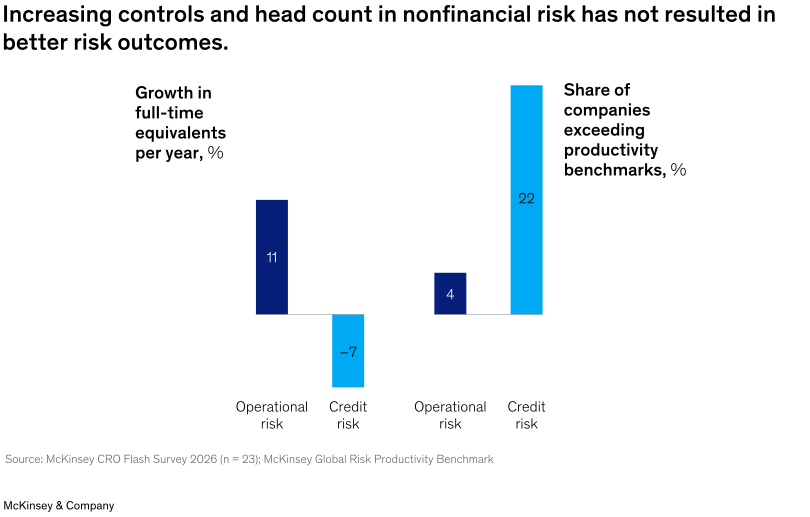
McKinsey’s Global Risk Productivity Benchmark shows that operational-risk full-time equivalent (FTE) head count grew by 11 percent per annum between 2020 and 2023. Yet the function, which expanded faster than other risk types, performs worst on productivity: Only 4 percent of respondents in our 2026 CRO Flash Survey of 23 leading global institutions report operational risk exceeding its productivity target, compared with 22 percent for credit risk, which reduced FTE intensity by 7 percent annually over the same period (Exhibit 1).
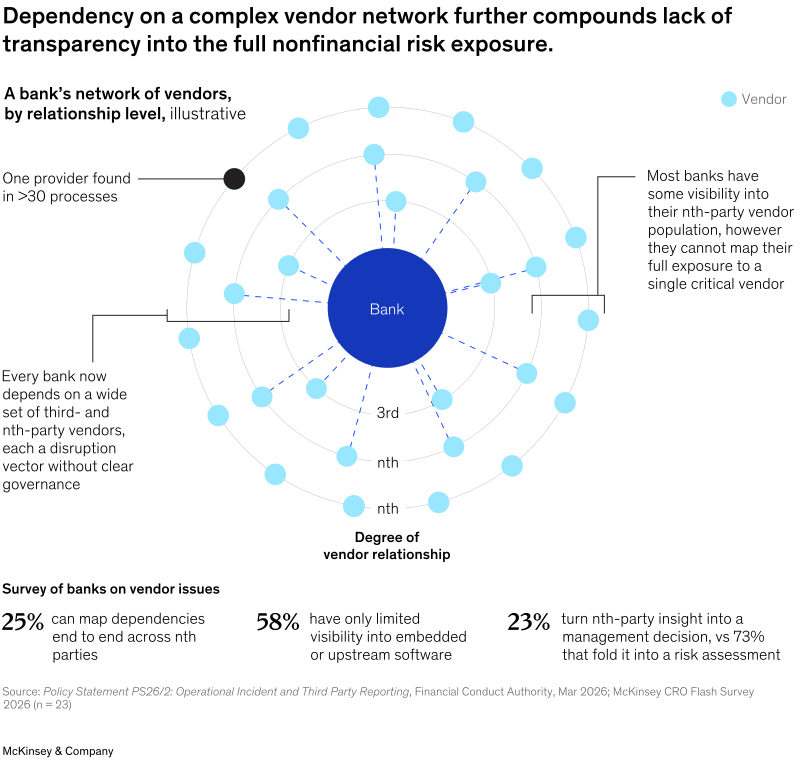
The problem is not getting any better. Ecosystem interdependencies have multiplied sharply: 58 percent of institutions report only moderate visibility into embedded software component dependencies, meaning most cannot map their full exposure to a single critical vendor, which is exactly the gap that vendor dependency mapping, as a first digital-twin use case, is positioned to close (Exhibit 2). Some regulators are moving to close that gap directly: The UK’s Financial Conduct Authority now requires firms to map and test dependencies across critical third parties.1
What other industries can teach banking about resilience
Three industry examples draw direct parallels to banking, including mining, nuclear power, and aviation. Each continually manages systematic risk across interconnected systems under conditions where the cost of failure is measured not in dollars but in lives.
Mining and heavy industry: Operational digital twins in practice
Energy, mining, and heavy manufacturing have developed sophisticated risk management frameworks precisely because the magnitude of a catastrophic event demands it. In Australian mining operations, safety culture is built upon the assumption that complex systems will fail in unexpected ways, and that resilience comes from understanding failure modes before they occur, not merely from controlling known hazards. Mining operators have built operational digital twins that serve as live, queryable models of mine operations and maintenance systems, enabling them to simulate the effects of equipment failures, schedule disruptions, or demand shocks before making changes to the physical systems. The ability to evaluate operational decisions in a simulated environment before executing them has materially reduced both unplanned downtime and incident rates. The same logic applies to banking operations. Before pushing a core-system upgrade, rotating a critical third-party vendor, or rolling out a new payment rail, a bank could run the change through a digital twin of its technology stack, transaction flows, and control environment first, surfacing how a failure would cascade through processes, customer channels, and reporting before it ever touches production.
Nuclear power: Learning from near misses
One of nuclear power generation’s signature contributions to risk management is the systematic treatment of near misses and weak signals. Anomalies are documented, analyzed, and sent back into operating procedures with the assumption that a near miss is a near hit. The same principle extends to modeling: A large electric utility uses simulation agents to build digital instances of its infrastructure across nuclear fuel sites, modeling how operational risks propagate before they materialize. This is the same logic a banking digital twin would apply to interconnected processes, vendors, and controls to close the gap between knowing where third-party exposure sits and having tested a response for it.
Aviation: Systematic learning and simulation-based training
Aviation has lessons in its systematic approach to learning from operational data, gathering data from every flight, investing after near misses (not just accidents), and continuously updating practices. But equally relevant for banking is what happens in the simulator. Pilots are routinely exposed to emergency scenarios they may never encounter in the normal course of flying, building the judgment and crisis response capability that cannot be acquired through normal flight hours alone.
As AI takes on an increasing share of analytical and junior-level tasks, risk professionals will have fewer opportunities to develop judgment through direct experience. The learning-by-doing pathway is narrowing: There will be fewer people on risk teams who have built a credit memo, run an onboarding or third-party diligence, or drafted a risk-and-control self-assessment (RCSA) from scratch. Simulation-based training environments, built on the same digital-twin infrastructure, can expose bankers and risk professionals to stress scenarios that normal operations would rarely produce, building the crisis judgment that no amount of routine work can substitute and identifying the areas where business and risk professionals may have gaps for further training, learning, and reinforcement.
A new perspective on risk management
It’s no longer enough for banks to simply identify and control stand-alone risks. Control-centric approaches generate risk inventories and reports, but they often don’t reveal how risk spreads through interconnected systems, how a bank would perform under stress, or how quickly it would recover. Banks need resilience: the ability to respond with confidence in a crisis, prioritize what must be protected, and emerge stronger after each event. Building a digital twin can give risk functions the tools and information to do that.
Banks may soon operate full-scale digital twins of their balance sheets and critical operations, monitoring both financial and operational resilience continuously and applying risk appetite more dynamically to make faster, better-informed decisions.
A digital twin of a bank’s operations expands what risk management can deliver. It provides a live, up-to-date read on where risk is concentrating and which dependencies are the most fragile. It also enables faster, enterprise-wide issue-and-incident response through an automated read-across capability that flags analogous exposures the moment a problem surfaces anywhere in the institution. Finally, it supports targeted, root-cause-focused action that addresses the underlying driver of a risk rather than just its surface manifestation.
The digital twin changes seven core decisions every chief risk officer (CRO) makes:
- Always-on risk assessment: Move from point-in-time risk-and-control self-assessments, refreshed once a year and out of date almost immediately, to a model in which controls and risks are rescored continuously as processes run, so the view of risk is always current rather than a stale snapshot.
- Connected risk intelligence: Replace risk data fragmented across siloed tools and spreadsheets with risks, controls, issues, and incidents linked in one live model, giving every stakeholder a single, connected view of exposure instead of reconciling conflicting reports from different systems.
- Scenario analysis and stress testing: Simulate the cascading impact of a vendor failure, major cyber event, or significant regulatory change before it occurs. Understanding the second- and third-order effects of a critical vendor going offline typically requires weeks of manual analysis today. A digital twin can reduce single-scenario propagation analysis to minutes. Broader architectural assessments, such as modeling a full-payment-processing chain, have been demonstrated in under 48 hours for early adopters of digital-twin-like capabilities. This enables a shift from periodic analysis to continuous operational awareness.
- Read-across and root-cause identification: When an issue surfaces in one part of the institution, instantly identify all analogous exposures elsewhere and trace to the underlying root cause. Today, institutions largely handle issues one at a time; a control failure in one business line may indicate identical exposure across dozens of other contexts that go undetected until the problem recurs.
- Concentration risk and nth-party dependency mapping: Reveal hidden single points of failure that manual assessments miss. The digital twin maps nth-party dependencies, tracing critical business services through their full technology vendor chains, and surfaces concentrations automatically and continuously.
- Automated change impact assessment: When a change occurs, for example, a system upgrade, vendor contract amendment, or organizational restructuring, trace its full downstream effect across the institution in near real time. Work that today takes months of manual impact analysis can be resolved in hours or days.
- Early warning and continuous monitoring: Capture weak signals and emerging patterns continuously, feeding them into the risk system and triggering escalation to accountable human decision-makers before situations deteriorate. The urgency behind this capability is concrete: Our flash survey found that every institution surveyed has mobilized a formal response to systemic large language model and agentic AI risks. While 73 percent report combining immediate containment actions with a long-term transformation program, only 14 percent report having advanced controls, such as red teaming or model testing, in place. Governance intent is running significantly ahead of operational preparedness and continuous monitoring infrastructure. The early-warning layer of the digital twin is the mechanism designed to close that gap.
To understand the advantages of the digital twin, consider the typical retail loan origination process. An agent continuously monitors control health, third-party status, and process performance at every stage, including modeling the end-to-end application process, know your customer (KYC), identity verification, credit assessment, underwriting, documentation and disbursement, and monitoring and servicing. When an income validation control fails, an agent could block the affected disbursement, tighten the validation rule and its data sources, pause automatic approvals for the affected segment, rerun applications already processed, and notify the risk and business owners—all without a human having to initiate the check.
What makes this operational is the trigger architecture that keeps the twin current and proactive. When a control fails internally, the twin could trace the exposure across processes that share the same control or dependency. When a peer institution is fined for a sanctions failure, the twin maps whether the same vendor, process design, or control gap exists, and surfaces it to the accountable owner to get ahead of regulatory scrutiny. When a critical vendor’s credit rating is downgraded, or a new event is disclosed against software embedded in the bank’s infrastructure, the twin quantifies the operational exposure in real time. Without this integration between signal and model, continuous monitoring remains an alerting system rather than an operational intelligence capability.
Taken together, these seven capabilities change the CRO’s operating posture in a specific way. Most risk functions today manage backward, reviewing what has occurred and assessing whether controls are operating effectively. The digital twin enables the CRO to manage forward, seeing the institution’s current exposure profile, testing it against emerging scenarios, and intervening before incidents compound. That shift from retrospective assurance to prospective decision support is what positions the risk function as a substantive input to strategic and operational choices, rather than a governance layer that follows them.
How banks can establish a digital twin
The pathway to a digital twin does not require starting from nothing or waiting for perfect data or a completed technology transformation program. Building toward this model is itself a forcing mechanism for simplification: The process of mapping processes, systems, vendors, and controls end to end reveals the complexity that has accumulated over the years and creates both the mandate and the road map to address it.
A large North American bank undertook a vendor dependency mapping initiative and found more than 200 previously unidentified concentrations of risks, including instances in which a single technology provider was embedded as a critical dependence in more than 30 business-critical processes.2 The exercise, initially scoped as a regulatory compliance effort, became the foundation for a broader operational-resilience capability: a dynamic critical service model updated continuously rather than on an annual assessment cycle.
Early adopters piloting digital-twin approaches in payments operations have reported that modeling payment-processing architectures can reduce time to conduct change impact assessments from months of manual mapping to under 48 hours3—a shift that reflects the difference between periodic analysis and continuous operational awareness. It also enables the institution to define and operationalize a minimum viable business model for payments, specifying which services must be maintained at defined levels under various stress scenarios—an approach that had previously existed only as a conceptual principle without operational grounding.
Agentic AI systems will play an increasingly significant role in this architecture, but it should be applied selectively. The monitoring capability runs along a maturity spectrum, where at the foundation, rules-based thresholds and deterministic automation provide continuous surveillance that banks can deploy today. Pattern recognition and anomaly detection add intelligence. For example, what is distinctly agentic (and distinctly harder) is the autonomous multistep reasoning illustrated in the loan origination example: not just detecting that a control has failed, but deciding to block, tighten, pause, rerun, and escalate without human initiation (and trigger-based human oversight and approval as needed).
Our flash survey shows that scaling, not adoption, is now the defining challenge: 50 percent of institutions are scaling AI across multiple risk domains, up from 15 percent in 2024, and 64 percent say that more than 60 percent of their risk staff actively use AI in day-to-day work. Agentic AI specifically remains one maturity tier behind, with 64 percent at proof of concept and fewer than 10 percent scaling across multiple domains. The design principle goes beyond conventional human-in-the-loop; it is about direct escalation to the accountable leader, the person who will own the consequences, with the right context for action.
The business case for establishing a digital twin
The case for building these capabilities extends beyond compliance and loss prevention. The target state is a risk function built on three interconnected elements: a continuously updated operational model connecting process, system, vendor, and control information; an analytics and simulation layer that runs scenarios against the real architecture; and a decision support layer that routes intelligence to decision-makers with context for action.
In practice, that operational model becomes a process backbone that connects the bank’s existing risk programs—such as third-party risk, cyber risk, model risk management, issues and events, controls monitoring, and operational resilience—into a single live view rather than a new program layered on top of them.
The real payoff is in four areas:
- Commercial acceleration: Better operational understanding enables faster product launches and more confident market entry. Risk implications of a new product or market can be modeled before launch rather than discovered afterward. Our research found that 96 percent of institutions selected AI for risk productivity as their top investment priority over the next three years, reflecting recognition that the current model cannot meet commercial demands without AI-driven acceleration.
- Simplification dividend: Mapping processes, systems, vendors, and controls end-to-end reveals the architectural complexity and process sprawl that have accumulated for years, creating both the mandate and road map to address them.
- Scalability: Because the underlying model scales with the institution rather than with head count, the same infrastructure that supports today’s risk footprint absorbs tomorrow’s growth. Credible operational resilience is also an increasingly visible competitive differentiator, reflected in strong regulatory relationships and client confidence.
- Talent attraction: The talent profile is shifting as 60 percent of institutions anticipate a move toward data- and technology-oriented roles or wholesale reskilling. The digital twin enables more sophisticated, analytically demanding risk work, improving the career proposition for quantitative talent at a time when the function must compete for data scientists and engineers.
There are several actions banks can take to generate value from a digital twin—without having to undergo a full transformation of the risk function.
First, pilot digital-twin use cases on the highest-impact processes. Critical vendor mapping and payment-processing resilience are strong candidates as both are analytically tractable, carry clear regulatory relevance, and generate immediate value while building the underlying data and modeling infrastructure. The goal of an initial pilot is not comprehensive coverage; rather, it is to establish the proof of concept and surface the data and process gaps that more complete models will need to address. Many institutions find the natural anchor for this work is the RCSA. Stitching together the process, risk, and control ontology that already underpins the RCSA creates the backbone on which the rest of the digital twin builds. AI can elevate it immediately at any stage of maturity, pressure testing the underlying taxonomy for institutions still building the foundation, acting as an objective challenger for those with an RCSA that isn’t yet fit for purpose, and making it dynamic and continuously updated for those ready for real-time insight.
Second, build the learning system now. Establishing structured mechanisms to capture near misses and weak signals, investigate them systematically, and feed insights back into practices does not require sophisticated technology. It requires deliberate design and leadership commitment. The mining, nuclear, and aviation industries’ near-miss-reporting culture was built on process discipline before AI supported it. Banks should not wait for the digital twin to begin the cultural shift toward systematic learning from weak signals.
Third, use AI as the accelerant. McKinsey’s research identifies three leading barriers to AI scaling in risk functions: governance complexity (45 percent of institutions), limited technical infrastructure (41 percent), and data access or quality constraints (41 percent). Funding, cited by 50 percent of institutions as a barrier in 2024, has fallen to 23 percent in 2026. The binding constraint no longer seems to be the budget.4
AI can help extract structure from unstructured data, reconcile inconsistent taxonomies across systems, and fill gaps that would otherwise take years to address manually. Each operational use case—such as automated control monitoring, vendor dependency mapping, or change impact assessment—simultaneously improves the underlying data infrastructure as a byproduct of normal operation. In other words, the technology that gets you there is often the same technology you are trying to build.
Implementations fail when they are treated as technology programs rather than as operating model and business changes. The effort should therefore be driven by business and risk priorities, as well as supported by technology. The digital twin is already possible in other industries, and setting it as a North Star to improve banking strategy, operations, and risk management is a worthy goal that will deliver real benefits along the journey.