Economic pressures, AI disruptions, and shifting workforce expectations are redefining effective people management. While many HR functions have strengthened processes in recent years, our new HR Monitor report reveals a need for broader progress. Structural gaps persist between operational planning and strategic foresight, training and skills growth, employee expectations and organizational responses, and AI experimentation and scaled impact. Below is an executive summary (for more, download the full report).
For this year’s report, we surveyed approximately 1,300 HR professionals and 5,500 employees across ten countries, with a primary focus on Europe (Belgium, France, Germany, Italy, Netherlands, Poland, Spain, and the United Kingdom), complemented by comparative data from the United States and China. Based on our survey data, the report identifies five priority changes that leaders will need to embrace in the age of human–AI collaboration:
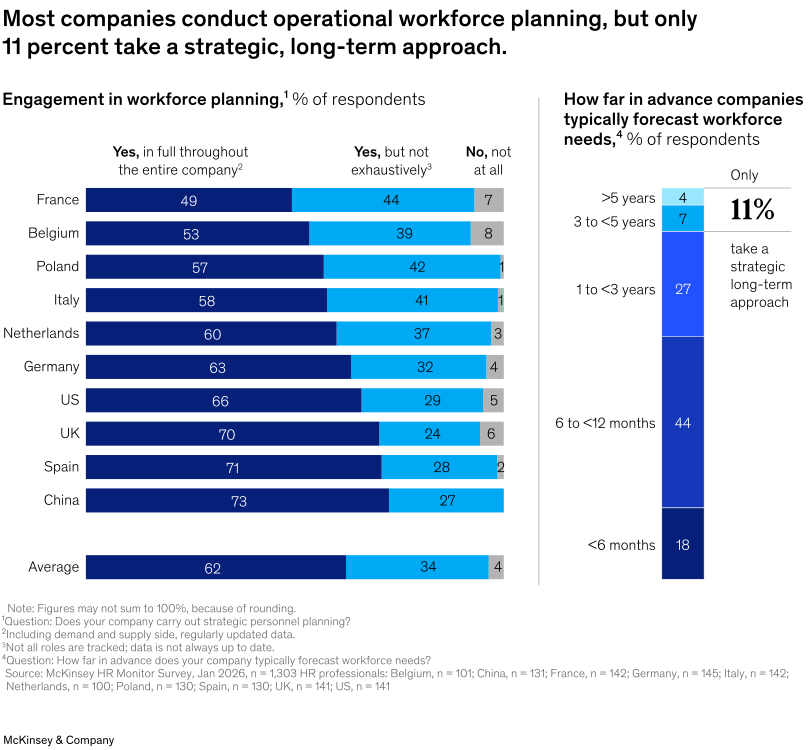
- Workforce planning must move beyond operational capacity planning to strategic capability planning. Automation and AI are rapidly reshaping how work gets done and which skills are required. Yet, workforce planning remains predominantly focused on short-term headcount planning, with only 11 percent of organizations adopting a long-term perspective (Exhibit 1). At the same time, skills gaps persist and demand is shifting toward more people-centered and AI-related capabilities as the need for routine task-based skills declines. Organizations must evolve toward forward-looking, task- and capability-based planning or risk underestimating the scale of the workforce transformation ahead.
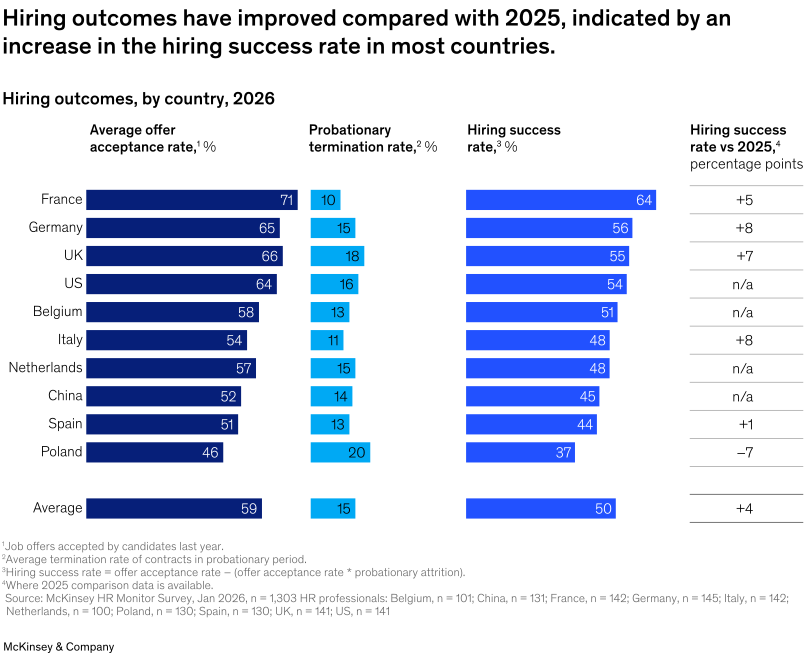
- In employer-driven labor markets, recruiting is becoming less critical but hiring effectiveness remains essential. Global labor markets have largely steadied, with offer acceptance rates up three percentage points and overall hiring success up four percentage points (Exhibit 2). (Note: Year-over-year differences in survey results should be interpreted as directional only, as country coverage changed slightly compared to 2025, with the addition of China, the Netherlands, and Belgium.) While the market continues to favor employers, they still need to make hiring practices more efficient. Companies may need to process higher application volumes per vacancy, requiring greater screening and coordination effort. At the same time, long hiring cycles persist, raising the risk of losing top candidates. AI has substantial potential to increase hiring speed and improve candidate experience, but it must be integrated into disciplined, well-designed processes instead of being layered onto existing complex approaches.
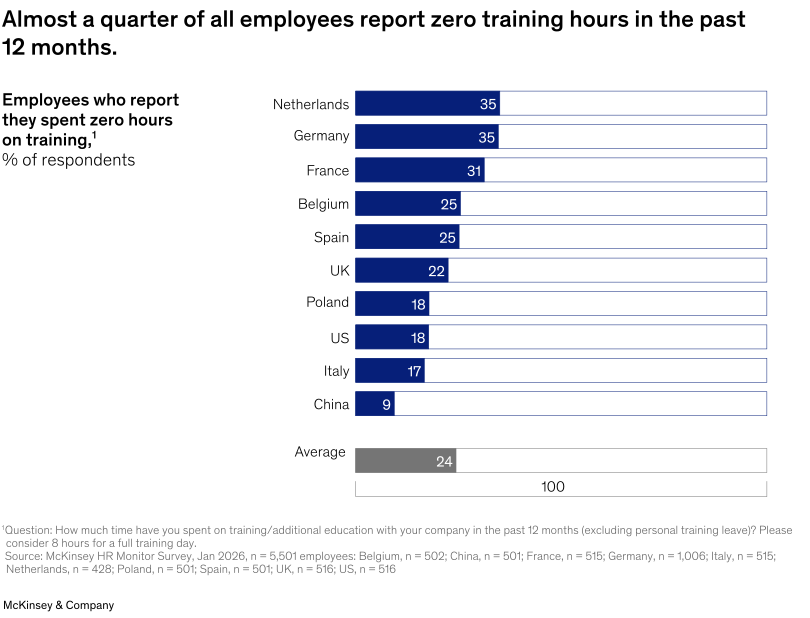
- Performance management and employee development are back on leaders’ agendas but remain fragmented in execution. Many organizations are placing renewed emphasis on measurable performance and systematic capability building. However, this ambition is not yet reflected in practice. Learning participation remains limited, with 24 percent of employees reporting no training participation at all (Exhibit 3). Feedback cycles are infrequent, with more than half of employees receiving feedback once per year or not at all. HR professionals tend to overestimate both participation in training and the importance that employees assign to development opportunities. Companies need to treat performance management as a core driver of employee development and improve measurement of skill building to better prepare their workforce for the future.
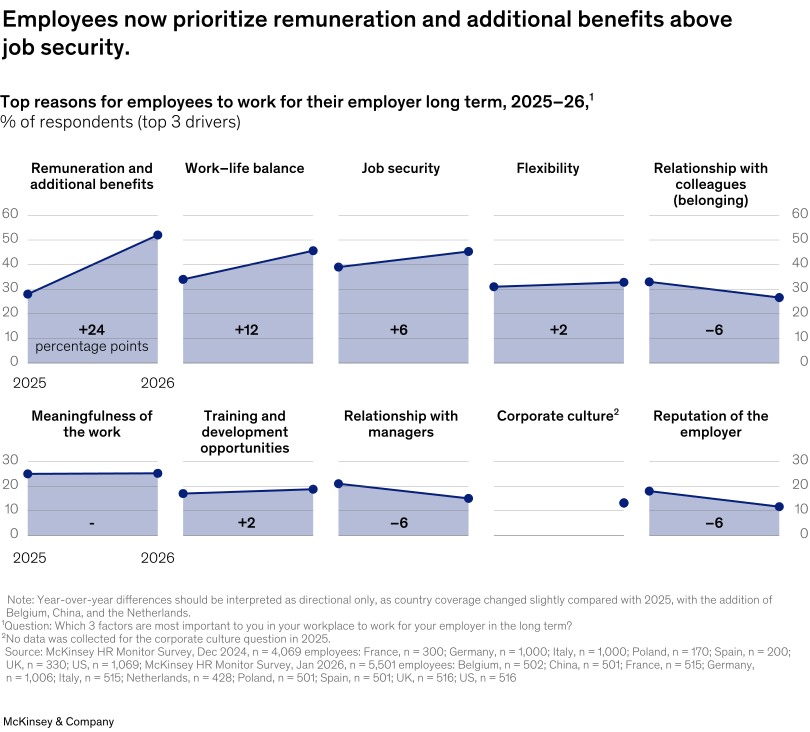
- Amid economic instability, labor market mobility is declining and compensation is a top concern for employees. In an environment of macroeconomic uncertainty, employee mobility is declining. Voluntary attrition is down two percentage points year over year, even as employee satisfaction levels remain broadly stable. At the same time, employees’ decisions to stay at their jobs are increasingly driven by tangible factors: compensation (52 percent), work–life balance (46 percent), and job security (45 percent) (Exhibit 4). While compensation has become a central concern for employees amid pressure on real incomes, companies are only partially addressing the issue. Employer-driven labor markets reduce external opportunities and, in turn, the pressure on organizations to adjust. Against this backdrop, improving employee experience is less about rolling out additional programs and more about reinforcing fairness, transparency, and sustainable workload models.
- Agentic HR operating models are emerging, but large-scale AI adoption remains limited. The traditional Ulrich model is gradually giving way to more agile and technology-enabled configurations, but most organizations remain in a hybrid transition. Although automation models suggest substantial AI potential across HR, adoption is progressing slowly (with zero- to six-percentage-point increases in operational use, depending on the domain). Many organizations remain in pilot mode, with deployments largely concentrated in administrative areas. The fragmented technology landscape and limited capability building continue to constrain companies’ ability to scale their AI adoption. Unlocking AI’s full value will require HR to redesign its operating model around flow-to-work principles, establish a unified data backbone, and move decisively from experimentation to enterprise-wide transformation.
The HR function stands at a defining moment. The shift toward AI-enabled, agentic organizations represents the greatest opportunity the function has had in decades, but also one of its most demanding challenges. The scope of change is substantial, requiring HR to rethink how work is structured, how capabilities are built, and how value is delivered across the enterprise. From here, two paths emerge. In one scenario, the growing complexity and technological developments outpace the function’s ability to respond, leading to an increasing share of HR responsibilities being absorbed by IT or other digital functions. In the other, HR rises to the challenge, stepping into a leadership role in shaping the future of work, potentially in close integration or even merging with technology functions, but with a clear mandate for the people function to define how human and agentic workforces operate together. Which path organizations take will depend on their ability to build a fact-based view of their maturity and performance and translate it into clear priorities for transformation.
Download the full report on which this article is based, HR Monitor 2026.