This time it's tariffs. For the past six years, our annual survey of global supply chain leaders has tracked the evolution of risk management and resilience measures through multiple waves of disruption. From COVID-19 to conflict in Europe and the Middle East, the setup and operation of the world's supply chains have been shaped by external influences throughout the 2020s.
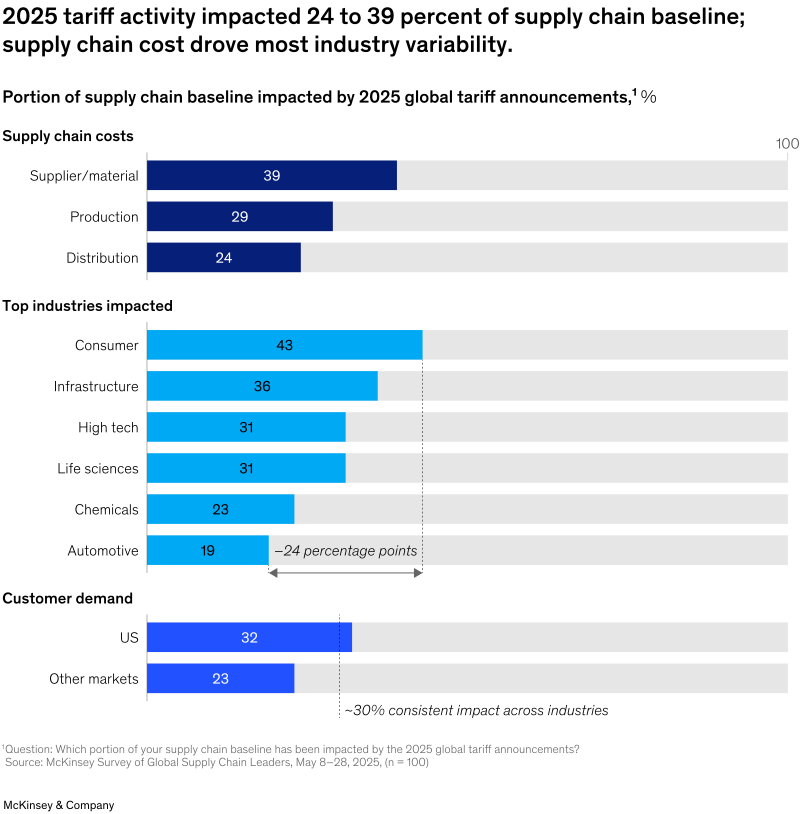
For 2025, one issue is top-of-mind among the 100 companies in our survey: the potential impact of tariffs on many of the world's most significant trade flows. Of respondents, 82 percent said their supply chains are affected by new tariffs, with 20 to 40 percent of their supply chain activity impacted in some way.
That impact played out across supply chain activities, with 39 percent of respondents seeing increases in supplier and material costs, and 30 percent reporting reductions in customer demand. Supply chains with a US connection were most likely to feel the effects, with 70 percent of respondents saying tariff impact on US customer demand was greater than or equal to impact on demand elsewhere. Among industries, consumer goods companies reported the highest impact, with tariffs affecting 43 percent of supply chain activities. Chemicals players saw the smallest impact, with only 23 percent of activities affected (Exhibit 1).
Tariff response
One option for companies navigating tariffs is to maintain the same supply chain setup and pass the extra costs on to their customers as price increases or surcharges. Our survey indicates that few companies have made that choice. Less than one-fifth of respondents told us they plan to pass through more than 80 percent of the cost of tariffs. The chemicals and automotive sectors show the highest rate of tariff pass-throughs, with more than 60 percent of new costs passed on. Across all industries in our survey, however, the weighted average pass-through rate was only 45 percent. That suggests most companies plan to absorb or mitigate the effects of tariffs in other ways (Exhibit 2).

Fast action, familiar tools
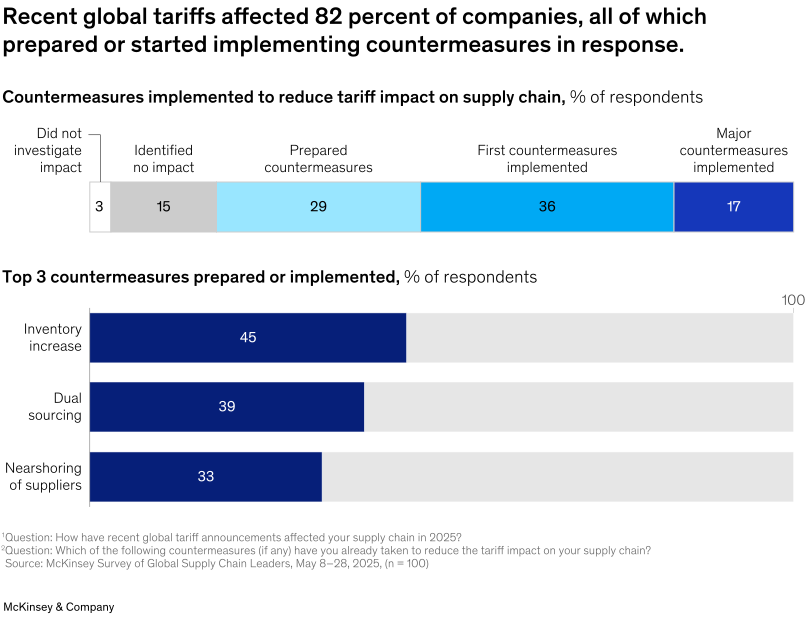
Previous waves of disruption have taught supply chain leaders that resilience depends upon robust planning and swift action. Every company that had identified tariff-related impact on their supply chains had either prepared or already implemented countermeasures.
Around 30 percent of respondents told us they were looking at tariff-specific responses, such as negotiating with suppliers to pass a share of tariff-related costs back up the supply chain, or applying to governments for tariff exemptions covering their industries or specific products.
Most countermeasures follow the same playbook that companies have applied when faced with other large-scale disruptions, however. Of respondents, 45 percent who are facing tariff impacts told us they are increasing inventories as mitigation; 39 percent are pursuing dual sourcing strategies for components or raw materials, and 33 percent are developing supplier nearshoring or onshoring plans (Exhibit 3).
Those are the same levers that we have seen companies adopt in response to supply chain challenges since we started collecting data in 2020. The initial impact of tariffs appears to be an acceleration of pre-existing supply chain resilience strategies rather than a redirection of them. Fewer than 7 percent of respondents told us they were introducing other countermeasures purely as a response to tariffs, except for nearshoring, where 12 percent said their plans were entirely driven by tariff mitigation.
Inventory policies in flux
When supply chains look vulnerable, companies tend to build up their inventories. These larger risk buffers have been a key supply chain risk management tool since the pandemic, which saw companies reverse a long trend toward leaner, just-in-time supply chains.
Our latest survey exposes tension in companies' inventory strategies. Organizations have been slowly reducing the size of their risk buffers over the past three years, with cash flow pressures cited by many as a principal driver. Tariff mitigation plans pushed the needle in the other direction this year, as companies moved more inventory into affected regions ahead of the introduction of new cross-border charges.
Yet cash flow pressures remain acute for many organizations, and few supply chain leaders see increased inventories as a long-term solution. Respondents say they are deploying a range of strategies to reduce or optimize inventory in the coming years, with many looking to adopt a more dynamic approach than they have in the past, continually adjusting inventory targets in response to demand forecasts and supply chain performance.
Footprint plans evolve
One potential outcome of tariff policies is for companies to produce and source more in the regions where they sell. That seems to be happening: 43 percent of respondents tell us they are planning to shift more of their supply chain footprint to the United States over the next three years for example, a 25 percentage-point increase from last year's survey. Respondents are also more likely to be expanding their supply chain footprint in Eastern Europe, Mexico, and Southeast Asia. On the flipside, 38 percent of respondents told us they plan to reduce their supply chain presence in China (Exhibit 4).

A deeper view of supplier risks
The surge in tariffs may also have driven a significant uptick in companies’ efforts to understand the makeup of their deeper-tier supply chains, with organizations needing to demonstrate the source of components and materials for compliance reasons. We found a 22 percentage-point increase in the share of organizations that have visibility into their tier-two suppliers, reversing several years of declining visibility.
Understanding the shape and status of upstream supplier networks is a mainstay of supply chain risk management. Yet creating deep, multi-tier visibility into complex global supply chains has proved difficult: 95 percent of respondents now have visibility into at least tier-one supplier risks, but that visibility extends into the tier two or beyond for only 42 percent of them.
While our surveys have found steady year-on-year increases, the share of organizations that claim a good understanding of risks associated with their tier-one suppliers, the share claiming similar visibility into deeper supply chain tiers has declined in recent years. While 58 percent of respondents in our survey have mapped their tier-two suppliers, fewer than half of them say they have regular direct contact with those companies. Leaders cite a range of reasons for that lack of engagement, including resource limitations in their own supply chain functions and a reluctance by tier-one suppliers to facilitate such connections. Some respondents told us that they lacked the technology necessary to monitor and track deep supply chain risks at the necessary scale, while others told us that supply chain risk and multi-tier viabilities were not seen as a priority by their organization's senior leadership (Exhibit 5).

A digital slowdown
If companies accelerated their efforts to improve supply chain transparency this year, the opposite is true of digitization projects. After rising steadily since 2022, the share of companies planning major investments in digital supply chain systems has plummeted, falling from 47 percent to 25 percent in the last year.
Respondents cite a range of reasons for this slowdown, including cost pressures and management resource limitations. A significant number of respondents told us that their organizations are prioritizing other large software projects, often new enterprise resource planning (ERP) system implementations.
While new digital investment has slowed, companies do report significant progress in the implementation of existing projects. In recent years, many leading players have invested in advanced planning and scheduling (APS) systems, for example. Last year, 40 percent of respondents reported that their APS systems were still in the deployment phase. This year, the share of projects in deployment has halved, and the share considered complete has doubled. A small number of respondents (2 percent) told us their APS implementations had failed and would need to be restarted.
Companies report much less progress in the adoption of AI technologies, however. Three quarters of respondents are planning, blueprinting, or piloting AI use cases, but only 19 percent say that they are deploying AI tools at scale. That’s broadly the same situation we found in last year’s survey.
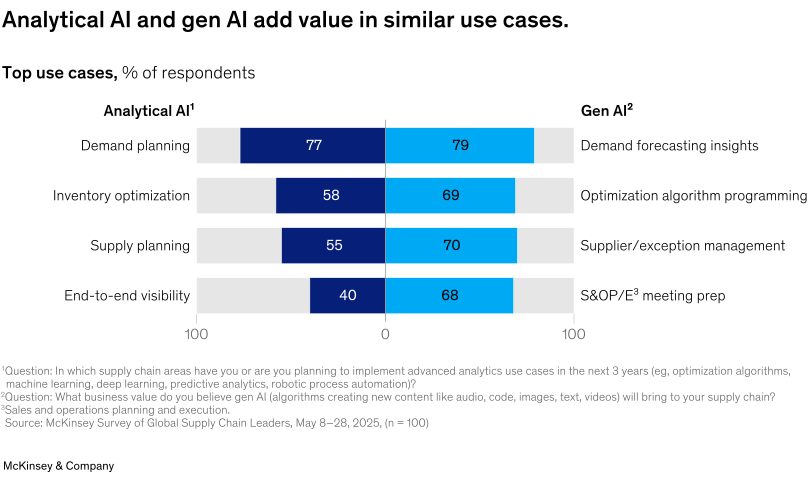
The rapidly changing technology landscape may also be holding back companies’ AI plans. Generative AI (gen AI) and agentic AI systems are now emerging as options to extend, complement, or replace existing analytical AI tools. These new systems have yet to achieve wide deployment in supply chain applications, but supply chain leaders see significant potential in their adoption. The top gen AI use cases identified by respondents in this year’s survey are demand forecasting, inventory optimization, and supply planning (Exhibit 6). That list is very similar to the top use cases for analytical AI, which suggests the best approach for different supply chain AI applications may be shifting as technologies evolve.
Tariffs have dominated supply chain leaders’ attention in 2025, leading them to focus on tactical responses—inventory shifts, supplier negotiations, and nearshoring—rather than long-term transformation. That agility has helped companies navigate an unusually volatile and uncertain year, but there has been a slowdown in advanced digitization. As global supply chains face mounting complexity, companies will require deeper visibility, faster analytics, and smarter automation to stay resilient. The leaders who resume their digital investment agendas soonest will be best equipped for the next wave of disruption.