


For decades, supply chain leaders have chased visibility, resilience, and efficiency through upgrading enterprise resource planning (ERP) systems, large-scale supply chain system transformations, or the use of advanced analytics. These investments have delivered progress in planning and insight generation. What has remained elusive is execution at speed and scale. This final mile—where decisions are translated into coordinated actions across procurement, manufacturing, logistics and fulfillment, and customer service—remains labor-intensive, fragmented, and slow. Robotic process automation (RPA) automated predefined, rules-based tasks, but lacked the flexibility and reasoning needed to orchestrate complex, dynamic supply chain decisions end to end.
Recent advances in artificial intelligence offer a credible path to closing this execution gap. AI systems can now interpret complex data, reason across trade-offs, and, increasingly, act on decisions rather than merely informing them. With the emergence of agentic AI, organizations have access to a new execution layer—one that has the potential to sense disruptions, decide on responses, and carry out actions autonomously across the supply chain. While adoption is at an early stage, and most deployments have yet to scale enterprise-wide, the technological building blocks are largely in place. Companies that move now can establish a meaningful lead in upgrading supply chain performance.
The next step in supply chain technology
The application of AI in supply chains has progressed through three phases, each expanding the scope of analytical sophistication.
Traditional AI, including machine learning models used in demand forecasting or inventory optimization, excels at pattern recognition and prediction. These systems analyze historical data to anticipate future outcomes, but they rely on humans to interpret results and initiate action.
Gen AI introduced a more interactive layer. Embedded as copilots within planning and execution tools, these systems help users explore scenarios, synthesize insights, and draft recommendations. They improve decision quality and speed, but they still depend on human direction to carry out multistep workflows.
Agentic AI represents a significant shift. Rather than stopping at prediction or recommendation, agentic systems are designed to act. They consist of networks of specialized agents such as knowledge agents that ingest and structure data, planning agents that evaluate options against objectives, and task agents that execute actions in operational systems (exhibit). Orchestration agents coordinate these components, ensuring that local decisions align with enterprise-level goals. Crucially, these agents are goal-seeking: They define objectives, plan actions, monitor outcomes, and adapt dynamically as conditions change.
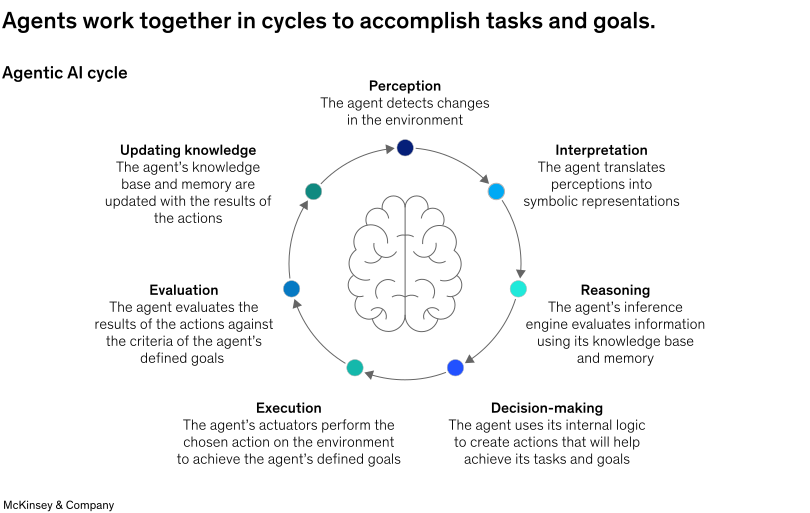
For organizations that have already implemented advanced analytics, traditional AI, and gen AI capabilities, agentic AI could serve as a powerful multiplier, driving incremental gains in efficiency, agility, and service. But it isn’t just today’s technology leaders that stand to benefit. For companies with fragmented systems or legacy infrastructure, agentic AI may offer a leapfrogging opportunity, allowing them to bypass traditional modernization and achieve rapid, transformative improvements.
From point solutions to orchestrated gains
Once fully implemented and adopted, agentic AI has the potential to fundamentally reshape supply chains, transforming them from reactive planning functions into dynamic ecosystems that continuously optimize for service, cost, and resilience. The opportunity is substantial. Early pilots have demonstrated tangible results, including 4 to 7 percent reductions in cost of goods sold, productivity gains of 20 to 50 percent, and decision cycles compressed from weeks to hours. These outcomes underscore the technology’s potential to deliver both incremental and breakthrough value. While agentic AI may not be able to transform everything, its ability to unlock significant performance improvements—whether by enhancing existing systems or leapfrogging outdated ones—positions it as a critical enabler for supply chain leaders navigating today’s complex and fast-changing landscape.
The full potential of agentic AI emerges only when it moves beyond isolated use cases. Traditional AI applications, such as demand forecasting or supplier risk scoring, have delivered measurable benefits, but they often remain siloed, solving specific problems without addressing the broader system. Agentic AI, by contrast, thrives in environments where it can orchestrate and optimize across multiple functions—for example, planning, procurement, logistics, store operations, and workforce management—unlocking synergies that single-use-case solutions cannot achieve.
The real value of agentic AI lies in its ability to act on predictions, closing the loop between insight and execution. For example, an agent that forecasts demand can automatically adjust procurement schedules, optimize inventory placement, and trigger logistics workflows, all in real time. Agentic AI can also translate complex AI and machine learning outputs into clear explanations of what is driving a recommendation, helping users build trust and act with greater confidence. This interconnected approach not only drives efficiency but also frees supply chain professionals to focus on higher-value tasks such as managing trade-offs, building supplier relationships, and driving strategic initiatives. The organizations that will lead in this space are those that reimagine their operating models to integrate agentic AI as the execution layer of the enterprise.
Take order management, for example, traditionally a labor-intensive process requiring multiple steps such as order entry, validation, inventory checks, and fulfillment coordination. These tasks are not only time-consuming but also prone to errors, leading to inefficiencies, delays, and suboptimal customer experiences. Systems already running today show how agentic AI can be used to transform this process by automating and optimizing the entire workflow. For example, an agentic AI system can reduce the time required for these tasks from 20 to 120 minutes to just one or two, enabling near-instantaneous order processing while significantly improving operational efficiency.
Agentic automation doesn’t just accelerate the process; it also ensures that decisions are data-driven and aligned with business priorities. AI agents can evaluate trade-offs between customer delivery requests and their cost implications, for example, presenting optimized options for decision-making or even executing decisions autonomously within predefined thresholds. By transforming order management into a seamless, intelligent process, agentic AI enhances both operational performance and customer satisfaction, setting a new standard for supply chain excellence.
Why gen AI efforts fall short—and where to focus for value
Despite the rapid adoption of gen AI, many organizations struggle to realize its full potential. McKinsey 2026 research found that 42 percent of organizations say AI has reduced their supply chain costs, but only 3 percent are seeing savings of more than 20 percent.1 This highlights a critical gap between implementation and value realization. Our research points to three root causes: fragmented workflows where AI tools are bolted onto legacy processes, narrow use-case thinking that fails to address systemic challenges, and weak learning loops that prevent continuous improvement.
Overcoming these issues will be especially imperative for agentic AI and its transformative power. Agents will behave differently, and require different levels of attention, training, and supervision at different times before they evolve into the agents that smoothly interact with companies’ existing systems, forming a digital nervous system for the enterprise. The complexity of this implementation in terms of timing, risk, skills, and performance represents the biggest challenge in supply chain management and leadership today.2
The solution lies in a holistic approach that addresses both the what and the how. The what is business-led reimagination, which includes:
- Defining a clear aspiration anchored in business outcomes and committing to a business case
- Prioritizing transformation by business domain, not isolated use cases, to ensure systemic impact
- Empowering business leaders to reimagine their domains and guide their teams on a learning journey to embrace agentic AI
The how focuses on execution and includes:
- Processes: Reimagine end-to-end workflows from an agent-back perspective; redefine accountabilities; and align incentives—for example, around system performance instead of individual task completion.
- Data: Prioritize high-value data sources, build reusable data products, and establish governance and security frameworks. Use AI to flag missing fields, inconsistent naming, duplicates, and anomalous values, then suggest or automate fixes before data reaches planning models.
- Technology: Develop a cloud-based platform with a modular, swappable ecosystem of technology partners, and combine gen AI, traditional AI, RPA, and integration layers into a single orchestration fabric.
- Operating model: Bring business and technology together in cross-functional, outcome-owned teams, and define how humans and agents collaborate, including decision rights, funding, and performance metrics, so that AI-enabled workflows can scale.
- Organization: Adopt hybrid operating models that integrate humans and agents, reimagine talent strategies, and establish a real-time, embedded governance. This should include critic and guardrail agents that monitor compliance, while humans retain accountability and oversee exceptions rather than reviewing every step.3
- Responsible adoption and scaling: AI systems can make mistakes, so organizations need to establish AI guardrails, ensure explainability, and drive change management to build trust and adoption. For example, clear rules need to be defined for instances where agents act autonomously and where human-in-the-loop checkpoints need to be created.
From controllers to conductors
Agentic AI will not eliminate the need for human judgment, but it will redefine where that judgment is applied. Planners, buyers, and schedulers will experience a shift from managing transactions to orchestrating ecosystems. Inevitably, and necessarily, new skills will emerge in the form of prompt engineering for orchestration, decision-threshold tuning, cross-domain reasoning, and vastly more than these examples. Successful leaders will embrace and foster this evolution through reskilling and overseeing human-in-the-loop governance assurance.
Early adopters are already realizing measurable value. A consumer packaged goods company has cut planning cycle time by 70 percent by embedding agentic coordination across demand, supply, and logistics. A retailer has reduced inventory by 12 percent while improving service levels by five percentage points through multiagent markdown optimization. Those who redesign their organizations around agentic ecosystems unlock compounding advantage across speed, resilience, and margin.
Agentic AI represents the execution layer every prior technology promised, but never delivered. The challenge is not whether to adopt agentic AI in supply chain operations—that must happen to some extent—but how deeply to rewire the enterprise around these technologies and capabilities.
1 “The state of AI in 2026: On the road to ROI,” McKinsey (survey findings), August 25, 2026.
2 For more on implementation, see McKinsey’s playbook, Rewired: How leading companies win with technology and AI.
3 “The agentic organization: Contours of the next paradigm for the AI era,” McKinsey, September 26, 2025.