Companies have invested heavily in AI and digital logistics capabilities in recent years, as they grapple with network disruptions, capacity volatility, labor constraints, and regulatory and geopolitical uncertainty—alongside the constant pressure to improve productivity. Transportation is becoming more digitized and warehouses are increasingly automated, with AI-enabled tools, digital twins, and visibility platforms moving from edge technology into the core of how logistics functions operate today.
With AI and digital capabilities becoming a standard feature of logistics, rather than a source of differentiation, attention needs to turn now to translating these capabilities into measurable operational and financial impact.
Robust adoption and increasing confidence
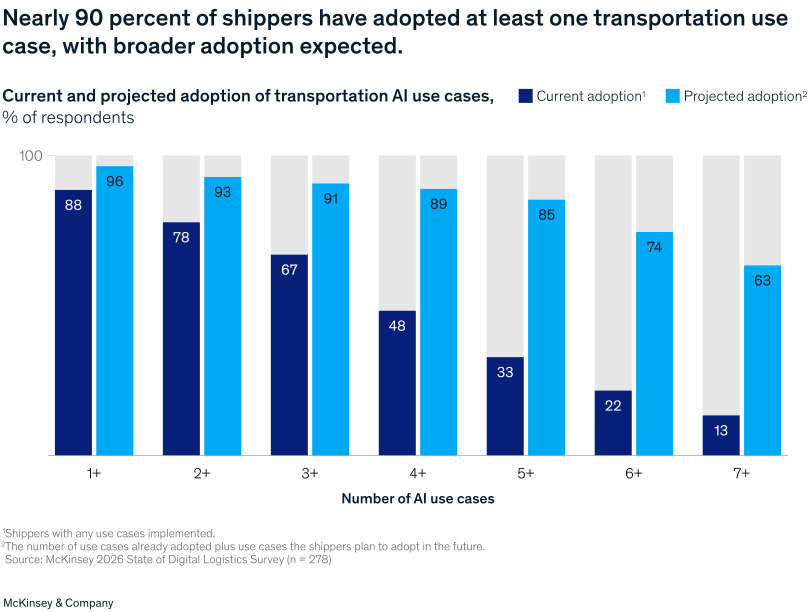
Since our previous digital logistics survey in 2024, the adoption of AI and digital use cases has surged across sectors. Nearly 90 percent of shippers have now adopted at least one transportation AI use case, and a third already have five or more transportation-related AI use cases in operation (Exhibit 1).1
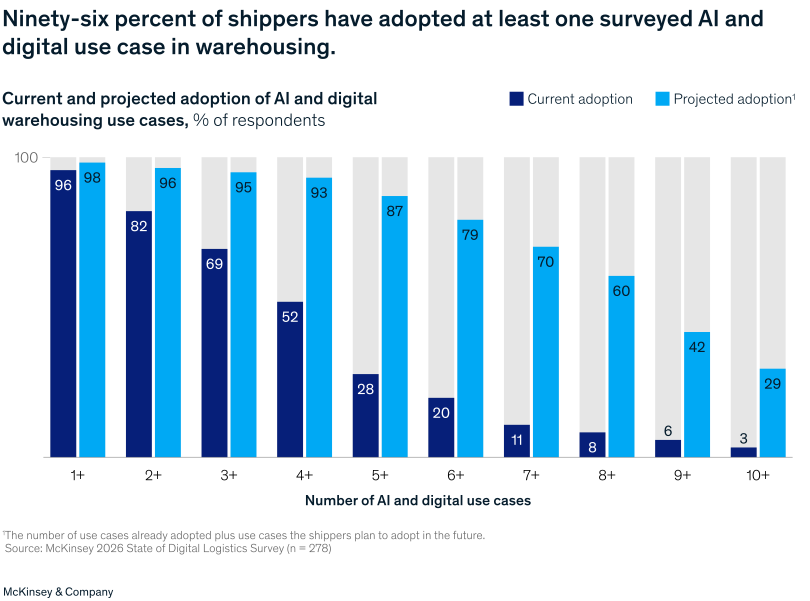
AI and digital adoption is equally robust in warehousing, with 96 percent of surveyed shippers having deployed at least one surveyed AI and digital use case. Shippers’ intent to continue deploying AI and digital tools over the coming years is also robust, with 93 percent planning to adopt four or more of the surveyed use cases (Exhibit 2).
Shippers are seeing value from their investments, too. Around 84 percent say AI and digital warehouse tools have met or exceeded their expectations, and 88 percent say the same for transportation use cases. As a result, shippers are becoming more digitally fluent and confident in their abilities to adopt AI. Around 74 percent of shippers now rate themselves four-plus out of five in their AI readiness across people, processes, systems, and governance (Exhibit 3).
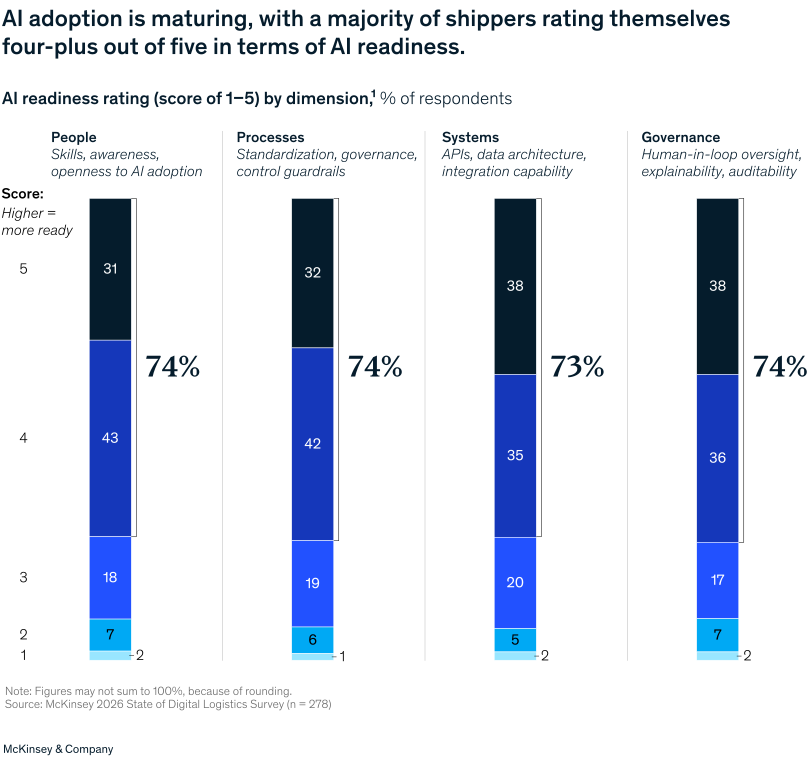
In short, our survey reveals relatively little differentiation between respondents: Adoption is becoming more commonplace, readiness is high, and planned investment intention is strong.
Converting AI and digital capabilities into operating decisions
As AI and digital tools proliferate across logistics functions, the differences in ROI will increasingly depend not only on the technologies used, but also on how effectively shippers embed AI and digital capabilities into workflows and convert insights into timely operating decisions.
The companies that are succeeding in capturing value have three behaviors in common: They use AI and digital capabilities to make trade-offs more visible; they move analysis closer to operational decisions; and they connect those decisions directly to execution through agentic capabilities.
Making trade-offs visible
One of the ways AI and digital capabilities improve decision-making is by making outcomes easier to see and evaluate. By pooling disparate data sources and layering in powerful analysis and simulation tools, the implications of decisions on cost, service, utilization, and risk become more visible within the same decision-making environment.
At a large global food company, a single view of transportation performance and costs—supported by drill-down dashboards that make it easier to identify the causes of service and cost issues—has helped leadership turn visibility into impact. The company had set out to reduce transportation costs in one of the most challenging freight markets in recent years, building a logistics control tower that combined data from four transportation systems and refreshed information hourly across roughly 20,000 shipments per week.
The company used that visibility to redesign fleet deployment, onboard more than 250 assets, expand capacity by 50 percent, and run targeted carrier sourcing events across 1,000 lanes and 3,000 weekly loads. By continuously deciding where to deploy dedicated fleet assets versus third-party carriers, the food manufacturer generated more than $50 million in impact while securing additional capacity in critical markets.
Likewise, another major global shipper has successfully turned better visibility into real-world savings. The company needed to create capacity for growth and adapt to a changing distribution network, while reducing operating expenses. Rather than committing to automation investments based on static business cases, the company created a digital twin of a distribution center and used it to test alternative footprint configuration scenarios.
Teams evaluated rack layouts, fulfillment processes, automated guided vehicle (AGV) and conveyor deployments, labor requirements, and interactions between automated equipment and frontline workers. They also modeled interleaving approaches and yard-labor planning scenarios before making changes in the field. The digital twin identified a more than 10 percent reduction in operating expenses and can now be applied across additional distribution centers in the network, creating a repeatable way to evaluate operational changes before investing capital.
Moving analytics closer to operational decisions
Another way companies are creating impact with AI and digital capabilities is by moving analysis into the operating environment, instead of treating analytics as a separate activity. Simulation, optimization, and AI-powered analysis are applied where decisions are made: in transportation and warehouse operations, in inventory decisions, and in exceptions management.
Organizations are using agentic AI track-and-trace agents, for example, to identify issues and perform interventions before shipment loads fail—monitoring shipments continuously and intervening when they detect route deviations, temperature excursions, late deliveries, or potential theft events.
With the distance between detection and action significantly reduced, the agents can accelerate issue resolution and decrease the number of loads that stall in transit, while significantly reducing the manual effort needed for follow-ups and exceptions handling.
Connecting decisions directly to execution
As the use of track-and-trace agent demonstrates, AI and digital capabilities become more powerful when they bring analysis closer to day-to-day operational decision-making. That impact is even greater when the time between decisions and execution is reduced. Companies that are linking information and analysis more quickly with actions that influence operational outcomes are creating value in diverse areas—from carrier selection and fleet allocation to warehouse configuration, exception intervention, inventory positioning, and fulfilment routing.
AI and digital capabilities are making the trade-offs embedded in everyday fulfilment decisions more visible, and the ability to respond to those insights more real-time. Consider, for example, a global retailer that built a digital representation of its supply chain to connect inventory positioning, supply planning, fulfillment decisions, and order-level profitability. Teams used the new capability to run more than 50 fulfillment simulations each day, evaluating alternative inventory-routing and replenishment strategies before implementing them. At the same time, an end-to-end profit-and-loss (P&L) view exposed value leakage at the SKU and order levels, making transportation, warehousing, duty, and last-mile costs visible within a single decision framework.
The retailer reduced fulfillment and inventory-holding costs by more than 10 percent, cut air freight by 5 percent, and improved utilization of a network node by approximately 20 percent. The result was a more continuous approach to managing network trade-offs, with operational and financial consequences evaluated together and acted on quickly.
Shippers may differ in the exact technologies they are using and how they are applying them, but the operating challenge for all companies remains the same: how to convert newfound AI and digital capabilities into better decisions, and better decisions into measurable and repeatable operational outcomes.
The companies creating value are doing so by making trade-offs more visible, moving analysis closer to operational decisions, and making sure those decisions are tightly connected to execution. As AI adoption continues to grow, the differences in performance may increasingly reflect how organizations structure, support, and execute critical operating decisions.