
About an hour and a half southeast of Melbourne, Australia, there is a quiet stretch of coast. Late last year, Seelan Singham (Australia, London, Atlanta, Melbourne, Kuala Lumpur, 1993–2025) spent 40 days there, fishing. He had suspended his phone number and replaced it with a temporary one known to exactly three people: his wife and his two children. Nobody else could reach him. That was the point.
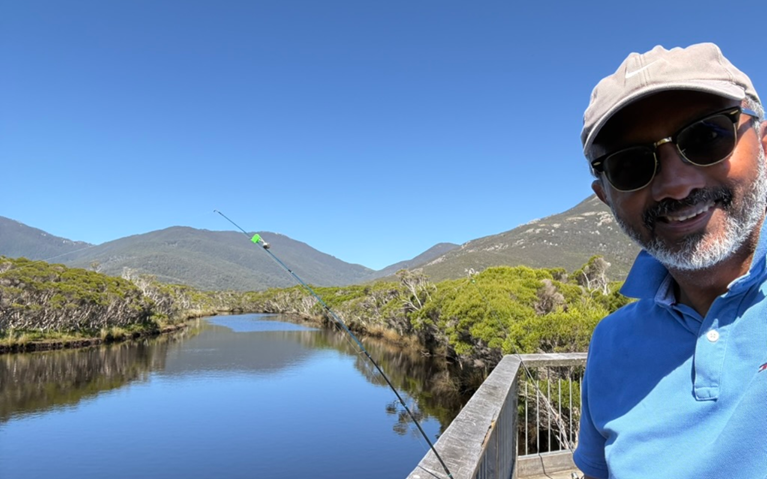
For a person who had spent 32 years at McKinsey being reachable by CEOs across the world, this took some adjusting. “I guess you can say fishing came after finishing and before finding,” he laughs. The fishing trip was one part of a six-month period off the grid. He spent six months away from Kuala Lumpur, Malaysia, where he has lived and served clients for 23 years, and had no contact with McKinsey colleagues and clients.
He went into the six-month, off-the-grid period with four objectives, he says:
• Say goodbye to his last chapter with deep gratitude
• Temporarily detach from some elements of his past life to create space
• Create unforgettable memories with his family and rediscover sources of personal joy
• Further discern his life purpose for the next chapter through a nine-day silent Jesuit retreat and 40 days of fishing
Over the past five years, Seelan has deeply researched the topic of transitions of successful leaders, reading more than 30 books on related subjects. He began applying what he learned to himself and to CEOs and other leaders. Some 70 leaders later, it has become his next profession.
Insploring: The power of looking inward
Seelan explains that the six-month break wasn’t the only catalyst for finding his next mission. Rather, he says, it sped up the process of looking inward for a purpose that he had begun two decades earlier and had worked on intensely over the previous five years. “Time off reveals what you’d already been becoming,” he says.
He adds that before leaders explore making decisions about what to do after finishing one career, they need to do what he calls ‘insploring’: “Insploring is looking within before you look externally, reacting to inbound opportunities and connecting with people to find jobs and opportunities.”
He continues, “Figure out your passions, your true north, and your constraints. Don’t talk your way into a decision you haven’t made inside. But you don’t just reflect your way to a next chapter either. As London Business School’s Herminia Ibarra advises, you experiment: try new things, then kill or ramp them up. With the right experiments, you learn not just about the specific new areas, but a great deal about yourself.”
While Seelan says he is not against outside advice, he is suspicious of what it optimizes for. “As counterintuitive as it sounds, seeking too much advice from too many mentors and clients too early in your transition can be unhealthy,” he says. “Many are likely to solve more for your strengths than for what gives you energy. Powerful people who have watched you succeed will typically offer you more of what you have already done well, or opportunities that help them. It is flattering, it is often lucrative, but it could lead you astray.”
Seven questions worth asking yourself while ‘insploring’
Below are the questions that Seelan has wrestled with, which he now puts in front of the leaders he advises. Seelan also asked a few leaders who have navigated or are navigating transitions for one piece of advice. Their responses are in blue.
1. How do you finish exceptionally well, at the right time, and on your own terms?This question comes from Seelan’s mentor Tsun-yan Hsieh, formerly Managing Director of McKinsey in Southeast Asia and Canada, who gave him that advice a few years ago. As Seelan says, “All three parts of that question are important and difficult to do. I spent the final stage of my McKinsey career trying to do it. Now I help CEOs do it.”
This is the question, Seelan says, that leaders avoid the longest. Most give it little thought until it is too late. Insploring, Seelan says, starts while you are still in the job, in doses small enough not to distract you from your current work.
He went looking for how people get it wrong: in poker players, in mountain climbers, and in Annie Duke’s research on quitting. For years, he told CEOs to “finish on a high” and “leave a legacy.” He now thinks that was sometimes dangerous advice for both the CEO and their organization. “Many of the climbers who died near the top of Everest had kept going past their turnaround time,” he says. “We have all seen leaders who stayed too long, at huge cost to the organization, their reputation, and their lives, chasing a legacy that didn’t last or a next high that was impossible to reach.”
Finishing exceptionally well, at the right time, on your own terms, sets up everything that comes after, he says. “You feel proud of what the organization achieved and your part in it, and that pride becomes inner confidence and outer reputation, a tailwind into the next chapter.” Botch the finish or stay too long – by far the more common outcome – and the move to your next chapter becomes even harder.
And it is a lonely battle against strong forces to stay. “Almost no one around you is 100 percent solving for what’s best for you. Boards, management teams, and even family members – each has a stake in your decision.”
“I left Ping An Group to rewrite a new chapter after ten years, while things were going great and we had built great teams. It felt early. Looking back, early was the right time.
“Many leaders spend years preparing for the job and almost no time preparing to stop. It is the harder of the two, and easy to put off. Those who do it find that what comes next is wider and richer, not smaller, in both expected and unexpected ways

Seelan’s six months began with closure. On a trip back to Toronto soon after he left McKinsey, he closed out the 40 years since arriving there as a refugee and gave thanks to his late parents and Canada for the gifts and opportunities he received. “It now feels like day one of the next 20-plus years, with a clean slate,” he explains.
Closure is half of it. “Subtracting some relationships, commitments, and things creates much-needed space for the new to grow, just as in gardening,” he says. As far as relationships go, his test is blunt: “Who will still call you when you’re no longer CEO and useful to them?”


Seelan says that one of his heroes, former football great Johan Cruyff, cleared out his old world. “’I never look backward,’” Seelan says Cruyff wrote in his book. “Cruyff said, ‘At home, I have nothing on my walls about football. No medals, awards, trophies.’” Seelan has done nearly the same; his study has no mementos from his old world. “Not because I’m not grateful,” he explains. “I’m deeply grateful. I’m just making room for what comes next.”
“For a founder, your company becomes your identity. The hardest and most freeing thing is learning who you are without it.
Big questions about the purpose of life are daunting, so Seelan advises starting smaller. What are you passionate about? What interests you? Or, easier still, what gives you energy? At this stage of life, Seelan argues, those questions matter even more than your strengths.
“I know what I’m good at, and I just don’t want to do it anymore,” he says, a line he credits to his mentor Adam Lewis, former McKinsey Managing Partner, Australia and New Zealand. “In the second half of life many of us want to do less of what we were great at in our careers. Not zero, but less, because some of it takes energy. We start to choose to do more of what we love, even if we are not great at it.” He is aware this contradicts the advice most of us were raised on. “Focus on your strengths is sound advice in the first half of your career. It is 100 percent counter to what you need in the second.”
He offers himself as a case study. At McKinsey he was told he was good at influencing leaders, orchestrating colleagues and large organizational transformation, and creating value for businesses in Southeast Asia. When he left, the offers arrived on cue: Board roles, opportunities built around Southeast Asian business. “I was privileged to receive them. But I just didn’t want to do that anymore.” Or in shorthand: “Just because you can, doesn’t mean you should.”
“Players are trained to do the one thing they are best at, again and again. After football, I had to ask a new question: what gives me energy? More and more, it is people. My time is precious, so I choose carefully: people who share my values, especially honesty and loyalty, who complement me and inspire me.
Most leaders ask which industry they are most passionate about. Seelan thinks the bigger question is who. The one or two people you work most closely with – the chair, the shareholder, the peer, the boss, the client – will make the biggest difference to your professional joy and impact. As Seelan puts it, “An A+ collaborator in an industry you hate will excite you more than a C person in an industry you love. Yet, most leaders in transition are far clearer about the industries they are passionate about than the qualities of people they would love to partner with. The people should have such special qualities that you will be so excited to run to work with them for years: ideally with complementary skills, always with aligned values.”
“I have worked across very different industries in various roles. What made the days good or hard was never what you were doing. It was almost always who you were doing the work with and for what purpose. The similarity of values, the trust, the common sense of mission – it makes the difficult easy.
“For my next adventure, I chose a leadership team and a CEO from whom I can learn an immense amount and deliver impact at a scale I aspire to achieve.”
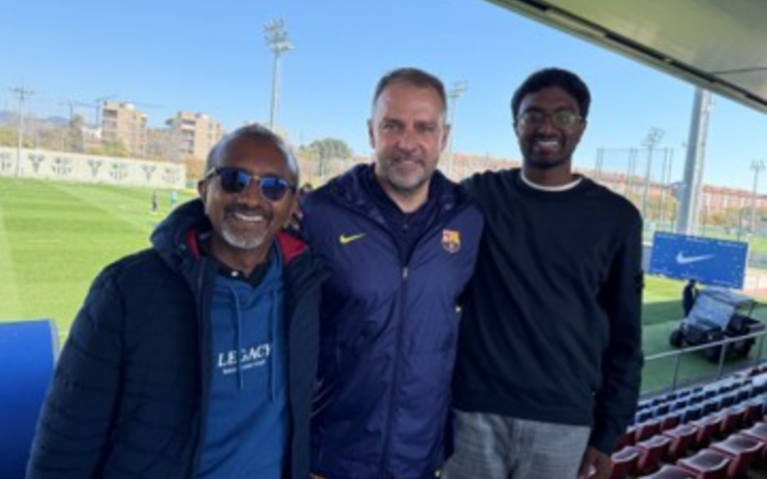

Seelan adapts Dr. Kerry Burnight’s idea of “joyspan” into his equation: joyspan = joy per hour × health hours. “Time is my scarcest resource, so everything I do, or don’t do, is to raise my joy per hour.” He used his six months off to rediscover what gives him joy. “The trips weren’t just holidays. They were experiments.” He has adapted Arthur Brooks’ ingredients of happiness for a joy formula for himself. For him, enjoyment means experiences around the ocean, football, and R&B music (especially Michael Jackson) with his family. Satisfaction and meaning come from helping leaders through major transitions. “Your true north may be different,” he says, adding, “but have one.”

“Good problem solving takes into account objectives and constraints,” Seelan says. So where can scarcity appear? Most successful CEOs, he says, have an abundance of knowledge, skills, connections, options, places to live, and usually wealth. What they do not have in abundance is energy, so their next chapter needs to accommodate the things and activities they are passionate about. The other scarcity is time. “How many summers should you reasonably assume you have left with your children, your parents, your partner, your vital few relationships, with everyone still in good health? How will your next chapter make the most of that?”
“In strategy, the costliest mistake is waiting for the hockey stick. In careers, it is staying for one more year that never quite arrives.

Few leaders ask this. Many partners have built a life around the leader’s absence, and a sudden full-time presence can strain a marriage. Often, the partner is going through their own transition at a similar time. So the likelihood of a strain is naturally very high as successful CEOs transition, and it takes purposeful work to make it work. Seelan and his wife, Prithiva, did the work and put their marriage at the center of the next chapter. “It feels like the start of a second marriage to my first amazing wife, with a next life centered around her: even more laughing, listening, talking and new experiences.”
Crossing the river by feeling the stones
Asked what he had to unlearn after 32 years of problem solving at McKinsey, he borrows a line often credited to Deng Xiaoping to answer: “crossing the river by feeling the stones.” McKinsey colleagues, he says, are typically hard-wired to plan, push, and make outcomes happen. In transition, that instinct fills one’s calendar with search firms, Board chairs, and fellow CEOs bearing opportunities. ‘Insploring,’ however, asks for something harder. “Feel the pull, not just inside you, from passion and purpose, but externally. Only when you respond to the pull do you see how the magic of serendipity is working for you.”

Serendipity, in his case, is pulling his passion for transitions in some unexpected directions. His practice advising CEOs and founders through major transition is widening to conversations with star players in European football and Australian cricket, whose transitions make a CEO’s look gentle. “They may have money, but they are done at 35, they excel at one thing that doesn’t transfer easily, and they lose structure, friendship, relevance and care from agents, clubs and sponsors. What do they do with the next 60 years? It comes earlier, it is more public, and everything they built their identity on stops almost overnight.”
Alongside the mid-life transition for CEOs and founders, he has become fascinated by what he calls the “quarterlife” transition, the stretch in our 20s and early 30s when, he says, six life-defining decisions take place (e.g., career, money, life partner).
So, he began a series of lessons to help his children navigate the six “change-my-life” decisions that would shape their next 60 years. It has since grown into a program, which he recently shared with a group of young professionals across the US, UK, and Australia. His mentor, former McKinsey Global Managing Partner Dominic Barton, says he thinks this is the only thing Seelan should focus on. “It is a massive need for the next generation – for all of our children – and no one is giving most of them the best advice. Not even top universities.” Seelan is passionate about it and is planning further experiments at Melbourne Business School at the University of Melbourne beginning in 2027.
All of this, he stresses, should be done early in the transition process, long before you leave: ideas and conversations, with zero expectation of outcome or timeline. Which brings him back to the water.
“I learned this fishing. You cast two or three lines in, you wait for the pull, and then you respond. You never know what you’re going to catch.”

