
Ask Rajan Singh (New York, 2006-06, 2007-09) to walk you through his career and you should settle in.
Before the age of 30, he had trained as an electrical engineer at IIT Kanpur, and served as commissioner of police in Trivandrum. Bored by the job, he left to study at Wharton, then spent 2 years at McKinsey before moving on to private equity. He has taught finance to bankers and physics to teenagers preparing for one of the hardest entrance exams in the world. He has launched two startups that failed and one, HabitStrong, that is very much alive.
Rajan launched HabitStrong during the pandemic as a two-week LinkedIn experiment to help people break their smartphone addiction. It has since grown into productivity programs for individuals and, more recently, multi-year transformations for large companies that are drowning in meetings, emails, and interruptions. Which is how a man who left the Firm certain he would never consult again finds himself running exactly the kind of engagement he might have led at McKinsey.
We caught up with Rajan, who is based in Trivandrum, to talk about fear, the trade-off between breadth and depth, what human judgment will still be worth in the age of AI, and why the next mountain isn't always worth climbing.
You've had more careers than many people have had jobs. Walk us through them.
I've tried whatever came to my mind and whatever seemed interesting. My goal was to become a scientist, so I did my undergrad in electrical engineering at IIT Kanpur.
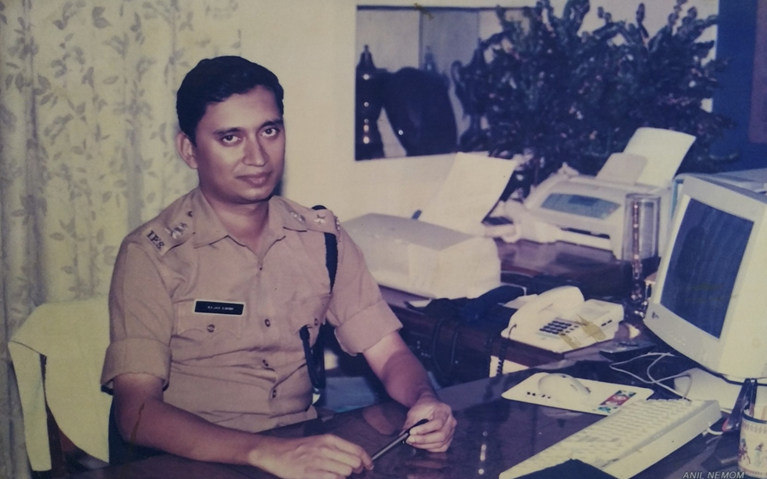
That left me a bit disillusioned, so I made a huge switch and went into policing through the Indian Civil Services. The Indian Police Service is the leadership cadre for all of the country's policing, paramilitary, and security organizations, other than the military. At 27 or 28, I became commissioner of police in Trivandrum, where I live now. I enjoyed the first few years, but it became very routine.
My time at McKinsey was about people and about figuring things out. I eventually decided I wanted to get into investing, so I joined a New York-based private equity fund and moved back to India with them.
A Wharton classmate pulled me into teaching finance to newly minted investment bankers. After a batch or two, I knew that wasn't for me, either, so I started an online education company called CourseBrew, right around the time Coursera launched. I tried, and I failed miserably. It was my first major failure in life. Until then, whatever I had wanted, I'd been able to accomplish.
So I went back to my first love and taught physics to students preparing for the IIT entrance exam, which is probably the toughest science exam in the world. After that came another startup, which also failed. And then HabitStrong, which I’m still involved with.
Now I've come full circle once more. I left McKinsey thinking I would never do consulting again. But I was giving a talk at one of the Big Four firms in India, and the CEO came up to me afterward and said, "Can you help us bring down the number of meetings and emails? There's too much noise getting in the way of the work." I said we could solve it, but only if we went to the root cause. He agreed, and I've now been running a productivity transformation there for a year and a half. It's the kind of work I would have done at McKinsey. So these are the things I've tried. I'll no doubt try a few more.
Should more people try as many things as you have?
I'd hesitate to be prescriptive. There is a trade-off. Because I've done so many different things, I can connect the dots across many realms of human experience, and there's real value in that. But on the flip side, had I stayed in private equity for 20 or 30 years, I could have become a very fine investor and seen a depth and nuance I never got to see in the short time I spent there. It's breadth versus depth.
It's how much your knowledge is able to compound versus starting fresh every time. People have to decide that for themselves.
Two things I can say with certainty, though. First, for a lot of people, fear is getting in the way of living life fully. I'm not saying to keep jumping around. I'm saying fear should not be the biggest factor in deciding whether to do something.
Second, given how much has changed in the last three or four years with AI, well-defined problems with precise answers are increasingly going to be solved by technology, or at least technology will play a major role. Where human judgment will remain essential is in broad, messy, multidimensional problems, where there's a human element, a process element, and a technical element all at once. And for those, breadth is an advantage.
So my advice is to be fearless, and be aware that, with a leap of faith, you can reach a very high level of proficiency in something new without having done it for 30 years. It's an option people rule out too quickly.
Are you the same way in your personal life?
I'm quite distractible. I've been exploring meditation fairly deeply for the last few years, and when I read, I jump between leadership, psychology, storytelling, writing. I just get excited about different things.
But here's the thing. When I'm doing something as a professional, I need depth and a first-principles understanding. The productivity transformations I'm running draw on specific areas of psychology and ideas from lean manufacturing, and when I do that, I go deep. If I tell a client ‘this is something I understand,’ I'd better understand it well enough to hold my own with anyone in the world on accuracy, depth, and clarity. So yes, I jump around. But the things I choose to make my temporary home, I go fairly deep into.
Tell us about HabitStrong. What problem did you want to solve?
As an entrepreneur, I've always looked for interesting and meaningful problems. What stood out to me was how much smartphone addiction and distraction were ruining our attention and changing how we live, often not for the better. We rushed headlong into new technologies without asking how we should reorganize the way we work in light of them.
Honestly, I didn't know I wanted to start HabitStrong. I wanted to solve smartphone addiction. COVID had just begun, my previous startup had shut down, and I didn't know what to do. I put up a post on LinkedIn: ‘I'm doing this for two weeks, I'll take a small cohort and help you break some of these habits, sign up if you want.’ About 20 people did, and the feedback was amazing. One thing led to another, and I ended up solving for productivity the same way. I created the program first and formed the company only once we saw people were interested.
In 2025, we started working with companies, and now others have reached out. When I started my career, we could sit and work for 10 or 12 hours with very little interruption. Back then people called the BlackBerry the "CrackBerry." Today the BlackBerry looks benign compared to what we face. So I'm helping companies change the way they work.
Looking back, is there a moment where you felt particularly fulfilled?
More than any specific job, there were moments and experiences, and often I didn't recognize their value until later. When I left McKinsey, I was certain I'd be an investor for life, and I didn't think much about the skills I'd gained. Today, I realize that I could not do anything else I’ve done, had I not spent even that short time at the Firm.
The same is true of the police service. There were moments when the job felt deeply meaningful and moments when I thought, what am I doing here? A year later I was at Wharton, looking back and thinking, actually, it wasn't that bad at all.
The bigger point is that a lot of things in life are meaningful, and sometimes we just can't see it in the moment. I've had a not-so-good habit of living in the future. Whatever I was doing, my mind was on the next mountain to climb. Dissatisfaction can be useful; it's part of why I've done so many things. But there are flavors of it. One says, I'm doing this, and I could do more. The other says, I'm here, but I'd rather be somewhere else. For a very long time, wherever I was, I felt I deserved to be in a better place. That's the wrong kind of dissatisfaction.
If there is one thing I could share from my experience, it's this: life is not in the future. Nothing dramatically amazing is going to happen three, five, or ten years down the line. Life is right now, whether you're a student or at a company you think you've outgrown. Everything is equally valid, and there's incredible value in things we can't see in the moment. If I have a regret, it isn't that I didn't do this or that. It's that I missed out on fully experiencing some of those things because I was so busy wanting to be somewhere else.
Did that realization feed into HabitStrong, and into your meditation practice?
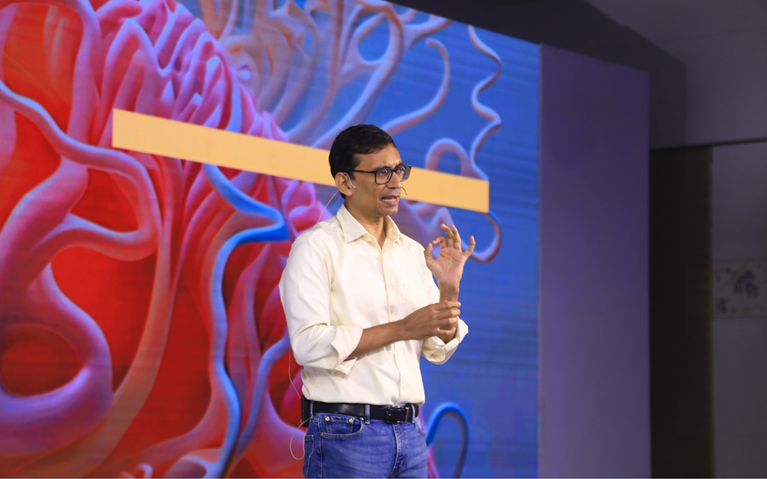
Yes, but it's less flattering than that. More than inspiration, it was a recognition that I wasn't as happy as I thought I should be. I was chasing something, and it wasn't leading to happiness, and the startup journey adds plenty of stress on top. When I got into meditation, I started to understand some of these things. That's become a core driver of what I do at HabitStrong, and it made me question my own patterns.
I can't say the habit is gone completely. But that mindset of wanting to be somewhere else has weakened very substantially. I no longer think the next company will be the real thing and this is just the preparation. Whatever I'm doing right now is the opportunity, and I try to enjoy it. I'd say I have slightly, just slightly, more wisdom than I had before. And still a very long way to go.
Thank you so much, Rajan. It's been lovely talking to you.
Thank you so much for the discussion.

