
Paris-based Stéphane Le Viet (New York 04-05) has founded, scaled, and sold technology companies. Today he runs École M, a network of 8 bilingual preschools in Paris, and Fondation 2000 Jours, a foundation focused on early childhood. In this conversation, he explains why he shifted from building for exit to building for a mission where results take twenty years to show, and what substitute teaching taught him that no McKinsey deck could.
You left Paris, went to Harvard, and then worked at McKinsey in New York. Looking back, what did that period teach you about ambition, reinvention, and what you thought you might want to work on?
For me, the biggest learning, which is very specific to someone from Paris discovering the world, was the people. The McKinsey folks became some of my closest friends and business partners. One became the godfather of my eldest daughter. Another became COO of a startup I founded.
It was completely transformational. It opened up the world of people and changed how I see my professional and personal life. France can be relatively narrow; you can live your entire life in one environment. McKinsey opened that up.
Your earlier ventures were built to scale and exit. Now you’ve chosen a longer horizon. What changed in your definition of success?
Early on, my definition of success was standard: best studies, best job. McKinsey was part of that. I didn’t really know what I wanted. I was moving step by step in a transactional way.
When I started companies, my goal was financial freedom. Technology was a passion from my teenage years, but the end goal was financial.
The real shift came when I realized I had achieved what I originally set out to achieve, financial independence, and I still wasn’t sure what I wanted to do on Monday morning. That was clarifying. It forced me to think about what I actually cared about, not what I was supposed to want.
Over time, especially when I had children, I redefined success. It became about freedom: who I work with, how I spend my time, where I live. Having kids reduced my professional time, so freedom became even more important.
Now success is about being available for my family and my friends, and building something meaningful.
Before launching the school, you spent a year visiting schools and even substitute teaching. What did you see firsthand that research on its own couldn’t have taught you?
The first thing that hit me was the physical reality of it. You stand in front of 20-25 children at 8:30am and you are responsible for every minute until they leave. Not intellectually responsible, the way I was used to at McKinsey. Physically, emotionally, in the moment. There is no deck to hide behind. There is no break.
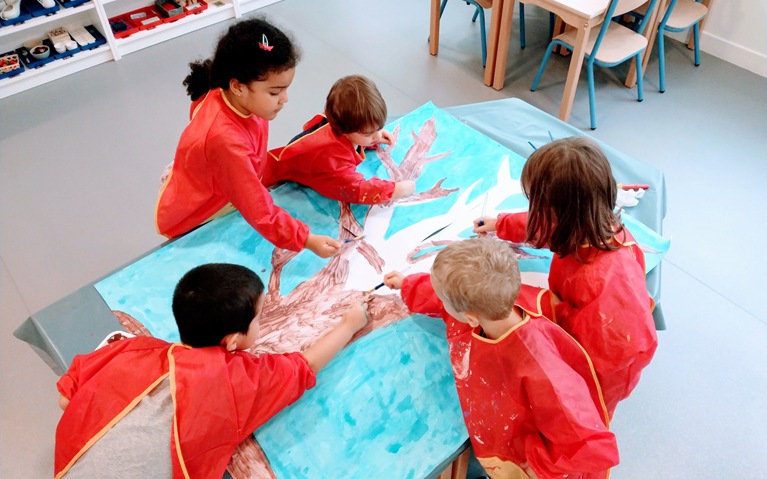
I went to a different school almost every day. What I kept asking the teachers, as honestly as I could, was why they stayed. The pay is low, the recognition is thin, the work never ends.
The answer was always the same. There is a moment when a child who did not understand something suddenly does. You see it move across their face. It is small, it lasts a second, and once you have seen it a few times you want to see it happen again.
You often speak about the importance of a child’s first 2,000 days. Was there a moment when that became your mission?
Like many parents, I knew that early years mattered, but I didn’t fully grasp how critical they were.
That changed through research, especially Nobel laureate James Heckman’s work showing a $7 return for every $1 invested in early childhood education.
We also saw data that showed that 80% of kids who drop out of school already show strong difficulties by age 6. That was striking.
It made us realize early childhood isn’t just important: it’s critical, especially for underprivileged children. That research pushed us not just toward schools, but toward a broader model that included philanthropy, because the children who benefit most from early support are often the least likely to have access to it.
What have been the hardest trade-offs in building your school model?
The hardest trade-off is between quality and scale. Preschool done well requires low adult-to-child ratios, trained teachers, and real materials. Each of those costs money. Every time we have tried to expand too fast, something has suffered. We have had to make peace with growing slowly, which is a strange discipline for someone who came from the world of venture-backed tech.
On fundraising: France has no culture of philanthropic giving to education. In the US, a school fundraising campaign is normal. Here, you have to build that case from scratch, which has been humbling.
In tech, feedback loops are fast. In education, outcomes take years. How do you decide what to measure?
We use data heavily to design pedagogy, drawing from research and best practices.
But for ongoing feedback loops, we focus more on non-pedagogical areas: operations, hiring, admissions, marketing. Those are highly data-driven and iterative.
For pedagogy itself, feedback is more human and teacher-driven rather than purely data-loop based. The honest answer is that we do not have good long-term measurement yet. We track engagement, language acquisition, motor development at age 5 or 6. But whether a child who came through our schools is more resilient at 25, we cannot know that for twenty years. That is uncomfortable for someone trained at McKinsey, where every hypothesis has a test. You have to make decisions before the full long-term data is available.
You’ve built ventures with people you deeply trust. What have you learned about co-founder chemistry?
I always pick the co-founder first, then the idea after that. Every time.
All my companies were built with close friends, and that trust has been the foundation of everything. But it comes with a cost: when things go wrong, and they always do at some point, the friendship becomes both an asset and a liability. You have to be willing to have hard conversations with people you love. Most co-founder breakdowns I have seen were not about strategy. They were about things that were never said.

In 10 years, how will you measure your impact?
It’s hard to measure, because it’s human-centered.
Success would be seeing children thriving academically, professionally, and as happy individuals.
I think of one girl who entered our school at age 4 with almost no language. Two years later, she was speaking publicly in French and English. That window, ages 3 to 6, was clearly decisive for her. It showed me how much can still be unlocked when the environment is right. Over a thousand children have now come through our schools. Most I will never follow personally. But each of them went through that same window, and that is what keeps the work meaningful at scale.
At scale, success means shifting how France allocates public investment in education. Right now, almost everything goes to secondary and higher education. The research says that is backwards. Moving that dial even slightly would matter more than anything I could build myself.
What is the most enduring lesson from McKinsey, and your best “only at McKinsey” story?
The biggest lesson is that being rigorous and being human are not in tension. The best people I met at the Firm held both at once. They would pressure-test an assumption and then take you to dinner. I have tried to build that into how we hire at École M.
The story: shortly after I joined, I was invited to lunch by Firm icon Ron Daniel. I had no idea who he was. Rumors spread amongst my analyst class that I was French royalty!
In reality, he invited one new analyst to lunch each year to stay connected to the Firm. He was incredibly humble. It was a great experience, and a funny misunderstanding.
What is your next bold, brilliant move?
Personally, letting my daughter go to boarding school in the United States at 14. For a French family, that is genuinely radical.
Professionally, the bold move is already underway: we are building a foundation with the ambition of reshaping how France thinks about the first years of life. That is not a five-year project. It may not show results in my career. That used to feel uncomfortable. Now it feels like the only thing worth doing.

