
___________________
Radka is an entrepreneur and leader with a passion for shaping the future of leadership. She’s the founder of ATAIRU, a leadership development firm, and co-founder of Alaigned, an AI platform focused on strategic alignment. With an MBA from Harvard and a deeply transformational parental journey, Radka describes her approach to life as “finding comfort in discomfort.”
Radka, you founded ATAIRU more than a decade ago with a vision to make an impact in the field of leadership. Can you share how your vision and mission have evolved over the years?
I’ve always loved this quote from Jeff Bezos: “I very frequently get the question, ‘What’s going to change in the next ten years?’ I almost never get the question, ‘What’s not going to change in the next ten years?’ That second question is actually the more important of the two, because you can build a business strategy around the things that are stable in time.”
Applying this quote to me, there are a few things that haven’t changed. First, I’ve always wanted to focus on leadership. Second, my ambition was never just to be a coach or mentor—I’ve always wanted to build an international company around that. And third, I’ve always aimed to create something impactful, something that leaves a mark on a larger scale. These three things have remained constant, and they still feel deeply aligned with my purpose and passion.
What has changed is how my vision has crystallized over time. When I started, I focused on authentic leadership because I noticed a gap—there was a lot of emphasis on management and processes, but not enough on leadership. To me, leadership is about unlocking potential in people and organizations, and I saw so much untapped value in the “soft stuff” that we’re not traditionally taught to work with.
Over time, my focus has shifted. While I still prioritize leadership, I’ve moved more toward strategic leadership and leading through change. We’ve done a lot of work on motivation and collaboration, but now, strategic leadership feels more critical than ever.
What makes strategic leadership the next big frontier for you?
Managers are often telling us: “We’re chasing too many rabbits. We’re stretched too thin. Our teams aren’t aligned on what really matters.” At the same time, we noticed a fascinating phenomenon: leaders want change, people are working hard, yet the changes just don’t happen. We kept asking ourselves—where does all that energy for change disappear? We call it the mystery of the Bermuda Triangle.
As we explored this, we discovered a common pattern: companies often lack strategic clarity and alignment. There’s no clear direction or shared understanding of what really matters. This is what causes that mysterious loss of energy and momentum.
To tackle this, we developed a methodology centered around the concept of a Strategic One-Pager and its cascade throughout the organization. We’ve already applied it in over one hundred companies, and we see it helps solve the Bermuda Triangle mystery by creating clarity and focus. Strategic leadership, which enables this kind of alignment and clarity, is what truly separates fast-moving companies from those who are moving slowly.
Being a leader isn’t just about being kind or supportive; it’s about moving your team or company from point A to point B — through people.
And what role does your newly established AI startup Alaigned play in this?
We saw that our methodology works really well, and we realized that AI is disrupting this field by opening up many new opportunities for companies to have a much greater impact. That’s exactly why we developed our app Alaigned. It’s designed to help leaders build strategic clarity, align their teams, and stay focused on execution.
Alaigned uses AI to guide teams through the process, making strategy more actionable and enabling companies to drive bigger and faster change.
At the Vogue Summit recently, you’ve spoken about your excitement for AI and its potential to transform leadership. How do you see AI supporting leaders in their daily work?
I think AI is an incredible tool for leaders. It’s super-fast, efficient, and tireless—qualities that are invaluable, especially when you’re juggling multiple responsibilities. But there’s also a deeper reason why I believe AI matters for leadership today.
The burden of strategic decision-making has exploded. According to Gartner, 65% of leaders feel overwhelmed by complexity. McKinsey estimates that Fortune 500 companies lose $250 million a year due to inefficient decisions. Bain found that 72% of executives believe their organizations make more bad decisions than good ones. And Oracle reports that leaders today make ten times more decisions per day than just three years ago—85% of them say it’s a major source of stress.
This is where AI can truly make a difference. It accelerates the entire strategy-to-execution cycle with real-time analysis, planning, and insights. It augments human judgment, reduces bias, and helps leaders make better choices faster. What’s even more exciting is that it democratizes strategic capabilities—especially for SMBs and under-resourced teams that previously didn’t have access to this kind of support.
With tools like Alaigned, AI can now help bridge the execution gap by generating action plans, surfacing misalignments, and keeping teams focused on what really matters. In this new era, I see AI not as a replacement for leadership—but as a powerful amplifier of it.
How do you approach challenges?
For me, stepping into challenges is like plunging into ice water. Every time I do it, I think about the “ice buckets” I’m avoiding—those tough issues I don’t want to address. It’s also about practicing comfort in discomfort. Finding comfort in discomfort is a skill and a mindset, and I think it’s something leaders should develop.
Do you think this ability to embrace discomfort is essential for leadership?
Absolutely. It ties into resilience, which is such a critical topic. Resilience isn’t about avoiding stress; it’s about learning how to navigate it. Everyone has their own ways of building resilience, but for me, it’s about stepping outside my comfort zone. That’s where growth happens.
You’ve been very open about your personal life, including raising a child on the autism spectrum. How has that experience shaped you?
It’s been transformative, not just because of Jonáš but because of all our children. Raising a child on the spectrum challenges your biases and judgments. You have to let go of expectations and enter their world. That’s been a profound lesson for me—learning to see the world through his eyes.
We view Jonáš as a gift, not just for us but for our whole ecosystem. It’s not easy, but it’s deeply rewarding. It’s also brought my husband Robert and me closer. Raising a family like ours requires a level of partnership and support that either strengthens your relationship or tests it to its limits. I’m grateful we’ve grown closer through it all.
You split your time between Prague and the mountains. How does that work for you?
My family moved to the mountains 30 years ago, so it’s home for me. My parents and sister are there, and we have a family business I’m involved in at a high level. The mountains are also where I feel most at peace.
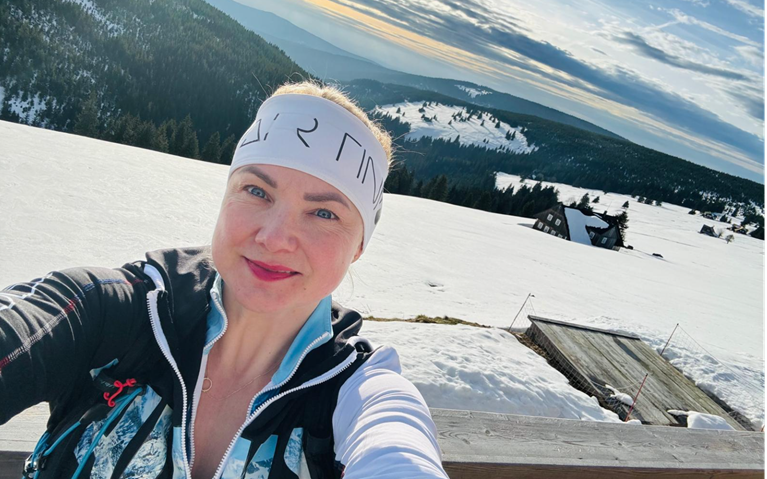
Robert and I both love skiing, and all our children ski too— Jonáš even competes in a snowboarding program for autistic kids. We spend every winter weekend there. For me, the mountains offer perspective. Being up high, looking at the world from above, helps me think differently. It’s where I reflect, ask questions, and find clarity.
That’s such a beautiful way to describe it. It reminds me of how some colleagues say they solve problems while running. Do you find the mountains have a similar effect?
Exactly. When I’m in the mountains, I often pose a question to myself and let it sit. The answer doesn’t always come immediately, but it does eventually. It’s like the mountains create space for insights to emerge.
Speaking of pause and reflection, do you think women leaders in general bring a different approach to leadership, perhaps by listening more?
That’s an interesting question. I do think women often bring a unique perspective to leadership, and listening is a big part of that. At McKinsey, I learned the power of asking questions. When you’re surrounded by people who are smarter or more experienced, your value comes from the questions you ask, not the answers you give.

