
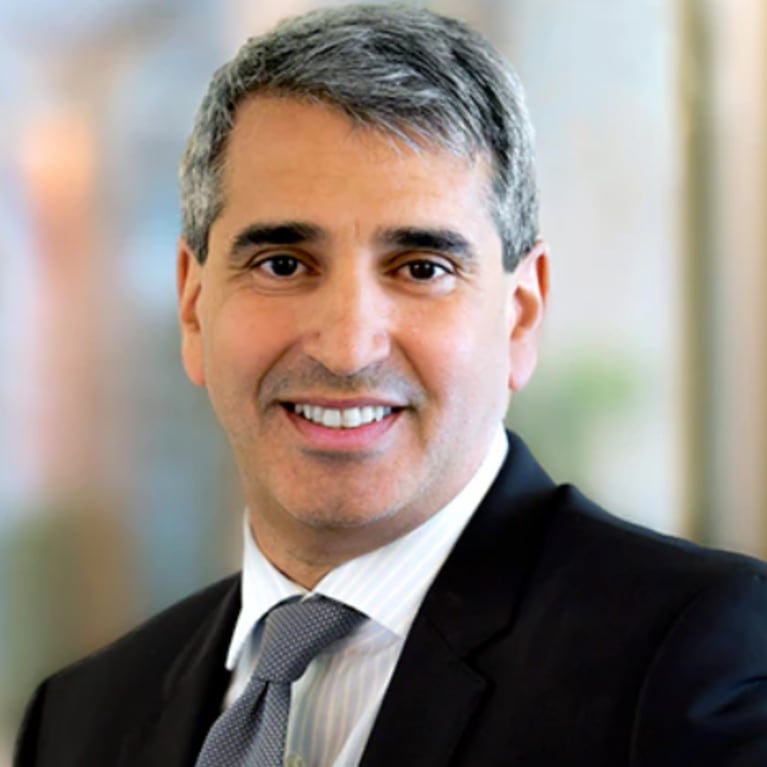
Bill Ready (Chicago, 05-05, 06-09), one of the most influential leaders in digital commerce and a serial entrepreneur, has spent his career at the intersection of technology, finance, and consumer experience. He led iPay Technologies through rapid growth and a $300 million acquisition, then built Braintree and Venmo from early-stage disruptors into a combined business acquired by PayPal, where he rose to COO overseeing global product, technology, and engineering. After serving as Google’s President of Commerce, Payments, and Next Billion Users, he took the helm as CEO of Pinterest in June 2022.
In this conversation, Bill sits down with McKinsey Senior Partner Tarek Elmasry, a former colleague from our Firm’s Chicago office, for a candid discussion about leading Pinterest through a period of disruption while doubling down on safety, positivity, and the power of visual discovery. Together they explore how his leadership philosophy has evolved toward bold, mission-driven bets, the role AI and regulation will play in shaping healthier digital platforms, and the enduring lessons from his McKinsey years that continue to guide how he builds teams and businesses today.
* * *
Tarek Elmasry: You became CEO of Pinterest in June of 2022. You had a lot of great experiences in advance of that. What surprised you when you stepped into the role?
Bill Ready: When I came to Pinterest, the platform was in a tough spot: the stock was down more than 80 percent, users were declining, and the company had been through cultural crises. For me, the appeal was that there were a lot of issues to address, but I could have an opportunity to do that end-to-end. That felt really good and still does.
A lot of what’s worked for us since then has come from thinking comprehensively about what’s happening in the industry – the move to AI, the role of safety and positivity in social media – and recognizing those are not things you can really solve if you only control 80 or 90 percent of the problem. You have to be able to pull every lever. This isn’t a startup, but it is harder to drive the full end-to-end; on the other hand, the potential impact is much greater.
Tarek: How has your leadership style evolved over time?
Bill: I’d point to two big changes. First, I’ve developed more tolerance for taking well-calculated risks. Early in my career, I didn’t set out to be an entrepreneur; I was working three jobs to put myself through undergrad, and doing a startup meant I could have one job instead of three. It didn’t feel like risk-taking, it felt practical.
With each successive startup that had some success, I was willing to take bigger swings. There’s no way I would have done Venmo if I hadn’t already had a successful exit beforehand; that gave me more courage in my convictions. Similarly, at Pinterest, things like creating a more positive alternative to social media and tuning ads for positivity were pretty contrarian when we leaned into them, but they’ve been central to how we’ve won. Those prior successes lowered the cost of a strikeout and made it easier to swing big.
The second evolution is around mission. From the very beginning, I loved building things – creating something out of the ether that people actually use. But the early things I built weren’t chosen for the mission; they were chances that I wanted to take as a computer science major to go build something in the dot-com era. Over time I realized, first, how much more fun it is to work on something where you deeply believe in the mission, and second, how much better the talent is that you can attract when the mission really matters.
I felt that strongly at Braintree, where the idea was to democratize one-click buying for the rest of the world so entrepreneurs and small business owners, people like my parents, could participate in digital commerce. That felt really good.
At Pinterest, we’ve seen the same dynamic. The more we’ve focused on a mission that matters – creating a more positive alternative to social media – the more we punch above our weight in the quality of talent we attract and in how passionate people are about the work. So that second evolution, making sure you’ve got a mission that really matters, is closely tied to the first: being willing to take bold bets. We put a big stake in the ground around building a more positive form of social media, and that’s about having a mission with real impact in the world and being willing to make bold bets – not reckless bets, but bold bets that are well-calculated risks.
Tarek: Picking up on that mission piece, you and I have talked before about how the safety and positivity of social media is so important to you. What was the origin of that?
Bill: The origin really came from two personal connections.
First, my daughter is 11. She’s not old enough for social media yet, but like most parents, I’m terrified of the day she is because of all the harms that are out there for kids on most social platforms. Seeing what’s happening to young people made this feel very real and very urgent.
Second, I felt a deep sense of responsibility. Like many others, I was deeply enamored with social media in the early days. I was at Accel when they were the first institutional investor in Facebook. We had multiple Facebook founders as seed investors in Venmo. We literally put a social feed in a payments app. We genuinely believed social media was helping the world be a better place—reconnecting with long-lost friends, understanding your neighbors, helping democracies rise up—until one day it wasn’t.
As I got more insight into what was happening with the algorithms, I started to feel both responsible, because I had been a small part of advancing social media, and also that I knew something that could be done differently. If you see the problem and you start to believe you know something that could help, it creates a responsibility to act.
My view was that social media became negative when AI got put in charge of what you see—when it stopped being a chronological feed of what your friends posted and started being what the AI thought you should see. That shift happened more than a decade ago. The AI was asked to maximize view time, and it figured out you look longer at the things that trigger you. AI is like a powerful genie: it grants wishes in ways you don’t expect. As the genie gets more powerful, we have to be much more thoughtful and intentional about what we ask it to do.
So the question for me was: if we could ask AI to maximize view time and that led to harms to emotional well-being and “engagement via enragement,” why couldn’t we give it a different objective? Why couldn’t we say that we would tune the AI to be more positive, to have people feel better after time on the platform instead of worse?
That’s what was so compelling about Pinterest. Even though the company was in a moment of crisis, I saw two really interesting things. One, I believe the future of search is going to be more visual, and Pinterest is inherently a visual platform with unique signals to tune AI on the curation that happens there. Two, while Pinterest had its issues and was even trying to prioritize short-form video like many others at one point, it had always worked to avoid the most negative elements of social media. There was a foundation where people already saw it as a more positive place; it just hadn’t been made central to the mission.
So I thought, what if we make this central to our reason for being? As the explosion of AI was coming, my view was that our stake in the ground would be to prove we can tune the AI for positivity and prove there’s a more positive alternative to the “engagement via enragement” model that has come to dominate social media.
Tarek: We're talking a lot about AI, which is appropriate for where we are. If I shift gears a little bit, everyone's talking about AI regulation. How should we think about the degrees, the levels, the types of regulation that makes sense for the world we live in?
Bill: First of all, just like any technology, AI can be used for good or for bad, and there are likely going to be examples of market failures. I’m a capitalist at heart, so I don’t think you need to regulate everything to the nth degree. But even as a capitalist, there are clear market failures, and we’ve definitely seen those with social media—the “engagement via enragement” example—and I think we’re already starting to see those with AI. Thoughtful regulation is going to be needed.
The technology is advancing so fast that it will be hard to regulate every specific tactic. We should regulate the outcomes more than the tactics. A good analogy is what happened in the auto industry: regulation doesn’t dictate every sensor and airbag; instead, crash test ratings were created. That did two things: it set a baseline of minimum safety standards, and it created a basis of competition as manufacturers tried to exceed those ratings and consumers chose based on safety performance.
I’d love to see a world where social media and AI companies are competing on their safety records in the same way. You probably need some baseline regulation for that, but the rules should focus on outcomes and leave space for companies to innovate in how they exceed those safety outcomes.
Some of our best use cases of AI at Pinterest have been using it not only to tune for positivity, but to keep bad content and bad actors off the platform. It’s a great example of how AI can be used for good or for bad—so let’s create standards that give people an incentive to innovate around using it more for good than for bad.
Tarek: Go back to the time you spent in our Firm’s Chicago office. What did you learn and what was helpful for you in that chapter of your career that you still use?
Bill: McKinsey was a fantastic learning ground for me. I’d done two startups before McKinsey, in business school, where the products were good but the business models didn’t work out. I was the first engineer but not the CEO, and this was before the days when the first engineer gets to run the company. I thought, “I’ve got to figure out how to run the business.” So I went to business school, and afterward I still felt I didn’t know enough. I asked, “Where else would be an amazing place to learn?” and McKinsey was that place.
Very few people get to see a broad enough sample set of how different businesses work. Some of the biggest unlocks come when you have an analog in an adjacent space and say, “What if I took the way this thing works in that industry and applied it over here?” McKinsey was where I really learned to do that. It increased my sample size and let me be around really smart people, seeing cross-industry learnings in action.
The second big thing that’s stuck with me is understanding what it really means to embrace diverse talent from all kinds of backgrounds and ways of thinking. Because you’re on a new team every few months, one of the first things you do is share your Myers-Briggs type. You quickly realize: everyone in the room is super smart, but we have very different backgrounds and different ways of seeing the world. By talking about that explicitly—“I’m an extrovert and like to talk things through; you’re an introvert and need time to think”—you open the aperture on the kinds of amazing talent you can bring together.
Ever since, I’ve aspired to surround myself with people who are both really brilliant and think differently from me. If you understand how to harness that, teams become very well-rounded and people become amazing complements to one another. McKinsey was a great place to learn that.
Tarek: I'm sizing you up as an ENTJ.
Bill: You’re absolutely right.
Tarek: Do you have any particular memories or anecdotes that you remember from your tenure, or colleagues who were mentors?
Bill: There were a lot of people who made a difference. Looking back, it’s amazing that although I was only in my mid-20s, Partners were bringing me into rooms with CEOs. How incredible is that? Where else does that happen? I’m hugely grateful to those Partners who created those opportunities, but I also think that’s the nature of McKinsey—this is what the place is, and it’s very hard to find elsewhere.
I just joined the board of Visa, and Ryan McInerney, the CEO, is also a McKinsey alum. He was very young when he was elected Partner. I’d done a lot of work in the Financial Institutions Group with Devin McGranahan, and Ryan recently told me about how much he had worked with Devin and learned from him, too. We each had multiple examples of Partners we’d learned from, but the common thread was the same: we were 20-something, fresh out of school, getting the chance to go into these amazing places and be in the room.
That’s a credit to the Partners of the Firm then, and it’s part of the DNA of the place that makes it so special.
Tarek: What advice might you offer our Firm as it turns 100 years old?
Bill: One of the most powerful things I took from McKinsey was the idea of the obligation to dissent. There’s that Marvin Bower story where essentially he was willing to tell a client that they were the problem with the company. It was clear he was risking the engagement, but that’s what clients need most. The people we work with, in any role, need the ability to hear what they need to hear, not just what they want to hear. It’s hugely critical in business and in actually getting things done, yet people are often afraid to do it.
We’re in a moment of tremendous change in the world. McKinsey helps so many companies through their most critical moments as they navigate that change. In that context, the obligation to dissent really matters. I can point to examples where I saw it in play and others where people still struggled with it. I remember being on a study, debating with a Partner as a pretty early-tenure associate. That Partner later became a huge mentor and champion, and actually relished that challenge.
My advice as the Firm turns 100 is: Hold on to that. In these moments of change, what clients need from McKinsey is that ability to tell them what they need to hear—maybe that what they want to do isn’t good for their customer, or is good short-term but short-sells their future. Those are the moments that really matter. Companies everywhere are facing moments that really matter and need that sounding board, that truth-telling. McKinsey has always been a place for that, and I hope it continues to be an anchor for the Firm.

