Reinventing food redistribution: A conversation with The Felix Project CEO Charlotte Hill
When Charlotte Hill, CEO of The Felix Project, speaks about food waste and hunger, she describes a simple but powerful vision: a world where no good food is wasted and no one goes hungry.
Now, with the merger with FareShare, the organization is aiming for something bigger: a UK-wide step change in how surplus food is rescued and redistributed.
Hill sat down with McKinsey’s Giorgio Bresciani and Kevin Van Ingelgem to discuss the mission, the ecosystem behind food redistribution, and what it takes to merge two mission-led organizations without losing momentum.
An edited version of the conversation follows.
Giorgio Bresciani: Charlotte, welcome. Let’s start at the heart of the Felix Project. What is your mission—and why does it matter today?
Charlotte Hill: McKinsey was such a foundational partner for Felix, so it’s a privilege to come and talk to you both.
Our mission and vision are of a world where no good food is wasted—and no one goes hungry. It sounds simple. But if you take a step back, about a third of the food we produce globally is thrown away. All of the effort, energy, water, packaging, air miles, and everything that goes into the production of that food—only for it to be thrown away—is one of the greatest contributors to climate change that we have. Meanwhile, more than 30 percent of UK society is living in some sort of food insecurity at the moment.
If we think about our role in this as the Felix Project, we want to get all that surplus food that isn’t needed over here to all of those incredible communities who can really use that food over here. We are the bridge between supply and demand.
Giorgio Bresciani: You rescue good food and redirect it to the people who really need it. How does it work on the ground? What are the challenges in executing that?
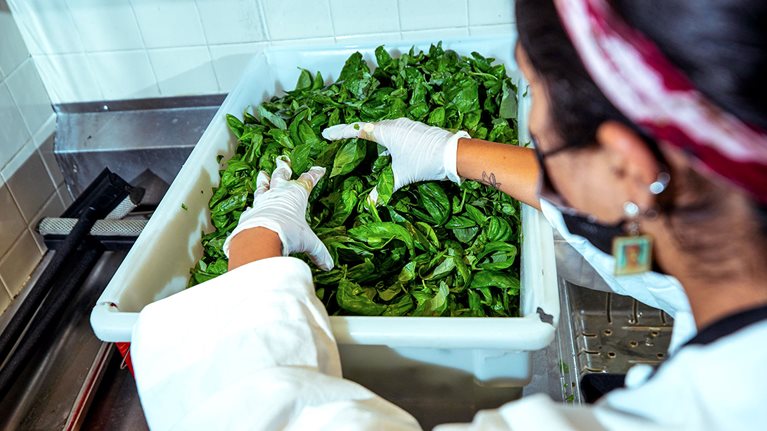
Charlotte Hill: We are effectively a world-class logistics company with a big heart. You have to maintain all of the food safety standards to get it from here to here. It’s a real logistical jigsaw to put together.
We do it in London through a network of about 1,250 community partners. Those might be homeless shelters, domestic violence refuges, food banks, or schools. They are effectively local community organizations that really understand the communities in which they are embedded.
People come for the food, but they also get health advice, employability support, domestic violence support, or whatever else that food enables. That is what lifts them out of the cycle of poverty or struggle and allows them to go on and have a much better life.
Giorgio Bresciani: One of the amazing things we’ve observed while working together is the ability of this project to create an ecosystem around the problem you are solving. It is incredibly complex. How do you bring all those elements together and drive the ecosystem to the best possible outcome?
Charlotte Hill: I say this all the time—I have the best job in the world. I get to work with some of the biggest retailers and manufacturers in the country, as well as farms and suppliers. On the other side, we work with tiny grassroots organizations that might be run entirely by volunteers.
This is where our partnership with McKinsey has come in. You have helped us over many years map and think about the role of all those different parts of our ecosystem and how we most effectively work with them.
We want everyone to feel they can play their part in moving toward a world where good food is not wasted, and no one goes hungry. The good news is that everyone can play their part.
Giorgio Bresciani: When you look back, how has working with McKinsey shaped your journey?
Charlotte Hill: If I think about the trajectory of the organization over the past ten years, it’s astonishing. Even as chief executive, living and breathing it every day, I am blown away by the growth, innovation, pace, energy, and strategic foresight that has enabled us to move into the spaces we needed to at the right times.
Take Felix’s Kitchen: It was a big shift for us. We had only ever rescued surplus food and given it away. We had never moved into production and cooking food. Yet, Felix's Kitchen has now celebrated over 5,000,000 meals going out the door. You were absolutely instrumental in building the plan behind that.
Or take the Coronation Food Project. We are fortunate enough to work with Their Majesties the King and Queen, who made helping move from food waste to food need one of the priorities of their reign. After delivering a project in London, His Majesty wanted to do something across all four nations. It was McKinsey who sat down with me and helped us think through what that could look like.
Kevin Van Ingelgem: An extremely exciting development has been the merger of the Felix Project and FareShare. How did the first conversation happen?
Charlotte Hill: What a moment for UK society. The early conversations came because of work we were already doing together, including the Coronation Food Project. As a London-based organization, we couldn’t deliver across four nations on our own. We needed a partner.
Kris, the CEO of FareShare, and I sat in a room and asked: If we put egos aside, do we genuinely believe we can achieve our mission better as one organization rather than two? If we answered yes to that question—and the work McKinsey did helped us think that through—then it was our responsibility, as two chief executives, to make it happen in the best possible way.
Kevin Van Ingelgem: Mergers are risky and difficult. How did you ensure it didn’t distract from your mission?
Charlotte Hill: One of the brilliant things McKinsey did was support us with additional capacity during the merger. We brought in a McKinsey colleague full-time as my chief of staff for a year. That ensured we had the brainpower to manage the merger without distracting our chief operating officer, who still had millions of meals to deliver, or our CFO, who had to keep the organization running.
We had no choice but to continue delivering—people rely on our food.
The innovation, impact, and growth did not stop. And alongside that, we delivered what I believe will be a highly impactful and successful merger.
Giorgio Bresciani: If we imagine a future where no good food is wasted and no one goes hungry, what role can the merged organization play?
Charlotte Hill: The food industry wants a one-stop shop in redistribution—a partner who can say yes to everything, who can be agile and responsive, and take food when it needs to be taken, safely and efficiently.
Our role is to use technology in the most intelligent way to be that bridge and take friction out of the system. We also need to do it in partnership with government, the private sector, farmers, and every element of the ecosystem required to make this happen. We believe we can make it happen. And we are grateful to have had McKinsey by our side—not just over the past ten years, but as we move into this next chapter as a merged organization.
Watch the full interview here: