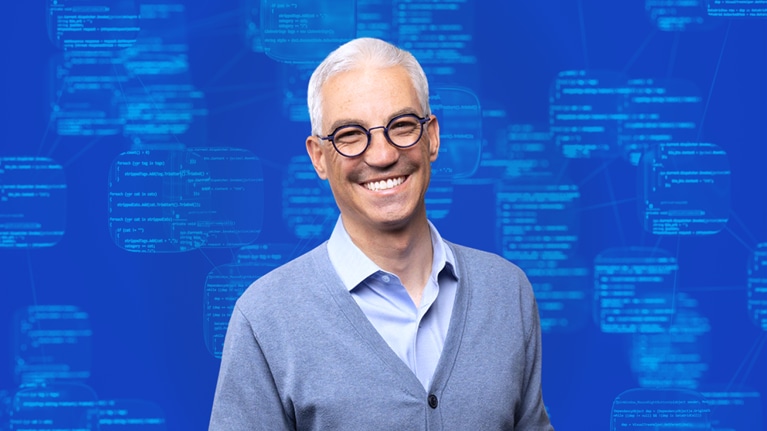
McKinsey’s Brent Pabst on why transformation starts with tech foundations
The second edition of Rewired offers a practical blueprint for organizations with bold ambitions to unlock value from tech transformations. This series explores the six core capabilities of the Rewired recipe and the people who bring them to life.
AI may be transforming enterprises, but it isn’t changing what makes transformation successful.
McKinsey Partner Brent Pabst, a contributor to the second edition of Rewired, draws on insights from the book, his client work, and his career in software engineering to explain why organizations need modern technology foundations, technically fluent leaders, and an enterprise-wide mindset to unlock AI’s full value.
Why AI success starts with technology foundations
For Brent, one of the biggest differences between the first and second editions of Rewired is an emphasis on the fundamentals.
“The first edition focused on the art of the possible and how to start a digital journey,” he says. “The second recognizes that AI creates value only when modern technology and data foundations are already in place. That means modernizing core systems and bringing data together in a way that AI can effectively use.”
At the same time, Brent and his coauthors were careful not to write a technical manual. The goal was to equip business leaders with the technical understanding required for decision-making.
“Nobody expects the chief revenue officer to build an application,” he explains. “But they do need to understand the implications and challenges so they can lead their organizations through the transformation and ensure the right tools and capabilities are in place to support it.”
An unconventional path to AI leadership
Brent hadn’t planned on a career in technology, initially studying broadcast communications. But after gaining work experience in the field during college, he realized it wasn’t the right fit. During a break from school, he joined a start-up as a systems engineer, where experience managing the company’s IT environment revealed a talent for technology. After completing several degrees in IT, he moved into software development, building custom applications for a variety of clients and manufacturing companies before becoming chief architect at a growing software company that builds software for schools and local governments.
In 2017, he joined a growing team of software engineers as one of the firm’s first to focus on delivering tailored new solutions directly to clients. Today, he leads McKinsey’s global software, cloud, cyber, and architecture guilds while working with energy companies on large-scale technology modernization and AI.
“When I first joined McKinsey, everything looked and felt like a management firm,” he says. “That’s still a key part of our work, but today, we’re also a technical delivery firm.”
He believes what sets McKinsey apart is its focus on building client capabilities, not just delivering solutions.
“Our clients don’t just see a group of contractors coming in; they see people who teach their teams how to do things differently. Ultimately, the goal is to evolve the organization so it can be self-sufficient after we’re gone. We always strive to work ourselves out of a job.”
Ultimately, the goal is to evolve the organization so it can be self-sufficient after we’re gone.
Applying familiar principles in unexpected places
That work has led Brent to some unexpected places. Among his most exciting recent projects is helping one of the world’s largest power generators use AI to improve maintenance planning, schedule work more effectively, verify safety checks, and help crews access the right information.
“If we can figure out how to apply AI in a regulated power generation context,” he says, “we can certainly apply it in many other highly regulated environments. We’re not putting AI into command-and-control systems; we’re optimizing the work of the people who keep those systems running.”
For all the excitement surrounding AI, Brent doesn’t believe organizations are facing an entirely new challenge. “We haven’t invented a whole bunch of net-new things outside the models themselves and how LLMs [large language models] work,” he says. “The way we apply them is actually fairly consistent with how we’ve applied computing principles in the past.”
He argues that the real challenge is organizational. Success depends less on deploying individual AI tools than on rethinking how work gets done across the business.
“It’s very easy for folks to apply bits and pieces of these principles here and there,” he says. “But we’re no longer at the stage where that’s going to cut it. Unless you tackle transformation holistically, it just becomes a collection of isolated use cases.”
Unless you tackle transformation holistically, it just becomes a collection of isolated use cases.
Brent believes the companies that succeed will be the ones with committed leadership, clear ownership, and a road map the organization can put into action. “It’s one thing to say we need to do these things,” he says. “It’s a whole other thing to build the structure and actually go do it. I’m curious to see who is going to pick up the mantle and drive change.”