Across the public sector, the adoption of AI has outpaced the financial machinery built to govern it. In the United States, a series of introductory federal agreements in 2025 put frontier AI models within reach of agencies for nominal sums, such as ChatGPT Enterprise and Claude being offered to federal agencies for $1, Gemini for 47 cents, Grok for 42 cents, and Perplexity for 25 cents. The General Services Administration’s (GSA’s) own USAi Evaluation Suite was made freely available.1 Similar pilots, grants, and vendor incentives have lowered the barrier to entry across additional public sector organizations and governments. These programs have worked as intended, enabling and accelerating the experimentation, building, and testing of workflows with agencies, moving AI from proof of concept into daily mission work faster than almost any enterprise technology before it.
But as these pilots convert to standard commercial pricing and usage grows from hundreds of users to hundreds of thousands, agencies will encounter their first true run rate. Many will discover what private sector finance teams already know: While unit token costs are falling, the total cost is rising fast. The acceleration of increasingly complex AI workflows with more agents, longer context, and more calls per task combined with the switch to consumption-based pricing yields financial situations that look very different from the seat licenses public budgets were built around. The result is a widening gap between the public sector’s AI ambition and AI financial control.
This article lays out three things public sector chief financial officers (CFOs), chief operating officers (COOs), and chief procurement officers (CPOs) should understand: the mechanics of AI spend, what to anticipate from the market during the next six to 12 months, and what can be done now to prepare.
From token max to token tax: Government’s looming bill
There’s a paradox at the heart of AI spend. The price to run a fixed level of AI capability has fallen roughly tenfold per year and about 1,000-fold over three years. It’s one of the steepest cost declines of any technology in modern history.2 Yet enterprise AI bills are climbing because usage is exploding at a faster rate.
Agentic workflows, which chain many model calls together to complete a task autonomously, routinely consume five to 30 times the tokens of a simple chatbot query, far more in complex cases.3 The FinOps Foundation’s 2026 survey found that 98 percent of practitioners now manage AI spend, up from 31 percent two years earlier, the fastest adoption of any cost discipline it has tracked, even as 40 percent still cannot quantify AI’s return. But tokens—the small unit of text (roughly a few characters) that AI models read and generate—and agent-step pricing introduce a volatility that legacy budgeting frameworks were never built to handle.4
Government leaders are not insulated from this. In all five agencies it examined, the US Government Accountability Office found officials struggled to understand AI costs and how vendors price AI licenses and services. In one case, a US Army program received a proposal to license an AI capability at roughly $300,000 per vehicle per year, which would have meant more than $500 million annually in licensing fees alone. The Army rejected it.5
And government usage is no longer hypothetical but scaling fast. US federal agencies reported 3,611 AI use cases in the 2025 inventory, up roughly 69 percent in a single year and five times more than 2023, with about 1,800 already deployed or piloting and 445 designated as high-impact.6 Spending has followed: The potential value of federal AI contracts reached an estimated $90 billion or more.7 The base on which tomorrow’s bills will compound is being laid right now.
In the private sector, organizations are starting to see the gap between their AI ambitions and their ability to control costs as they move beyond experimentation into active deployment. A McKinsey survey of 120 enterprises, including 75 respondents with sufficiently advanced AI adoption maturity to enable robust cross-industry analysis, found that 93 percent had exceeded their planned AI budget (Exhibit 1). While this survey was primarily focused on private organizations, the findings are applicable to any enterprise accelerating AI, and government leaders are likely to rapidly see the same impact in their own agencies.
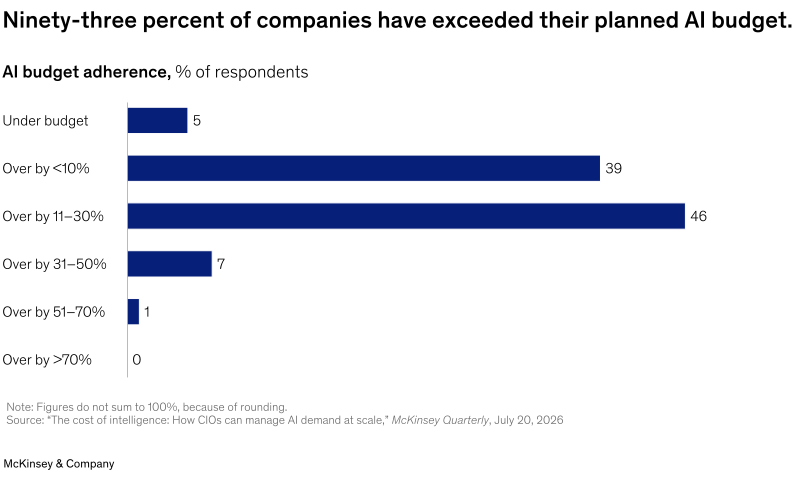
A horizontal bar chart shows AI budget adherence in percent of respondents. 5% are under budget, 39% are over by less than 10%, 46 percent are over by 11–30%, 7% are over by 31–50%, 1% are over by 51–70%, and 0% are over by more than 70%.
Note: Figures do not sum to 100%, because of rounding.
Source: “The cost of intelligence: How CIOs can manage AI demand at scale,” McKinsey Quarterly, July 20, 2026
Protecting both budgets and missions requires agency leaders understand the new economics of AI and pivot to treating it and token consumption as a distinct, managed spend category while learning how to use AI agents to create value. Those who wait risk surprise bills, stalled programs, and a much harder conversation with appropriators.
What government leaders should know about AI spend
When US government agencies first started migrating from on-premises computing infrastructure to the cloud, many assumed cost management would be straightforward. But they did not account for the costs of vendor lock-in, complex pricing models, and the critical requirement of building out the necessary financial-operations (FinOps) scaffolding to maintain control and oversight across expanding cloud services.
Variable AI-token consumption, rapid experimentation, and a lack of model differentiation threaten similar challenges unless government leaders get ahead of the curve. We recommend agency leaders apply four distinct but interrelated lenses to understand, implement, and succeed with strategic AI spend (Exhibit 2). These four lenses recur, underpinning five mindset shifts (what to know), two market dynamics (what to anticipate), and six practical steps (what to do).
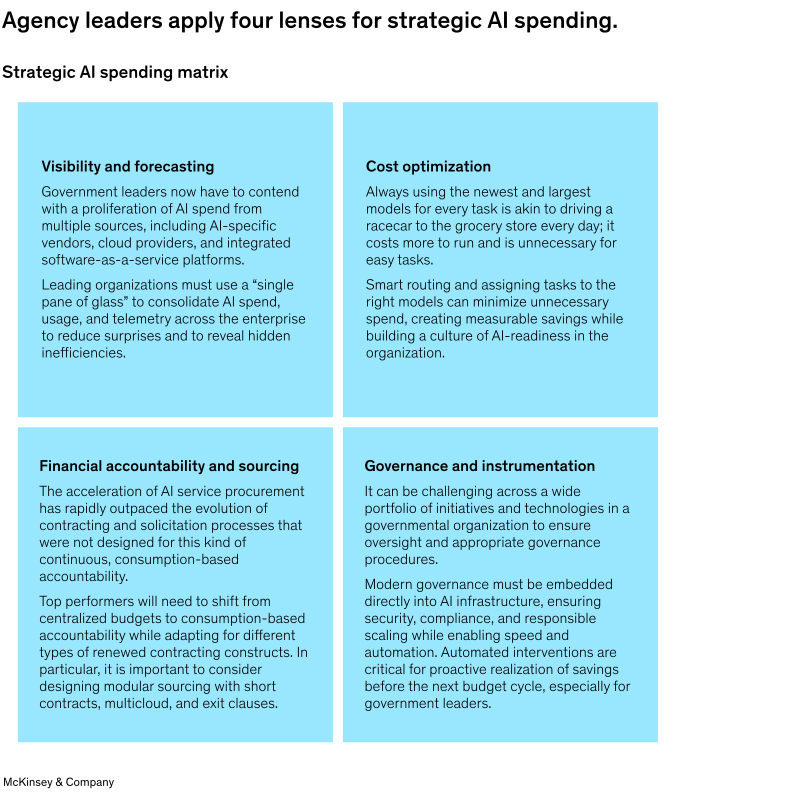
A matrix shows four lenses for strategic AI spending. The top left quadrant of the matrix is visibility and forecasting. Under this lens, government leaders now have to contend with a proliferation of AI spend from multiple sources, including AI-specific vendors, cloud providers, and integrated software-as-a-service platforms. ¬Leading organizations must use a “single pane of glass” to consolidate AI spend, usage, and telemetry across the enterprise to reduce surprises and to reveal hidden inefficiencies.
The top right quadrant is cost optimization. Under this lens, always using the newest and largest models for every task is akin to driving a racecar to the grocery store every day; it costs more to run and is unnecessary for easy tasks. ¬ Smart routing and assigning tasks to the right models can minimize unnecessary spend, creating measurable savings while building a culture of AI-readiness in the organization.
The bottom left quadrant is financial accountability and sourcing. Under this lens, the acceleration of AI service procurement has rapidly outpaced the evolution of contracting and solicitation processes that were not designed for this kind of continuous, consumption-based accountability.¬ Top performers will need to shift from centralized budgets to consumption-based accountability while adapting for different types of renewed contracting constructs. In particular, it is important to consider designing modular sourcing with short contracts, multicloud, and exit clauses.
The last and bottom right quadrant is governance and instrumentation. Under this lens, it can be challenging across a wide portfolio of initiatives and technologies in a governmental organization to ensure oversight and appropriate governance procedures.¬ Modern governance must be embedded directly into AI infrastructure, ensuring security, compliance, and responsible scaling while enabling speed and automation. Automated interventions are critical for proactive realization of savings before the next budget cycle, especially for government leaders.
Five mindset shifts capture what leaders most often get wrong
AI spend behaves unlike any line item most agencies have managed before. It is consumption-based, compounding, and only loosely correlated with value unless someone is actively managing the link. Five mindset shifts capture the change.
Mindset shift one: From ‘AI is basically free’ to ‘AI is a cost category’
The dollar-per-agency headline is a pilot price, not a run rate or an accurate predictor of future costs. This is especially acute for government agencies because of both the upcoming cost spike and the lack of ROI discipline in decision-making. Even though token costs have plummeted, it makes each individual action cheap, not the total bill small.
As access widens from a few power users to an entire workforce, and as simple prompts give way to multistep agents, volume growth routinely outpaces price decline. And without adequate visibility, governance, and automation, that volume growth can quickly overtake cost forecasts. While the per-token cost may decline, the exponential usage increase yields a total rising cost; it is the inference-cost paradox, and it will catch finance teams by surprise because the unit economics look so favorable initially.
From an organizational standpoint, central IT can no longer carry the burden in a world where AI makes up 30 percent of IT costs.8 There must be a chargeback or showback approach implemented across a portfolio to ensure financial accountability across a given agency.
The cliff looks different depending on where you sit. In defense, there is usually no subsidy to expire at all. The constraint is a fixed ceiling because, for example, the Pentagon’s Chief Digital and AI Office’s awarding of $200 million contracts to Anthropic, Google, OpenAI, and xAI are finite, and agentic workloads can draw them down well ahead of the planning cycle.9 For state and local buyers, who likely never received the federal $1 rate, the “cliff” is simply the balanced-budget ceiling they already operate under, so an unplanned run rate becomes a same-year shortfall rather than a future problem.
Mindset shift two: From ‘it’s just another IT line item’ to ‘AI must be treated differently’
AI usage and spend have unique cost meters and variables that are net new for enterprise organizations. AI is billed by consumption: the volume of text it processes and the number of automated steps it takes to finish a task. None of that maps cleanly onto familiar units such as seats, servers, or software licenses. Costs can also compound silently. An automated agent stuck in a loop can run up charges within hours, an error that simple cloud overprovisioning never produced. The FinOps Foundation treats AI as a distinct technology category—and in many organizations, a distinct scope of financial management—for exactly this reason.10 Folding it into a generic IT budget guarantees it will be both undergoverned and underforecast.
Mindset shift three: From ‘we’ll pay for it with licenses’ to ‘we’ll pay by usage’
Per-seat and per-asset licensing breaks down at scale, which is exactly the failure point that government leaders will run into as they scale AI technology broadly. The previous US Army example where licensing fees would have reached more than $500 million a year shows what happens when a consumption technology is priced like shrink-wrapped software.11 The GSA has signaled the alternative: It is pursuing usage-based pricing for its USAi platform rather than licensing, as well as structured pricing that accounts for the complexity of model usage so that agencies “do not pay more than needed for simple prompts.”12 Leaders should expect to pay for what they use and should build the metering to know what that is.
The same potential pitfall applies at the state and local level. For example, a state agency may license an AI tool across its whole workforce in the hope of a step change in capability. But if those licenses have low utilization, most of the spend shows up immediately while the hoped-for ROI lags, a smaller-dollar repeat of the Army’s rejected proposal. The discipline is the same: Buy usage, meter it, and keep an exit path in any participating addendum.
Mindset shift four: From ‘more AI spend means more value’ to ‘more AI spend must provide evidence of more value’
Without unit economics, spend and value drift apart. Private sector FinOps teams have learned to track cost per useful outcome, such as cost per resolved ticket, per summarized document, and per accepted recommendation, rather than aggregate token volume because the aggregate number tells you how much you spent, not whether it was worth it.13 The cautionary archetype is the “zombie agent,” an always-on workflow that consumes more in compute than it returns in value, persisting only because no one is measuring it. The goal is not about “cutting AI costs” for its own sake, but to successfully deliver and demonstrate value and impact for the organization in relation to its cost.
Mindset shift five: From ‘procurement happens once’ to ‘procurement is always happening’
A traditional system is bought, fielded, and sustained. AI is consumed continuously, and its cost moves every month with demand, model choice, and workflow design. Cost management cannot be a one-time acquisition event but rather an ongoing operating discipline, tied to a continuous assessment of impact. Given the pace of change, shorter contract terms give companies more flexibility so they are not locked-in while industry speeds ahead. The corollary is that the right moment to design that discipline is before the subsidies lapse, not after the first oversized bill.
Where the market is headed
Taken together, the five mindset shifts make a single point: AI and token consumption is a spending category in its own right and needs to have its own meters, volatility, owner, and link to mission value. The most important move a government leader can make is naming it in the first place. Yet the government AI market is also shifting under leaders’ feet, including the potential role government will play in the oversight and regulation of AI. Two overarching dynamics will shape spend and pricing through 2026 and into 2027, and each carries a direct implication for how agencies should budget and buy.
A shifting contracting and procurement landscape
The GSA’s dollar-per-agency agreements, launched through its OneGov initiative, offered introductory terms ahead of the upcoming and unavoidable subsidy cliff. As these agreements expire through 2026 and 2027, expect them to convert to negotiated, longer-term agreements at competitive but real rates; GSA officials have already signaled a move toward longer-term OneGov deals.14 The implication is to model fiscal year 2027 budgets on postsubsidy run rates now, not on today’s pilot pricing. The agencies that rebaseline early will avoid the cliff; those that don’t will hit it midyear.
At the same time, there is a structural shift toward firm-fixed-price agreements, as seen in the late-April 2025 executive order that pushed the government away from cost-reimbursement contracting.15 GSA is currently finalizing an AI-specific acquisition rule that sets a preference for fixed-price models.16 The Office of Management and Budget is directing agencies to include pricing-transparency provisions in solicitations and to evaluate the value of a solution across its life cycle.17 There is a genuine tension here between fixed-price predictability and inherently variable, usage-based AI consumption. Expect hybrid and tiered constructs, such as fixed platform fees plus metered usage bands, and write contracts that make consumption visible and capped rather than open-ended.
These shifts are accelerated by the consolidation around shared vehicles and platforms, with federal buying increasingly routed through common entry points. GSA’s USAi—a secure, no-cost evaluation suite launched in August 2025—already offers models from Amazon, Anthropic, Google, Meta, Microsoft, and OpenAI and has reached more than 20 agencies.18 It lets agencies test and compare models before they buy, with the Department of War’s enterprise GenAI.mil platform, launched in December 2025, playing a similar role inside the department.19 Notably, the GSA itself does not expect agencies to lean on USAi indefinitely but views the suite as an on-ramp until market dynamics take over.20 At the same time, capable open-weight and self-hostable models establish a credible cost floor and real negotiating leverage against proprietary vendors. Faster access cuts both ways: It lowers the barrier to starting and the barrier to runaway spend, so use the shared evaluation platforms and the existence of open-weight alternatives as leverage in negotiations and as protection against lock-in.
A drive to associate AI usage, costs, and value
While unit token cost continues to decline for older models, total bills will likely keep rising due to expensive new frontier models and unique token economics. Leaders will need to budget for volume, not for price relief. The “good enough” tier of models keeps getting cheaper and better as last year’s frontier becomes this year’s commodity, while frontier reasoning models stay premium.21 Most of a leader’s cost leverage therefore comes from routing work to the cheapest model that clears the quality bar as well as from disciplined usage management, not waiting for the next price cut.
Agentic AI workflows (chains of AI agents operating end to end in a process or workflow) will drive the acceleration of costs moving forward in the near term. In July 2025, the Pentagon’s Chief Digital and Artificial Intelligence Office awarded contracts with a $200 million ceiling each to OpenAI, Anthropic, Google, and xAI (up to $800 million in total) to develop agentic AI workflows across mission areas.22 The broader market is moving the same way: Gartner projects AI spending worldwide will reach $2.59 trillion in 2026, up 47 percent year over year, calling 2026 the inflection year for enterprise adoption; within that, it expects spending on agentic AI software to jump roughly 141 percent to nearly $202 billion and overtake chatbots and assistants by 2027.23 But the same forecast carries a warning that should sober any government buyer: Gartner expects more than 40 percent of agentic AI projects to be canceled by the end of 2027, undone by escalating costs, unclear value, and inadequate controls.24 Agents multiply token consumption per task. They are the single biggest driver of the spend curve and should be forecast deliberately rather than discovered in arrears, and the projects that survive will be the ones whose cost is tied to demonstrated value from the start.
This is not only a defense problem. As agents move into civilian casework and into state and local services such as 311 support, benefits eligibility, and permitting, the same token multiplier applies, only now against much smaller budgets, where a single runaway loop can eat a real share of an annual appropriation. Gartner’s warning is most likely to come true where controls and budgets are thinnest.
What leaders can do now to prepare
Preparation does not require waiting for the next budget cycle or a new system of record. It requires standing up a management discipline. Six steps turn AI spend from a surprise into a managed category and enables an agency to wield AI services effectively and successfully.
Formalize AI spend as a managed category with a named owner
Designate joint accountability across the CFO, COO, chief technology officer, CPO, and chief AI officer roles, and define the cost drivers to be tracked, such as overall usage volume, automated agent activity, and the domain-specific factors that drive cost so finance and operations work from one shared picture. Bring AI spend into a single system of record alongside cloud rather than scattering it across program budgets where no one sees the total.
Instrument for attribution, accountability, and traceability
Require every AI request to be automatically tagged with the agency, program, use case, model, and environment it belongs to. Without tagging, cost allocation is guesswork and accountability becomes impossible. This type of instrumentation is also essential for an effective security posture as AI usage scales. It is the AI-era equivalent of tagging cloud resources, and it is even more critical because the attribution gaps are larger and can be more damaging because costs compound faster.
Adopt a government ‘TokenOps’ discipline
Stand up an ongoing cost management discipline for AI, the equivalent of the FinOps practice agencies already use for the cloud, built on the same inform, optimize, and operate cycle. The levers capturing most of the savings are well understood: matching each task to the least expensive model that still meets the quality bar, reusing work the system has already done, scheduling nonurgent work for cheaper processing during nonpeak times, and capping runaway usage before it compounds. The engineering mechanics belong in your technical teams’ playbook. What leadership must insist on is that these levers are applied. At the same time, cost cutting must never outrun value. Pushing usage down too aggressively can degrade quality in ways simple cloud savings never did, so every optimization should be paired with a quality check and a cost-per-outcome measure that keeps savings aligned with the mission.
Set guardrails and forecast the postsubsidy run rate
Put hard budget caps and anomaly alerts at the level of the individual feature or agent, not just at the team level, because a single misbehaving agent can exhaust a budget in hours. This is especially important in organizations where agents and features may be shared in an internal marketplace for faster adoption, yielding high usage of a feature or agent across teams and within silos. In parallel, rebaseline fiscal year 2027 budgets at postsubsidy pricing and scenario-plan the OneGov cliff so the transition from a dollar per agency to market rates is a planned event rather than a shock. Rebaselining looks different by segment: Federal civilian teams should scenario-plan the OneGov cliff into the 2027 financial year, defense teams should track draw-down against the committed ceiling by command and mission, and state and local teams should set hard caps against the current annual budget because there is no subsidy runway to absorb an overrun.
Buy for flexibility and leverage
Favor usage-based and structured or tiered pricing, and insist on the pricing-transparency provisions that M-25-22 already calls for. Preserve portability and an exit path so you can move to a better or cheaper model when one arrives; the architecture should let the government own the information layer, not just rent an opaque service. Use OneGov and GSA marketplace vehicles for speed, and use the existence of open-weight alternatives as a floor in negotiations. For state and local buyers, “buy for flexibility” means identifying vehicles that enable speed while ensuring usage-based pricing. For example, one pathway is via cooperative vehicles (NASPO ValuePoint and the like25) with Participating Addendum flexibility and explicit exit clauses—the cooperative-purchasing equivalent of the portability and transparency provisions M-25-22 calls for at the federal level.26
Link spend to impact
Close the loop by tracking cost per useful mission outcome: per case adjudicated, benefits claim processed, FOIA request answered, or inspection report drafted. Use those unit economics to retire low-value and “zombie” workflows and to redirect the savings to higher impact ones. Tie continued funding to demonstrated mission value, the same logic that makes any AI investment defensible to appropriators. Do the math: If managing token usage and model routing cuts the cost per outcome by even 30 to 40 percent at constant quality, that saving compounds across every transaction and funds the next wave of adoption.
Taken together, these steps turn AI from an unpredictable, compounding liability into a category leaders can plan around and defend.
For government leaders in the United States, managing the transition from subsidized AI usage is about more than efficiency. It is about whether agencies can sustain the AI capabilities their missions increasingly depend on, without the budget shocks that would force them offline. The subsidies that made it easy to start may have been a gift, but they were also a clock. The leaders who use the time they have left to name AI spend as a category, meter it, govern it, and tie it to impact will be the ones funding the next wave of progress, not absorbing the next surprise bill. Whether it’s a civilian department on the OneGov clock, a command drawing down a frontier-AI ceiling, or a county buying off a cooperative contract, the work is the same, and the time to start is now.