A wave of change is sweeping through traditional corporate and investment banking (CIB) despite steadily rising revenues, as our December 2025 report explains.
Banks of all sizes are moving to restructure, streamline, and outsource operations. Firms are also racing to adopt AI as technological advances threaten to upend banking and other industries around the world. The moves by CIBs are happening amid increased market volatility, a rise in nonbank competitors, and a rapidly changing economic and geopolitical landscape.
These forces mean lofty bank financials are unlikely to continue without systematic and radical simplification to lift productivity and effectiveness. Doing so will help firms sharpen their competitive edge and position them for long-term success.
Banks still at the starting gate can adapt by using transformative methods that include both the pursuit of AI technologies and new tech operating models, while also tapping traditional evergreen levers such as front-office excellence, performance management, staff relocations, operations efficiency, and third-party spend optimization.
CIB institutions following this road map can modernize their structures, reduce duplication, and automate processes. In doing so, they can future-proof their business models with a tight focus on core products and services, enhance client experiences, and boost employee satisfaction. The resulting efficiencies will free up capital, allowing CIBs to quickly redeploy resources to faster-growing segments or invest in cutting-edge technologies. Such strategic flexibility is essential in a rapidly evolving industry.
This article serves as a high-level overview on how CIBs can embrace a bold yet disciplined approach to simplification.
The path forward
Banks can deploy several simplification strategies to enhance efficiency, reduce costs, and drive innovation that breaks down silos, questions legacy systems, and prepares institutions for a competitive future. Here is a closer look at technology-driven as well as evergreen productivity strategies.
AI-enhanced productivity moves
CIBs can reimagine their businesses by leveraging advanced technologies such as generative AI and agentic AI, platform-based operating models, and external plug-and-play solutions. These technological approaches can enable end-to-end (E2E) transformation, fostering collaboration across functions and unlocking new levels of efficiency and innovation.
Artificial intelligence. Gen AI and other AI technologies have been reshaping labor-intensive processes across the banking industry since 2023. Leading institutions are deploying gen AI to improve research productivity, accelerate client-facing activities, and enhance efficiency and cost performance.
Early adopters illustrate the range of impact. A major global CIB built its own internal AI tool to improve the speed, accuracy, and efficiency of constructing investment indices, with human quality-control oversight. Similarly, another global bank created an AI tool aimed at simplifying complex internal processes to help staff navigate and comply with policies across the firm.
The rise of AI agents. Agentic AI represents a significant advancement in AI’s potential impact on CIBs. The use of agents could create a huge advantage for banks by lowering overall operational costs by 20 percent or more, equivalent to 9 to 15 percent of operating profits.
This is possible because agentic AI can automate complex E2E workflows that involve multiple steps, actors, and systems. Agents can quickly gather information from multiple sources; autonomously plan, make decisions, and execute tasks; use tools to process data and integrate with existing systems; and learn and improve over time.
Where agentic AI could drive CIB value. In banking, AI agents are already delivering an incredible omnichannel experience; tailoring personalized products and journeys for each customer; providing instant, frictionless customer E2E operations; automating back-office operations; and enhancing compliance and risk management:
- Frontline efficacy. Leading banks are using AI agents to enhance client prospecting, lead prioritization, and account planning by integrating information from internal systems and external data sources. These tools can generate timely insights, prepare meeting materials, and reveal cross-sell opportunities, enabling bankers to reallocate time from administrative tasks to higher-value client engagement. More-advanced AI applications can support deal structuring and pricing by drawing on product, risk, and market data to draft term sheets, run scenarios, and highlight trade-offs for human review.
- Zero-touch operations. Agentic AI is also accelerating progress toward teams of agents that can independently run workflows with limited human oversight. In CIB operations, this means automating E2E processes such as loan origination checks, trade confirmations, collateral calls, and treasury reconciliations. These zero-touch systems can triage exceptions, resolve straightforward issues, and escalate only the highest-risk cases for additional review.
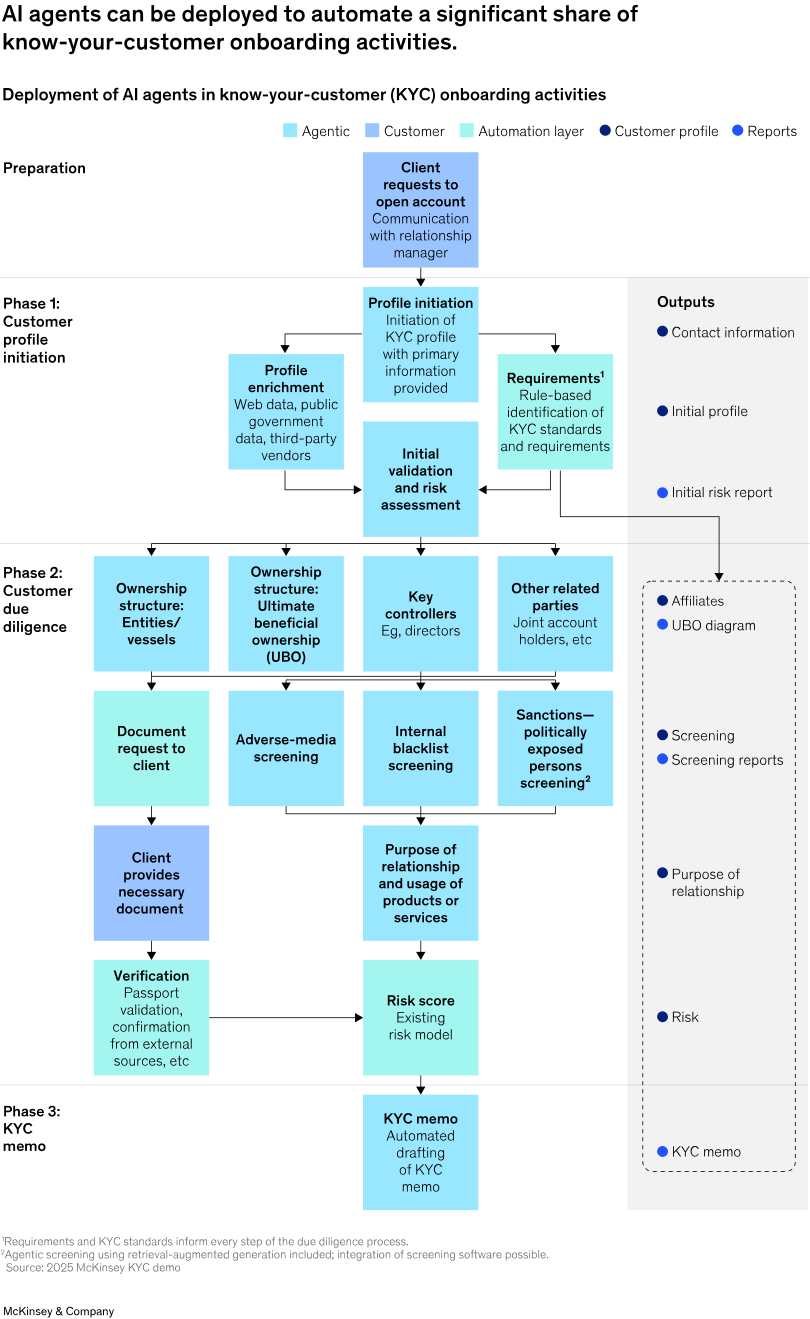
- Autonomous financial crime resolution. AI agents can continuously monitor transactions in real time, profile behaviors, and detect suspicious patterns at a level of granularity that was previously impossible (Exhibit 1). They can automatically draft alerts, resolve low-risk cases, and route complex cases to human investigators with prebuilt case files. In CIB, agentic know-your-customer (KYC) and anti-money-laundering systems are already helping accelerate client onboarding and improve the accuracy of sanctions screening.
- Next-generation functioning. Across corporate operations, agentic AI is eliminating swaths of routine work. In finance, agents can gather data, reconcile sources, generate draft budgets, and run scenario models in minutes. In HR, they can screen résumés, schedule interviews, and manage onboarding workflows. Similar gains are emerging in procurement, legal, and compliance.
- AI-enabled risk management. Agentic systems can test risk controls in real time, detect anomalies, and launch remediation workflows without waiting for periodic reviews. For credit risk, agents can manage data collection, run credit models, draft underwriting memos, and monitor portfolios, alerting officers when exposures shift or risks emerge.
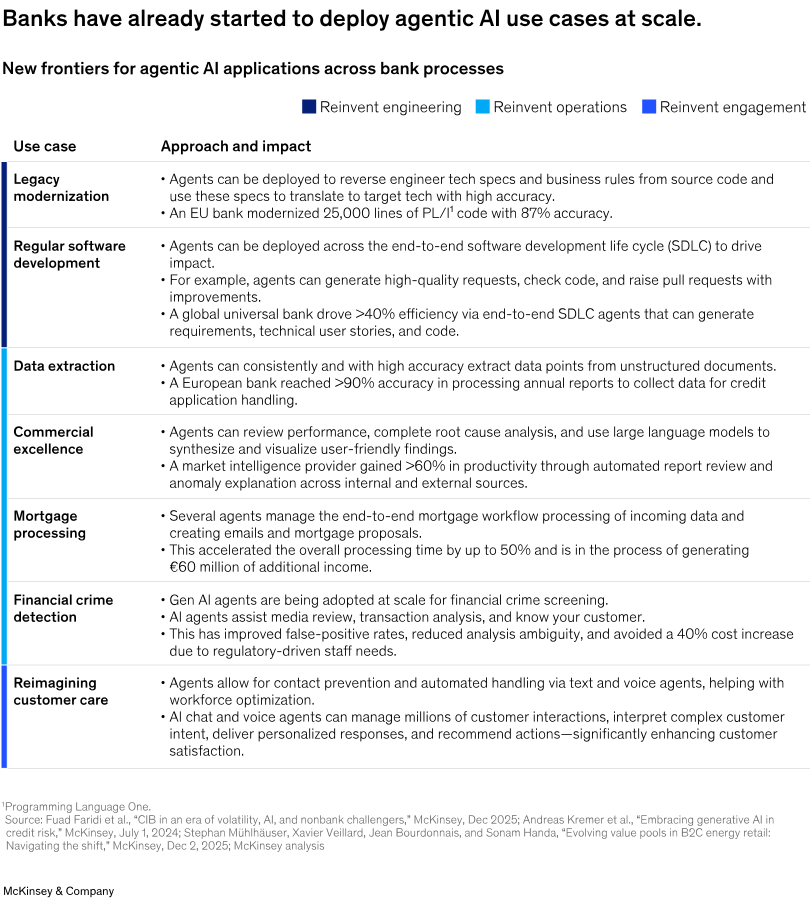
- Agentic product and technology factories. Perhaps the most transformative impact is in technology delivery. Human and AI agent teams can dramatically accelerate product development by automating coding, testing, documentation, and other processes. Agents can also map and modernize legacy systems, discovering new processes, analyzing dependencies, and generating updated code or documentation (Exhibit 2). For many banks, this represents the first scalable pathway to addressing technical debt while simultaneously speeding time to market.
Evergreen levers
Traditional levers for corporate change remain important for a bank’s operational improvement. Accounting for up to two-thirds of efficiency initiatives,1 these levers improve productivity, drive cost reductions across the value chain, and are embedded practices at even the most cautious banking institutions:
- Client coverage optimization. Leading banks are restructuring client service models with high-touch and low-touch categories. This includes reallocating banker capacity with specialist-product bankers assigned to high-value clients, and junior staff or self-service tools assigned to mid- to low-value clients. Digital platform investments can help with such changes by enhancing customer experiences with user-friendly interfaces and advanced account features.
- Global operating and delivery model efficiency. Banks are increasingly leveraging global talent pools to optimize costs and scale operations by relocating junior and support staff to lower-cost locations, realigning seniority pyramids to reduce overstaffing of senior roles, and streamlining workflows such as deal tracking and client data management. One major global CIB, for instance, expanded its Poland center tenfold over five years, while another European bank grew its operation eightfold. Similarly, several European banks have relocated middle- and back-office activities to Portugal.
- Systematic performance management. CIBs can establish mechanisms across their organizations to monitor the performance distribution curve for workforces and ensure that the curve remains stable over time. Additionally, strong performance management plans can help companies retain top talent—a key asset in achieving strategic ambitions.
- Challenging legacy practices. Banks must revisit and question longstanding assumptions and entrenched ways of working, things that often linger after they no longer deliver real value. Such a review can have three parts: looking at process outputs to determine if they genuinely still inform business or control decisions; reviewing the uniqueness of a process or deliverable with an eye toward eliminating redundancies; and doggedly questioning the value added of each step in a process.
- Third-party spend optimization. Strict expense management and rationalization of third-party spending are critical levers for driving efficiency and implementing stricter controls on contractor costs and travel budgets. Cost reductions can be achieved by renegotiating brokerage fees, optimizing intraday liquidity requirements, and rationalizing spending across market data, travel and expenses, legal, recruitment, and marketing.
Tech operating model transformation. Banks are rethinking tech operating models to better enable seamless collaboration across business, technology, and support functions. This E2E rewiring ensures that organizations can focus on top priorities while minimizing nonessential investments.
A large American bank, for example, has adopted a product and platform operating model where teams are organized around specific products and shared technology platforms. Such a model can significantly reduce time to market. It also can provide a 15 to 20 percent boost in research and development productivity, and a 20 to 30 percent reduction in quality issues—all within 12 to 18 months.
- Platform play. Banks are looking for external plug-and-play platforms that offer outsourcing of integrated IT functions and business process services. This shift enhances operational flexibility and reduces costs.
The impact of change
CIBs can position themselves to thrive in an increasingly competitive environment by combining traditional efficiency measures with innovative technologies and modernized operating models. This approach will drive significant cost savings while ensuring agility, resilience, and sustained growth in a rapidly changing financial ecosystem:
- Faster adaptation to client needs. Process simplification is a prerequisite for efficient CIB adaptation. Some leading banks are combining the streamlining of existing practices with enhanced customer experiences through easier, faster, and more flexible user interfaces. Process simplification can also accelerate product delivery by making it easier to rearrange priorities, accelerate development of apps, and reduce testing needs. Some banks have reduced delivery times on projects by up to 30 percent. This capability is crucial for CIBs to quickly and effectively respond to emergencies and capitalize on opportunities with minimal delay.
- Control enhancement. Establishing clearer business routines and simplifying key contributions can lead to a significant improvement of quality controls. Some banks leverage process simplification to improve line-of-defense efficiencies and better secure due enforcement of regulations.
- Optimized technology spending. Banks can reduce portfolio and labor inefficiencies by up to 20 to 30 percent by eliminating unnecessary tech expenditures and redirecting investments toward new high-priority objectives and results.2 This ensures that resources are allocated to high-impact initiatives, driving both innovation and cost efficiency.
In sum, radical simplification can be tailored to address the unique needs of each bank. The approach works for targeted transformations within specific domains or business lines, or comprehensive, organization-wide overhauls.
CIBs, however, have historically struggled to fully embrace transformative change for several reasons:
- Shaking the past. Operational complexity from business, technological, and human legacies is hard to overcome in any industry. The banking industry’s reliance on high-end talent and nuanced human judgment also makes it difficult to codify or automate decision-making processes that improve efficiency.
- Volatile market and regulatory environments. Constantly shifting market structures and regulatory requirements complicate the timing and execution of simplification efforts.
- Technology limitations. While promising, technology often proves difficult and costly to adapt to the bespoke needs of CIBs, leading to hesitation in the reimagining of operating models.
To overcome these barriers, CIBs must adopt a strategic, holistic approach to transformation that balances ambition with pragmatism:
- Start with the basics. Banks need to challenge everything to find and tackle the source of problems. Firms must undertake a systematic mapping of processes, identify key activities linked to systems, and make sure teams know the right starting point and can prioritize transformational actions. This initial mapping is a practice used by several banks across multiple projects to maximize impact.
- Keep value creation objective. This approach systematically combines cost reductions and customer satisfaction enhancement to unlock new sources of value. Banks should pursue market best practices, appropriate technology advancements, and a current understanding of client needs.
- Reimagine the operating model. Go beyond tools and workflows to fundamentally rethink human interaction loops, economic models, and the overall operating structure. Addressing these foundational elements is essential to capturing the full value of change.
- Secure financial sustainability. Structure actions to generate significant quick wins, securing both the internal reputation of the program and a self-funding equation for immediate payback. A focus on quick wins reduces the chance of a tunnel effect and accelerates project delivery metabolism.
- Prioritize robust change management. Engage all stakeholders—market participants, investors, boards, and employees—to align on a shared vision for the new operating model. Address skepticism early on and focus on execution to prevent promising initiatives from stalling or being dismissed prematurely.
By embracing a bold yet disciplined approach to simplification, CIBs can unlock significant productivity gains, enhance their competitive edge, and position themselves for long-term success in an increasingly dynamic and demanding environment. The time to act is now.