




Industrial heat represents nearly two-thirds of global industrial energy consumption and a significant share of operating costs for many sectors.1 Electrifying heat generation has long been technically feasible, but in most markets the economics have not stacked up, constrained by high up-front capital expenditures, electricity prices, and grid fees.
To assess how evolving European power market dynamics affect this equation, we modeled the internal rate of return (IRR) of an eight-hour thermal energy storage (TES) system across six European countries in 2030.2 The analysis incorporates grid fee structures and additional value streams, such as intraday trading and ancillary services.
Our findings suggest that the business case for industrial heat electrification is strengthening. In most markets assessed, projected returns approach or exceed typical industrial hurdle rates under expected 2030 conditions. As the economics improve, however, scaling electrified heat may depend not only on technology costs but also on how industrial players address capital exposure, market participation, and capability requirements.
Shifting energy market fundamentals
With the ongoing integration of renewable energy sources (RES) into the European power grid, electricity price volatility is likely to continue. McKinsey analysis suggests European markets with a high share of renewable power generation could see a rise in annual price standard deviation of between 60 and 170 percent, a significant increase in price swings.3 At the same time, fossil fuel prices remain volatile, impacted largely by geopolitical shocks and a heavy reliance on imports.4
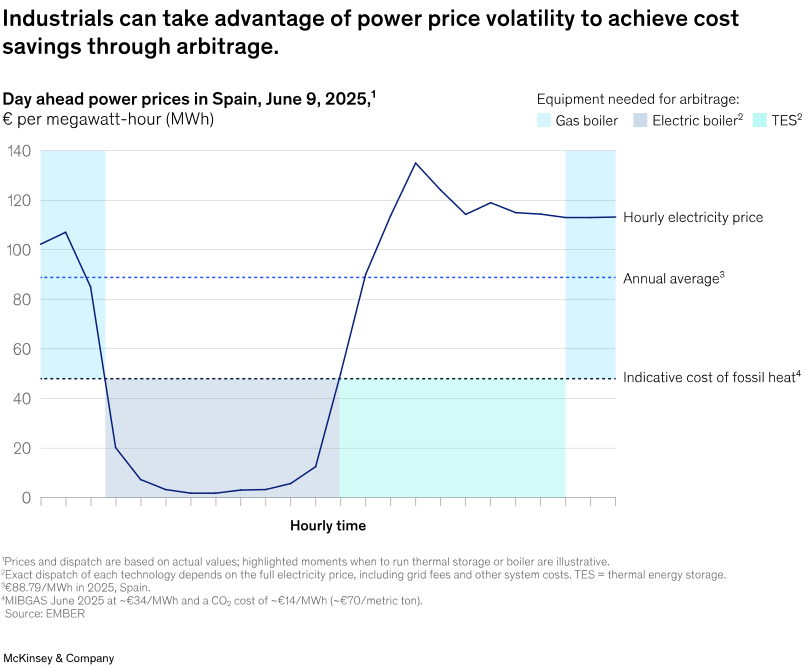
In several European markets, day-ahead electricity prices are already lower than gas (including CO₂ costs) 15 to 40 percent of the time, even after transmission and distribution charges.5
Thermal energy storage allows industrial players to capture this price spread by storing low-cost electricity and using it when needed. This ability to decouple heat production from real-time power prices can materially improve project returns.6
Installing electric boilers and TES alongside gas infrastructure can allow operators to switch between fuels based on price and store low-cost electricity (Exhibit 1).
The strengthening business case for heat electrification in Europe
To understand what the business case for heat electrification looks like across key European markets, we assessed the IRR of an eight-hour TES system in six European countries in 2030.7
Our analysis found that IRRs of more than 15 percent are achievable in most countries assessed (Exhibit 2).8 This includes the impact of grid fee discounts, as well as potential upside from intraday trading and ancillary services.9 In practical terms, this places TES investments within or above the hurdle rates of many industrial players.10 Spain emerged as the country with the strongest business case, with an estimated IRR of around 20 percent for an eight-hour TES system by 2030, even without any additional trading upside or grid fee discounts.
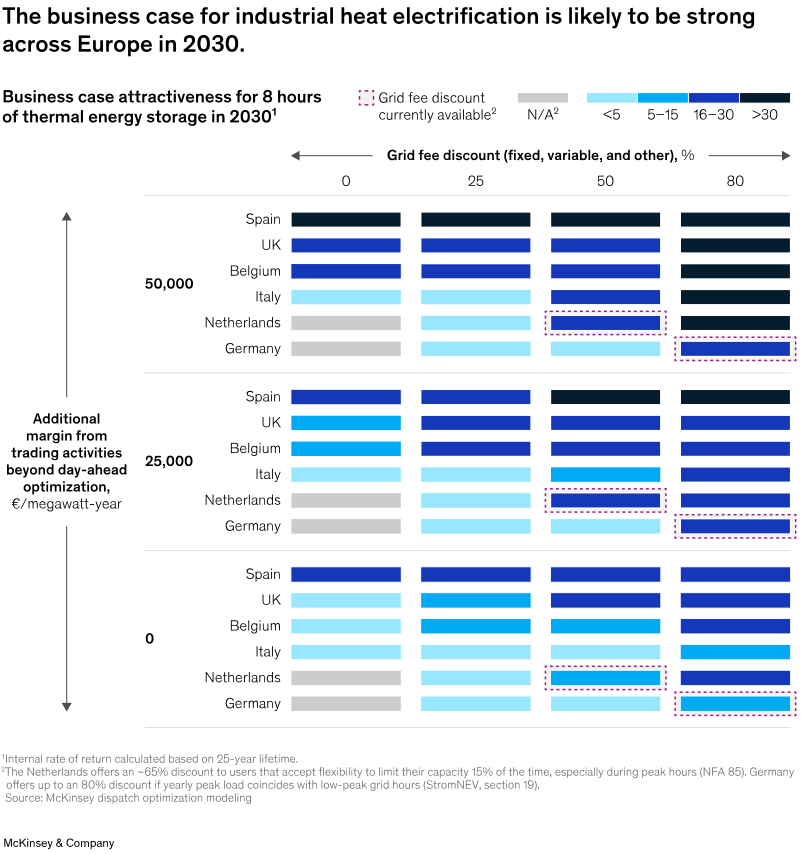
Favorable grid fees and additional revenue streams support the business case for industrial heat electrification in many European countries. Grid fee discounts can materially improve project economics. High grid fees narrow the price difference between electricity and gas (including CO₂ costs), which reduces the savings that electrification can capture. Germany and the Netherlands already offer substantial grid fee discounts, and Europe is moving toward more dynamic electricity pricing structures, potentially further improving heat electrification business cases.11
An additional revenue stream could arise from industrial participation in short-term markets beyond day-ahead, as well as from ancillary services.12 Together, these incremental high-margin value streams strengthen the financial viability of heat electrification.
Thermal energy storage in Europe is poised to scale rapidly
Our analysis suggests that TES deployment in Europe has the potential to grow rapidly. If TES for industrial use scales in a similar way to battery energy storage systems (BESS), we estimate that TES storage capacity in Europe could grow from less than 0.5 gigawatt-hours (GWh) today to more than 200 GWh by 2035, representing a cumulative capital expenditure (capex) deployment opportunity of around €16 billion.
Several large-scale installations have already been announced or installed. Heineken has contracted a 100 megawatt-hour (MWh) heat battery project from Rondo Energy at its Lisbon brewery. It is expected to be the largest heat battery in the global beverage industry.13 In Denmark, Hyme Energy is seeking EU funding for a 200 MWh thermal storage system for Arla Foods, which could potentially be the world’s largest industrial thermal storage system. And in Hungary, a 56 MWh thermal energy storage system from Kyoto Group provides steam at a major corn processing plant, providing low-cost industrial heat at scale.14
How industrials and energy players could seize the opportunity
The case for industrial heat electrification is compelling, but to capitalize on the opportunity, European industrials need to consider challenges in three key areas:
- Managing capital exposure. The high up-front capex required for TES systems can be a barrier to adoption, especially as storage duration increases. Industrial operators often seek short payback periods, which is difficult given the long-term nature of industrial electrification projects.
- Navigating system complexity. The complexity of obtaining grid fee discounts and securing electrification incentives add further challenges. For instance, obtaining grid fee discounts usually requires load shifting, which in turn, requires potentially complex changes to day-to-day operations.
- Building and accessing capabilities. Many industrials lack the specific capabilities needed to optimize power pricing markets (for example, in energy trading) and to navigate value chain complexity for implementation. Long grid connection queues can also discourage implementation and investment.
This is not only a technology shift for European industrials but also a business model shift. In executing a TES strategy, companies face choices: build electrification and market-optimization capabilities in-house, form selective partnerships, or use end-to-end third-party models such as heat-as-a-service (HaaS).
HaaS structures bundle financing, technical integration, market participation, and operational risk management into a single offering, addressing up-front capex, as well as the trading, regulatory, and execution complexity inherent in industrial heat electrification. Under these models, providers typically offer heat at a contracted price per megawatt-hour, assuming performance and market risk.
As market conditions evolve, the pace of industrial heat electrification is likely to depend not only on technology economics but also on how these commercial models develop.
The business case for industrial heat electrification in Europe using TES is steadily growing, and market conditions could become even more favorable in the years ahead. Industrials that forge strategic partnerships now to take advantage of this opportunity could unlock significant value, while also contributing to Europe’s net-zero goals.
The authors wish to thank Adrian Pelz, Ken Somers, Romana Pilepich, and Yves Gulda for their contributions to this blog post.
1 “Tackling heat electrification to decarbonize industry,” McKinsey, December 2, 2024.
2 Thermal energy storage systems act like heat batteries, converting electrical energy into heat, storing it, and delivering it on demand to industrial processes.
3 “Improving B2B energy propositions: Four trends reshaping the industry,” McKinsey, January 27, 2025.
4 Gergely Molnar and Carlos Fernández Alvarez, “What drives natural gas price volatility in Europe and beyond?,” International Energy Agency, July 21, 2025.
5 McKinsey analysis based on Eurostat and Ember wholesale electricity price data; “European wholesale electricity price data,” Ember.
6 “Unlocking Europe’s €8 billion energy flexibility opportunity,” McKinsey, October 16, 2025.
7 Belgium, Germany, Italy, the Netherlands, Spain, and the United Kingdom.
8 Analysis was conducted using proprietary 2030 day-ahead curves and holding expected 2030 operating expenditure savings constant over a 25-year project lifetime. To further test the business case and understand the factors driving it, we calculated internal rates of return (IRRs) for e-boilers alone, multiple durations of thermal energy storage (TES systems), and multiple time horizons, all underpinned by a detailed analysis of grid fees for large industrial companies.
9 To put this in perspective, battery assets could have realized up to €100,000 to €200,000 megawatts per year (MW/year) in Germany in 2024 to 2025 by cross-optimizing across merchant trading and ancillary services, while frequency response revenues in the United Kingdom were at approximately €26,000 MW/year in 2025. Enspired blog, “Monthly portfolio performance updates & market trends 2024–25,” October 21, 2025; Zach Williams, “Germany: Europe’s biggest merchant market—but why isn’t investment pouring in?,” Modo Energy, June 13, 2025; and Zach Jennings, “ME BESS GB: Revenues fall to £59k/MW/year in November 2025,” Modo Energy, December 4, 2025.
10 Grid fee discounts are reduced network charges for flexible electricity users, such as thermal energy storage (TES) systems that shift demand away from peak periods, relieve grid congestion, and unlock existing capacity without requiring new infrastructure. Such schemes are already available in several European countries, including Germany and the Netherlands.
11 McKinsey analysis based on data from ACER Europe; ACM Energy; ARERA (the Italian Regulatory Authority for Energy, Networks and Environment); Aurora; BNetzA; BOE; CNMC (China Nonferrous Metal Mining Group); Elia; EU Commission; and TenneT.
12 Note that ancillary service markets are “shallow” in the sense that while they can improve the business case substantially today, as penetration of TES increases, supply and demand dynamics will come into play and reduce revenues. When this happens, the business case for industrial heat electrification will largely depend on day-ahead dynamics, which are expected to remain volatile and thus support the business case.
13 “Rondo Energy to deploy 100 MWh heat battery for HEINEKEN, powered by solar from EDP,” Rondo, November 3, 2025.
14 Cameron Murray, “Hyme seeking EU funds for ‘world’s largest industrial thermal storage’ system in Denmark,” Energy Storage News, January 6, 2025; and Andy Colthorpe, “Kyoto Group’s 56 MWh thermal energy storage system replaces natural gas at corn processing plant in Hungary,” Energy Storage News, October 14, 2025.