Despite the ongoing increase in market share for electric vehicles (EVs), sales growth has slowed in many regions after years of rapid expansion. Consumer behavior is one important piece of the EV adoption puzzle, say Senior Partner Philipp Kampshoff and coauthors. Our annual mobility survey revealed that the price difference between comparable internal combustion engine (ICE) vehicles and battery electric vehicles (BEV) factors into purchasing decisions. In Europe and the United States, only about a third of respondents say they would accept a BEV premium.
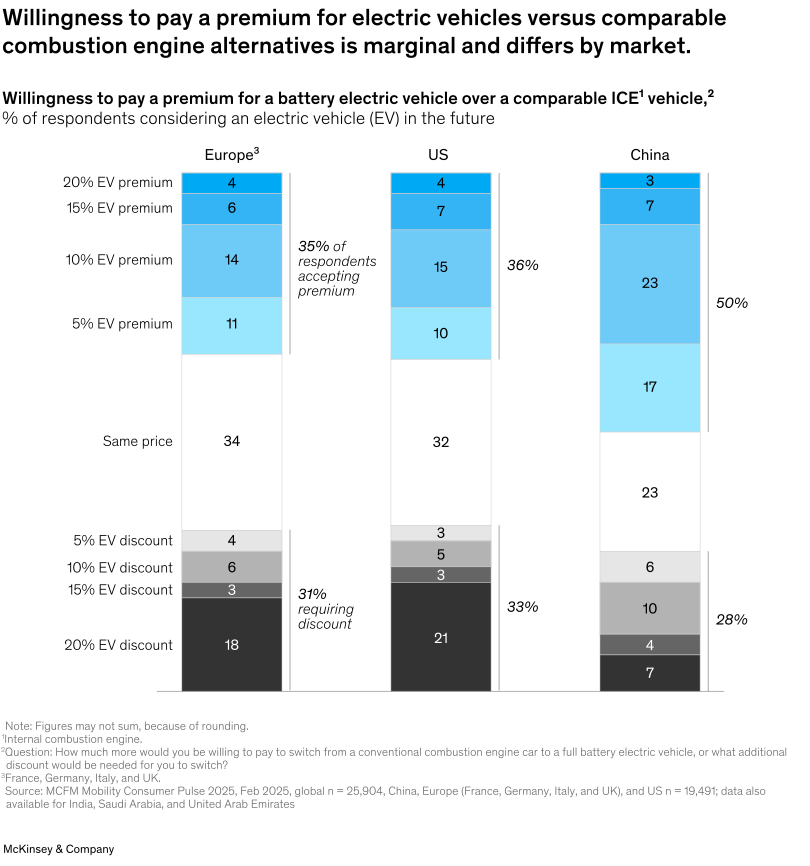
Image description:
A stacked bar chart displays consumers’ willingness to pay a premium or accept a discount for a battery electric vehicle (BEV) compared with a comparable internal combustion engine (ICE) vehicle, based on survey responses from China, Europe, and the US. The chart shows the percentage of respondents considering an EV in the future who would accept various price differences. In Europe, 34% of respondents would accept the same price for a BEV as an ICE vehicle, while 11%, 14%, 6%, and 4% would pay a 5%, 10%, 15%, and 20% premium, respectively. Conversely, 18%, 3%, 6%, and 4% would require a 20%, 15%, 10%, and 5% discount, respectively. The US shows similar patterns, with 32% accepting the same price, 10%, 15%, 7%, and 4% willing to pay premiums of 5%, 10%, 15%, and 20%, respectively. Discounts were required by 21%, 3%, 5%, and 3% for the same percentages as Europe. China shows 23% accepting a BEV at the same price as an ICE vehicle, and 17%, 23%, 7%, and 3% willing to pay a 5%, 10%, 15%, and 20% premium, respectively. Conversely, 6%, 10%, 4%, and 7% would accept a BEV with discounts of 5%, 10%, 15%, and 20%, respectively.
Note: This image description was completed with the assistance of Writer, a gen AI tool.
Source: MCFM Mobility Consumer Pulse 2025, Feb 2025, global n = 25,904, China, Europe (France, Germany, Italy, and UK), and US n = 19,491; data also available for India, Saudi Arabia, and United Arab Emirates.
End of image description.
To read the article, see “New twists in the electric-vehicle transition: A consumer perspective,” April 22, 2025.