The global trade system is on the brink of major change, but patterns differ significantly across scenarios. In the baseline scenario, by 2035, trade corridors between emerging markets and China could grow 4–5 percent annually, while those involving advanced economies could grow at 2 percent. In a fragmentation scenario, trade between China and advanced economies could drop significantly, but trade among advanced economies would accelerate, according to Senior Partner Olivia White and coauthors. And while trade between China and emerging markets would grow faster under fragmentation, it would slow under diversification compared with baseline.
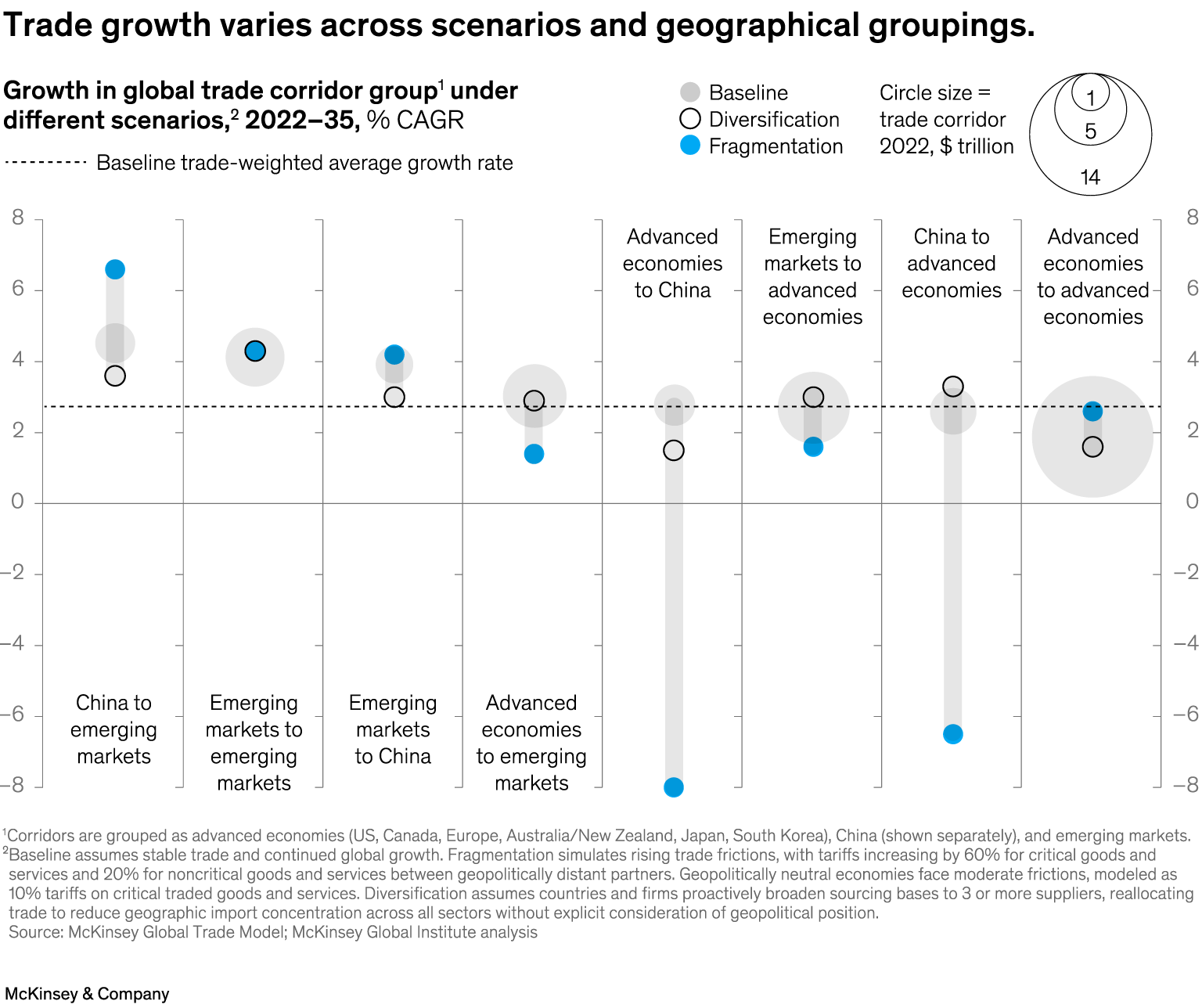
Image description:
A bubble chart illustrates the growth in global trade corridor groups under different scenarios from 2022 to 2035, measured as a percentage of CAGR. The chart is divided into 8 categories of trade corridors: China to emerging markets, emerging markets to emerging markets, emerging markets to China, advanced economies to emerging markets, advanced economies to China, emerging markets to advanced economies, China to advanced economies, and advanced economies to advanced economies. Each category contains 3 bubbles representing the baseline, diversification, and fragmentation scenarios. The size of the bubbles corresponds with the trade corridor’s value in 2022, with larger bubbles indicating larger trade values. The baseline scenario assumes stable trade and continued global growth, with growth rates ranging from approximately 3% to 5%. The diversification scenario shows varied growth rates, with some corridors experiencing lower growth, such as advanced economies to China at around 2%, while others remain relatively stable. The fragmentation scenario reveals more pronounced variations, with growth rates ranging from around –8% to over +6%, and some corridors, like advanced economies to China and China to advanced economies, experiencing a decline to around –8% and –6%, respectively.
Note: This image description was completed with the assistance of Writer, a gen AI tool. Source: McKinsey Global Trade Model; McKinsey Global Institute analysis.
End of image description.
To read the article, see “A new trade paradigm: How shifts in trade corridors could affect business,” June 18, 2025.