Global trade is undergoing significant change. Senior Partner Sven Smit and coauthors use a “rearrangement ratio” to gauge the feasibility of shifting US imports away from China. A high ratio indicates difficulty and a low ratio indicates easier substitution. They found that basic manufacturing sectors have higher US–China rearrangement ratios, since China is a major supplier and the United States is an outsize buyer. Therefore, tariff pressure to rearrange trade is likely to be higher in sectors that are the most difficult to rearrange.
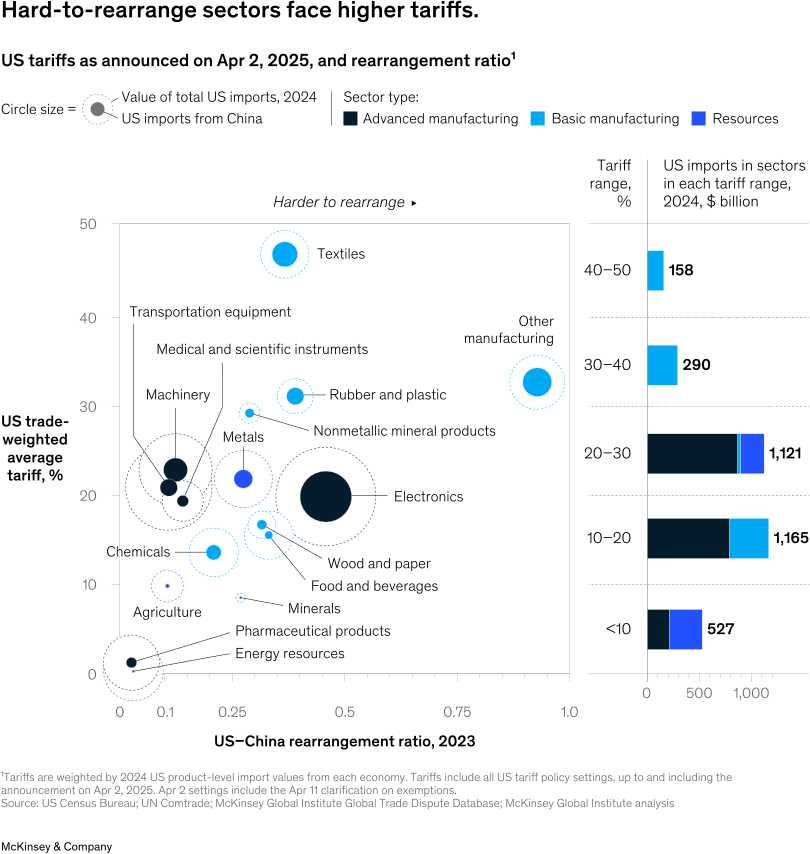
Image description:
A bubble chart shows the relationship between US tariffs as announced on April 2, 2025, and the rearrangement ratio, with a bar chart on the right displaying the tariff range and US imports in each range. The bubble chart’s y-axis represents the US trade-weighted average tariff percentage, ranging from 0 to 50, while the x-axis represents the US–China rearrangement ratio in 2023, ranging from 0 to 1.0. The size of each bubble corresponds to the value of total US imports in 2024. Sectors are categorized into 3 types: advanced manufacturing, basic manufacturing, and resources. The chart shows that sectors such as textiles, rubber and plastic, and other manufacturing have higher tariffs, between 30 and 50%, and are considered harder to rearrange, with ratios above 0.5. In contrast, sectors such as agriculture, pharmaceutical products, and energy resources have lower tariffs, below 10%, and are easier to rearrange, with ratios below 0.25. The accompanying bar chart illustrates the distribution of US imports across different tariff ranges, with $158 billion in the 40 to 50% range, $290 billion in the 30 to 40% range, $1,121 billion in the 20 to 30% range, $1,165 billion in the 10 to 20% range, and $527 billion in the less than 10% range.
Note: This image description was completed with the assistance of Writer, a gen AI tool.
Source: US Census Bureau; UN Comtrade; McKinsey Global Institute Global Trade Dispute Database; McKinsey Global Institute analysis.
End of image description.
To read the article, see “The great trade rearrangement,” June 25, 2025.