Disruptor OEMs are deploying new operating models that can accelerate performance and outpace incumbents. For example, Chinese OEMs producing battery electric vehicles (BEVs) in 2020 were on cost parity with established European and US OEMs. Now, the Chinese OEMs have cut costs by up to 20 percent compared with their peers, Senior Partner Tomas Nauclér and colleagues explain. Across sectors, disruptor OEMs have also managed to innovate at a pace that is two to three times faster than established OEMs.
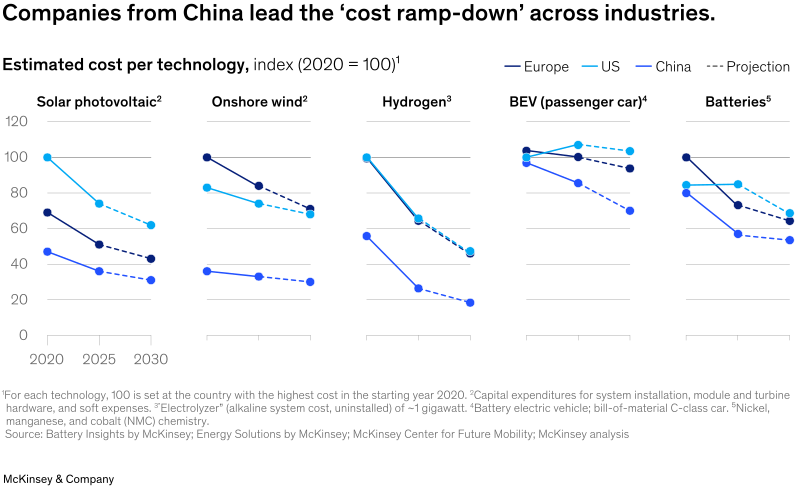
Image description:
A series of 5 line charts illustrates the estimated cost per technology across various industries, indexed to a baseline of 100 in 2020, representing the country with the highest cost that year. The charts compare costs in Europe, the US, and China for solar photovoltaic, onshore wind, hydrogen, battery electric vehicles (BEVs) for passenger cars, and batteries. The data shows a general downward trend in costs over time across all regions and technologies, with some variations. For solar photovoltaic, the costs in Europe and the US start higher and decrease, while China's costs are lower and continue to decline. For onshore wind, the US has the highest initial cost, decreasing over time, while Europe and China show similar trends. The cost of hydrogen production is highest in Europe and the US and decreases significantly, with China following a similar trajectory. For BEVs, costs are highest in Europe and decrease. The US shows increasing costs for BEVs that may decline by 2030, and China shows lower costs with a continued decline. The charts include projections for future years, indicating continued cost reductions across all technologies and regions.
Note: This image description was completed with the assistance of Writer, a gen AI tool.
McKinsey Battery Insights; McKinsey Center for Future Mobility; McKinsey Global Energy Insights; McKinsey Hydrogen Insights.
End of image description.
To read the article, see “‘Innovation Execution’—a new industrial paradigm emerges,” September 4, 2025.