The built environment makes up nearly 40 percent of global energy-related CO2 emissions. However, the use of circularity—a process that shifts a value chain from take, make, and dispose to one that continually reuses and repurposes materials to minimize waste and optimize resources—could abate as much as 13 percent of the built environment’s carbon emissions by 2030, Senior Partner Daniele Chiarella and coauthors explain. Some global industries, such as aerospace, automotive, and medical, have already demonstrated extensive adoption of circularity practices.
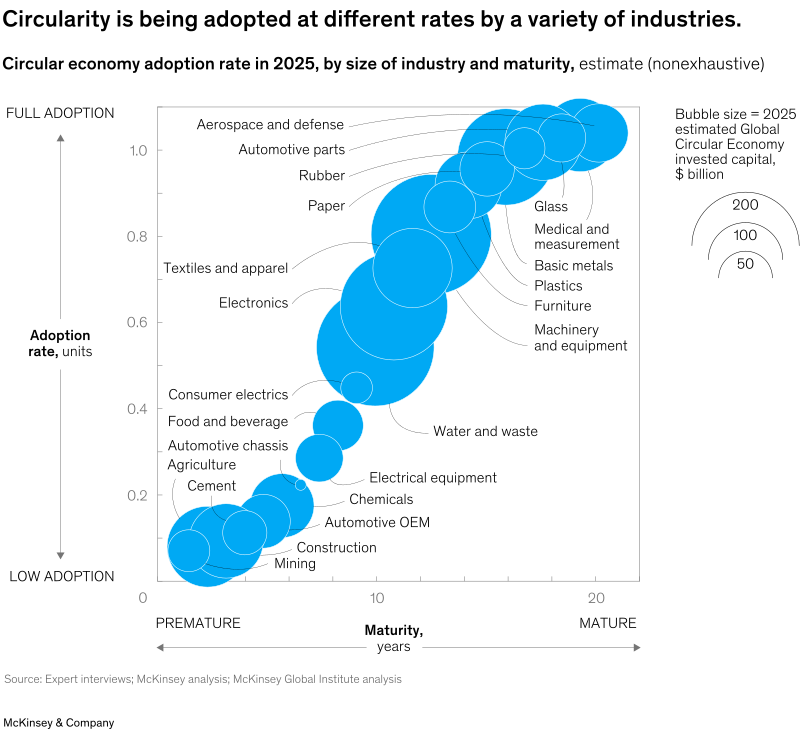
Image description:
A scatter plot shows the circular economy adoption rate in 2025, by size of industry and maturity. The vertical axis is labeled “Adoption rate, units,” ranging from 0 to 1.0, with “Full adoption” at the top and “Low adoption” at the bottom. The horizontal axis is labeled “Maturity, years,” ranging from 0 to 22, with “Premature” on the left and “Mature” on the right. Each industry is represented by a blue bubble, with the size of the bubble corresponding to the estimated global circular economy invested capital in 2025. A legend shows bubble sizes representing $50 billion, $100 billion, and $200 billion. The industries are scattered across the plot, with aerospace and defense, automotive parts, rubber, and paper having high adoption rates and maturity. Textiles and apparel and electronics are in the midrange. Mining, construction, automotive OEM, and cement have low adoption rates and maturity. Industries including glass, medical and measurement, basic metals, plastics, furniture, and machinery and equipment have high maturity, but vary widely in adoption rates. Water and waste, electrical equipment, and chemicals are in the midrange for maturity and adoption rate.
Note: This image description was completed with the assistance of Writer, a gen AI tool.
Source: Expert interviews; McKinsey analysis; McKinsey Global Institute analysis.
End of image description.
To read the article, see “How circularity can make the built environment more sustainable,” May 16, 2025.