Africa’s financial markets are among the most dynamic in the world, buoyed by high interest rates and growth in noninterest income. With a market size of $107 billion in 2025, Africa’s banking sector is sizable but concentrated: About 70 percent of the sector’s revenues are generated by five markets, led by South Africa and Egypt, McKinsey’s Carolyne Gathinji, Mayowa Kuyoro, Mohan Sambandan, Umar Bagus, and colleagues note. Double-digit growth in smaller markets, however, signals that new frontiers may be opening.
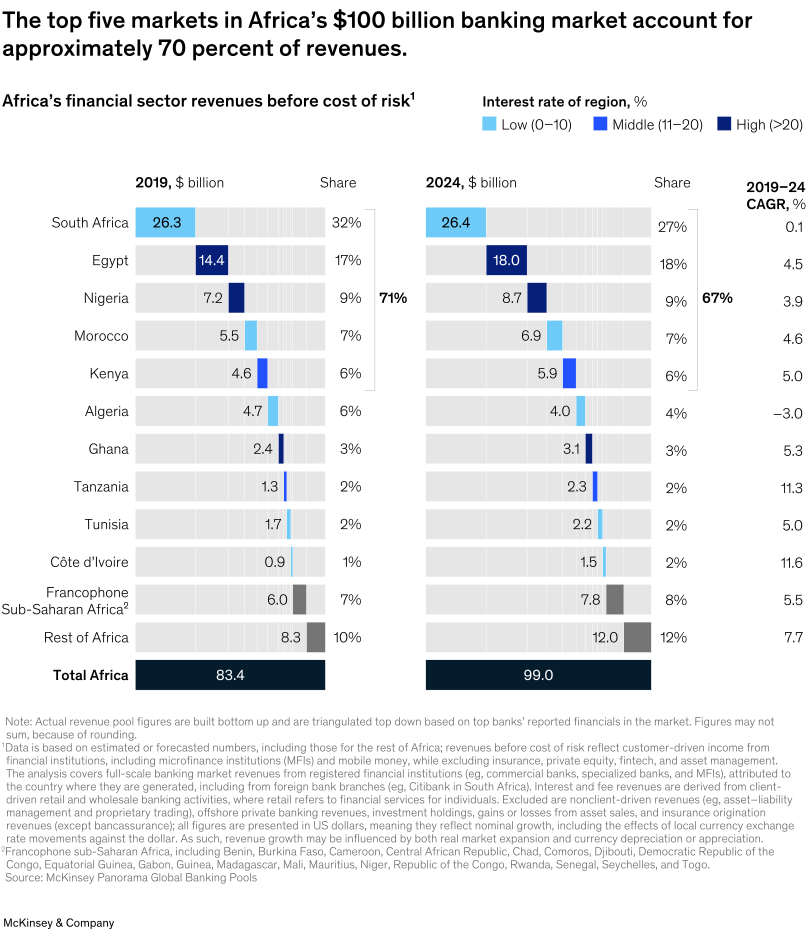
Image description:
A bar chart compares Africa’s banking-sector revenues before cost of risk in 2019 versus 2024, measured in billions of US dollars and share of total African revenues. Total African banking revenues increased from $83.4 billion in 2019 to $99.0 billion in 2024. The five largest markets—South Africa, Egypt, Nigeria, Morocco, and Kenya—represented 71% of revenues in 2019 and 67% in 2024.
In 2024, South Africa remained the largest market at $26.4 billion (27% share), followed by Egypt at $18.0 billion (18%), Nigeria at $8.7 billion (9%), Morocco at $6.9 billion (7%), and Kenya at $5.9 billion (6%). A CAGR column for 2019–24 shows the strongest growth in Côte d’Ivoire (11.6%), Tanzania (11.3%), and the rest of Africa (7.7%), while Algeria declined by 3.0%. Color coding indicates regional interest-rate environments: low (0–10%), middle (11–20%), and high (>20%).
Note: This image description was completed with the assistance of Writer, a gen AI tool.
Source: McKinsey Panorama Global Banking Pools.
End of image description.
To read the report, see “From potential to performance: A snapshot of African banking,” March 31, 2026.