

Traditionally, technology resilience meant anticipating failure. Companies invested in redundant infrastructure, backup data centers, disaster recovery plans, and failover mechanisms to ensure continuity during outages. For decades, this model worked. Applications were relatively monolithic, infrastructure changes were infrequent, and failure modes were largely predictable. Those days are over.
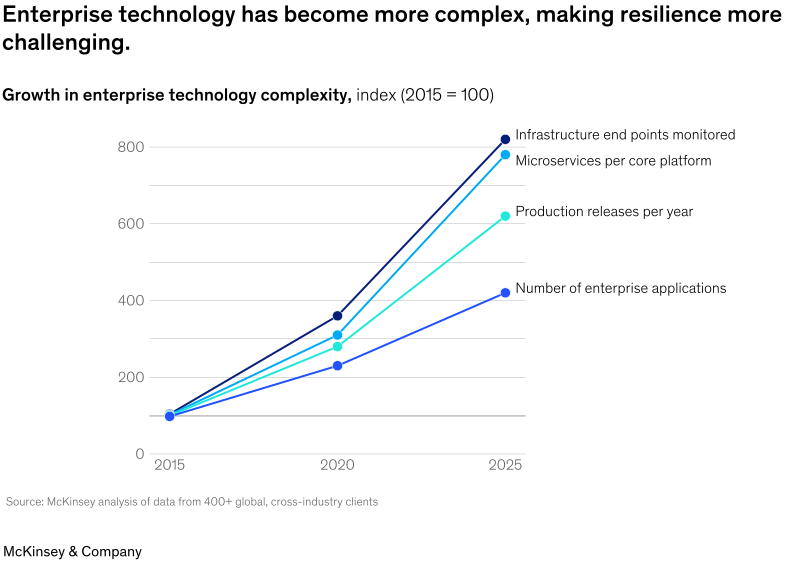
Enterprise technology has become so complex that traditional resilience strategies alone cannot keep pace. Systems today are highly distributed, multicloud, API-driven, and integrated across fintech, software as a service (SaaS), and AI services (Exhibit 1). As applications scale across thousands of microservices and process millions of transactions, outages rarely present as single points of failure. Instead, they emerge as cascading patterns triggered by subtle interactions among services, configurations, and workloads. Detecting these patterns early is difficult for humans, and remediating them manually slows down business growth.
In this complex new operating environment, AI is emerging as the foundation of next-generation resilience. That’s because resilience is no longer about responding to failure as it happens; it’s about forecasting potential incidents before they materialize and enabling infrastructure to self-heal. AI, especially agentic AI, is adept at this automated predict-and-fix work.
A structural shift in how resilience is engineered
With AI-driven resilience, systems continuously observe their own behavior through telemetry spanning applications, infrastructure, networks, and deployments. Machine learning (ML) models learn from this data to identify early anomalies and recurring failure signatures, often before traditional thresholds are breached. When agentic AI is deployed, detection is directly connected to action. Automated remediation engines can initiate recovery steps proactively without waiting for incident escalation or human approval.
Technical foundations of AI-driven resilience
For CIOs, achieving AI-first resilience is not about adding intelligence at the margins but about redesigning the technical foundations of resilience itself, starting with how systems observe, decide, and act. Four steps help organizations embark on this journey.
Predictive telemetry engineering
Modern applications generate enormous volumes of telemetry across logs, metrics, traces, network traffic, database activity, system health, and deployment events. Historically, this data supported monitoring and alerting after problems emerged. But AI can fundamentally change telemetry by turning it into a predictive signal rather than a retrospective record.
To establish AI-powered telemetry, organizations can deploy ML models to analyze patterns across data streams. This can help identify early indicators of degradation, such as subtle latency drift, emerging queue congestion, or the memory fragmentation that precedes instability. Large language models (LLMs) can further enhance this capability by interpreting unstructured data at scale, parsing millions of log events, surfacing likely causes, and comparing current behavior with historical failure patterns. Forecasting models add a forward-looking dimension, predicting demand surges or resource contention in advance of occurrence and enabling proactive capacity adjustments without chronic overprovisioning.
Automated remediation and self-healing systems
Prediction alone does not deliver resilience unless systems are empowered to respond. AI can enable an execution layer in which detection and remediation are linked. When AI models identify emerging risk, agents can trigger corrective actions automatically rather than waiting for a human to escalate the situation.
In practice, this includes restarting “unhealthy” services when anomalous behavior is detected, redirecting traffic across regions using predictive routing, and isolating degraded or compromised workloads through temporary segmentation. It also entails adjusting autoscaling parameters based on learned demand patterns or rolling back deployments that correlate with instability. These agent-based actions occur within predefined guardrails without requiring human approval for routine scenarios. This represents a clear departure from the traditional “alert and wait” model. The objective shifts toward zero-touch recovery, in which systems autonomously resolve common failure modes and human operators intervene only when truly novel conditions arise.
Resilience-aware platform engineering
AI can also be used to reshape the architectural layer on which resilience is built, particularly in cloud-native environments. Over the past decade, resilience has begun evolving from a reactive practice into a predictive, AI-native capability. Platform components that were once statically configured can become adaptive.
Kubernetes clusters, for example, can continuously rebalance workloads using ML-driven placement algorithms that reduce correlated failure risk. Load balancers can reroute traffic based on predicted saturation rather than static thresholds. FinOps engines increasingly balance cost, performance, and availability dynamically, avoiding the trade-offs imposed by fixed provisioning policies. Automated chaos experimentation platforms further strengthen resilience by continuously simulating failures and feeding observed outcomes back into system tuning. Resilience thus evolves from architecture plus redundancy to architecture plus adaptive intelligence that improves over time.
Autonomous security and zero-trust enforcement
As systems become more interconnected, operational resilience and cyber resilience converge. AI can strengthen both simultaneously. It does this by shifting security from static controls to continuous, behavior-based enforcement.
Threat detection increasingly relies on identifying deviations from normal behavior rather than known signatures. With AI, identity verification becomes continuous, applied to users and workloads at every transaction or interaction. When anomalies are detected, compromised access paths can be contained automatically. AI-driven policy enforcement extends across end points, APIs, and networks, while vulnerability management moves upstream by anticipating exploit trends rather than reacting after exposure. In this model, security becomes a dynamic learning perimeter embedded in the platform, reinforcing resilience rather than operating as a separate control layer.
Operating model of an AI-first resilience organization
As resilience becomes more autonomous, companies are rethinking not only their technology stacks but also the operating models that govern reliability. High-resilience organizations are moving away from manual, incident-driven response toward operating structures built around intelligent automation.
Product and platform operating models play a central role in this shift by defining resilience as a measurable objective rather than an implicit outcome. Platform teams are responsible for building and managing shared digital foundations—including cloud platforms, delivery pipelines, and control planes—that allow resilience to be engineered once and reused across the enterprise. Within this model, metrics expand beyond availability to include how early failures are detected, how often recovery occurs without human intervention, and how consistently systems improve after disruption. Shared visibility into these metrics enables teams to collaborate more effectively on enterprise-wide reliability.
For example, a visible change is occurring within site reliability and operations teams. Rather than focusing primarily on responding to alerts, these teams increasingly act as automation engineers. Knowledge that once lived in documentation is translated into machine-readable workflows that systems apply autonomously.
Incident response also becomes model driven. AI systems analyze logs, traces, configuration histories, and prior incidents to generate root-cause hypotheses in near real time. This reduces reliance on individual expertise, shortens recovery cycles, and allows teams to focus on improving system behavior.
Testing evolves as well. Chaos engineering moves from a periodic exercise to a continuous capability, with regular disruptions refining detection and remediation over time. Finally, resilience becomes embedded in product delivery, with observability, rollback, and automated repair designed into every release rather than added after the fact.
Maturity model: What leading organizations are doing now
Across sectors in which reliability is nonnegotiable, consistent patterns are emerging in how AI-enabled resilience is being implemented. Leading organizations are training ML models on years of incident and performance data to identify early warning signals that reliably precede disruption. These signals are often subtle but become predictive when analyzed at scale and over time.
LLMs are increasingly used to analyze deployment logs and configuration histories, helping teams identify fragile code paths and operational patterns that introduce risk before they fail in production. At higher maturity levels, remediation pipelines operate autonomously, executing rollbacks, scaling actions, or traffic rerouting without approval gates for predefined scenarios.
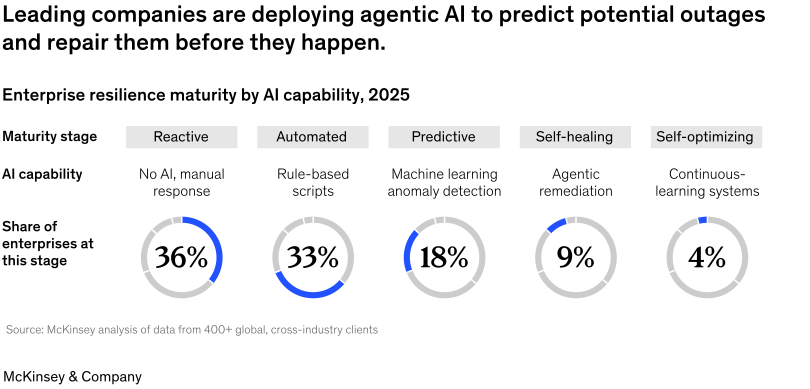
Self-healing systems can also evolve into self-optimizing ones that continuously improve configurations and resource utilization to reduce both recovery time and cost. Governance shifts accordingly, with policy-as-code frameworks embedding risk controls directly into the platform rather than relying on external processes. Few companies have achieved the ultimate goal of self-optimizing systems—in fact, two-thirds have not even deployed the first “reactive” stage of enterprise resilience—but a few leading companies are pulling ahead (Exhibit 2). These companies are deploying agentic AI applications that not only predict potential outages but also repair them before they happen to continuously improve resilience.
The road ahead: Resilience as an intelligent fabric
The next five years will look materially different for enterprise resilience. Critical systems will increasingly anticipate failure with high confidence rather than reacting after impact occurs. AI-driven observability platforms will replace manual dashboards with continuous interpretation and prediction. Deployment strategies will rely on autonomous rollbacks and failovers, while security postures will adapt dynamically to global threat patterns. Cloud infrastructures will balance performance, cost, and resilience without relying on static instructions. Resilience will function as an always-on intelligent fabric spanning applications, data, networks, cloud platforms, and security layers.
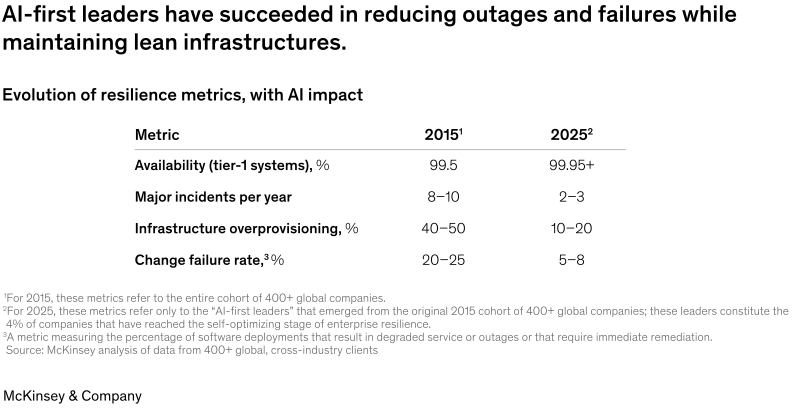
AI-first leaders achieve real technical progress—and business value—from their efforts (Exhibit 3).
For CIOs, chief technology officers, and chief information security officers, resilience won’t become AI-first overnight. But the time to act is now. Five actions can help technology leaders build the technical and operating foundations that allow their systems to autonomously anticipate and recover from disruption:
- Build a unified telemetry and observability backbone that integrates application, infrastructure, network, and security data to create a single foundation for prediction and automation rather than fragmented monitoring.
- Invest in AI-driven incident forecasting and self-healing automation so systems can anticipate degradation and execute recovery actions without waiting for human escalation.
- Adopt continuous chaos engineering to test failure scenarios in production-like environments, and use the results to continuously strengthen detection and remediation.
- Re-architect security around zero trust and continuous validation, embedding behavioral detection and automated containment directly into the platform layer.
- Redesign the operating model for automation-first response, empowering teams to transition from manual-incident handlers to builders and overseers of autonomous resilience systems.
Technology leaders who take deliberate steps to embed AI into their resilience programs will set their companies up for long-term growth and value creation. These companies will shift resilience practices from preventing downtime to sustaining continuity—becoming proactive organizations rather than reactive.
Chandrasekhar Panda is a partner in McKinsey’s Riyadh office, and Henning Soller is a partner in the Frankfurt office.