






This blog post is part of a research collaboration between McKinsey and RAVL.
As McKinsey has written previously, micro frontends modernize digital customer experiences, improve delivery speed, help scale teams, and enable modular development. But when the benefits of micro frontends fall short, the problem is more likely to stem from an outdated operating model than a technology or knowledge gap.
In the race to modernize digital experiences, many organizations focus on tech stacks and frameworks. But the hidden barrier to scale is not technology; it’s structure. When an organization decides to adopt micro frontends, its readiness must extend beyond technology. The operating model—how teams are structured, how governance is applied, and how delivery is orchestrated—is just as critical to success.
Outdated ways of organizing teams, pipelines, and governance cannot fully support micro frontend ways of working at scale. In our experience, and that of companies in a range of sectors, to fully realize the benefits of micro frontends, an organization must have an operating model based on concentric operating principles. In this post, we explore why this type of operating model is essential and outline how to facilitate its implementation.
Micro frontend benefits are diminished by monolithic frontend delivery models
Throughout the past decade, modern frontend development has enabled rich, responsive digital interfaces. Micro frontends address complexity and scale by dividing the frontend into independent, domain-aligned modules. Each module can be developed, tested, and deployed by a separate team, enabling faster and parallel delivery. But micro frontends perform best when work is carried out in a decentralized manner and change ownership is localized. As new tools have been deployed and digital products have become more complex and grown in scale, limitations posed by continued monolithic ways of working in frontends, where all code lives in a single application maintained by centralized teams, have become apparent. Many organizations adopt micro frontends without changing their delivery model, retaining models that are centralized (such as an approval base or release train orchestration), share continuous integration and continuous delivery (CI/CD), or operate in functional silos. As a result, teams still experience cross-team coordination delays and deployment freezes and generally lack the autonomy that micro frontends can provide.
Three factors behind real-world disruptions in the monolithic frontend model
Many companies have experienced how the monolithic model breaks down when it is used to build frontend applications in large, multiteam systems. In our experience, there are three nontechnological factors that derail monolithic frontend systems:
- Lack of team autonomy and increased coordination overhead. When multiple teams work on the same code base, they are unable to develop, test, or deploy features independently without affecting one another. Responsibilities and dependencies overlap and merge conflicts become more likely. When such conflicts occur, functions break and teams must coordinate with one another to resolve the issues.
- Scaling challenges and technical debt accumulation. As applications and teams grow, monolithic architecture becomes increasingly difficult to scale. The tightly coupled code base makes it challenging to isolate failures, adopt new technologies, or refactor without significant risk, leading to bloated code and mounting technical debt. As a result, new team members face steep learning curves, productivity declines, and the organization struggles to keep up with evolving business needs or user expectations.
- Single deployment pipeline bottlenecks. A monolithic frontend relies on a single deployment pipeline, which means even small changes require rebuilding and redeploying the entire application. This increases build times, bundle sizes, and the risk of introducing systemwide failures. As a result, teams lose the ability to release features or fixes independently, which slows down time to market and reduces responsiveness to critical issues or user feedback.
Using monolithic operations models in multiteam environments carries hidden costs
Indeed, organizations that retain monolithic frontend operating models within a micro frontend model in a multiteam environment often incur compounding costs. Some of these costs are readily apparent, while others are harder to detect, such as the following:
- Longer time to market. Critical product releases are often delayed by heavily centralized governance, shared CI/CD, and time-consuming, systemwide regression testing. Releases are delayed as teams wait for approval gates, align with release trains, and freeze changes for stabilization. Such delays prevent teams from achieving the short time to market that digital-first organizations need to remain efficient and competitive.
- High maintenance overhead. Monolithic code bases are large and complex. As a result, monolithic code bases increase the incidence of merge conflicts and fragile test suites (automated test failures even in the absence of code changes) that create problems that developers must resolve. This discourages refactoring and component reuse while diverting developers from working on feature delivery.
- Developer dissatisfaction and hampered productivity. Developers working in monolithic systems are frustrated by the share of mundane and repetitive tasks in their workflows as well as little autonomy, slow feedback loops, and bureaucratic deployment processes. Having to devote significant time to understand old monolithic coding and troubleshoot historical issues accumulated in the code base before they can make progress on their development is discouraging and dampens engineers’ job satisfaction. High-performing engineers prefer to take ownership of the process rather than take and make handoffs.
- User experience (UX) fragmentation. A large monolithic code base often causes inconsistencies in component development. Teams frequently copy and modify components, creating multiple slightly different versions. Shared components add complexity because tightly coupled dependencies can cause cascading failures when moved due to their ad hoc nature. Forked components further compound the issue, requiring reconciliation before global updates, which delays progress and introduces UX inconsistencies. These inconsistencies can erode customer trust and harm the product or brand's reputation.
A concentric operating model to maximize micro frontend advantages
In our experience, organizations need to redesign how work is structured, delivered, and governed to fully realize the promise of micro frontends. This begins with careful planning and consideration of the following:
- A dedicated frontend architecture design. Early stakeholder alignment and initial design efforts are essential to create a unified architectural approach that can be deployed by multiple teams in parallel.
- A clear orchestration plan. Because micro frontends inherently make orchestration more complex, a clear plan based on microservice best practices is needed to manage the complex integration of individual, easy-to-develop (well-defined) micro frontends.
- Strong governance process. Scope boundaries for micro frontends must be clear and well-documented as well as reinforced by a strong commitment to cross-team collaboration around these boundaries.
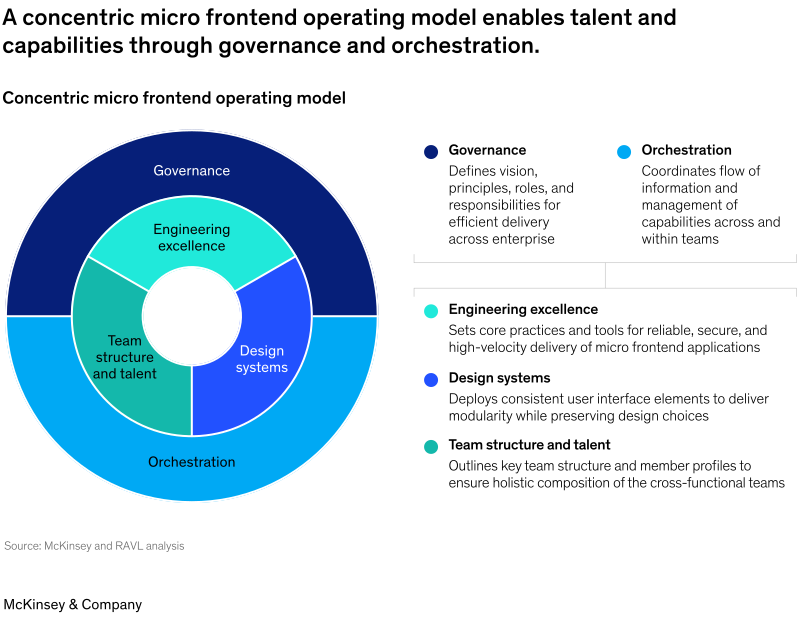
Building on the initial planning described above, organizations can establish the operating model best equipped to optimize micro frontends: a concentric model with two layers that comprise the key dimensions of development and the relationships between them (Exhibit 1).
The outer layer of the concentric operating model: Governance and orchestration
In monolithic operating models, governance relies on manual review boards, top-down standards, and static documentation, all of which can slow teams down and limit responsiveness.
In contrast, the concentric operating model that is best suited to micro frontends embeds governance within the platform where interface contracts define boundaries, shared tooling enforces policies (dependency limits, for example), and observability drives alignment via real-time data. A leading streaming service’s framework exemplifies this approach; its teams publish independently deployable user interface (UI) fragments that are orchestrated dynamically at runtime.
The fundamental shift that takes place when going from a monolithic to concentric operating model is moving from control to enablement. Instead of slowing work down with undue oversight, the platform creates conditions in which doing the right thing is the easy thing. Platform teams act as enablers rather than gatekeepers, tooling and templates help to codify best practices, and contracts and automation replace manual coordination. In short, governance becomes invisible because it is deeply embedded in the design, build, delivery, and operating models.
The inner layer of the concentric operating model: Foundational enablers
Three foundational enablers must be reconfigured to support micro frontends at scale.
Team structure and talent. In monolithic operating models, teams are organized by function (in the frontend, the backend, or quality assurance, for example) and often contribute to a single shared code base. At scale, this organization can lead to coordination overhead costs and unclear ownership.
Conversely, in agile-at-scale organizations, teams are cross-functional and domain-aligned. They own a product area end to end—including UI, APIs, and deployment pipelines.
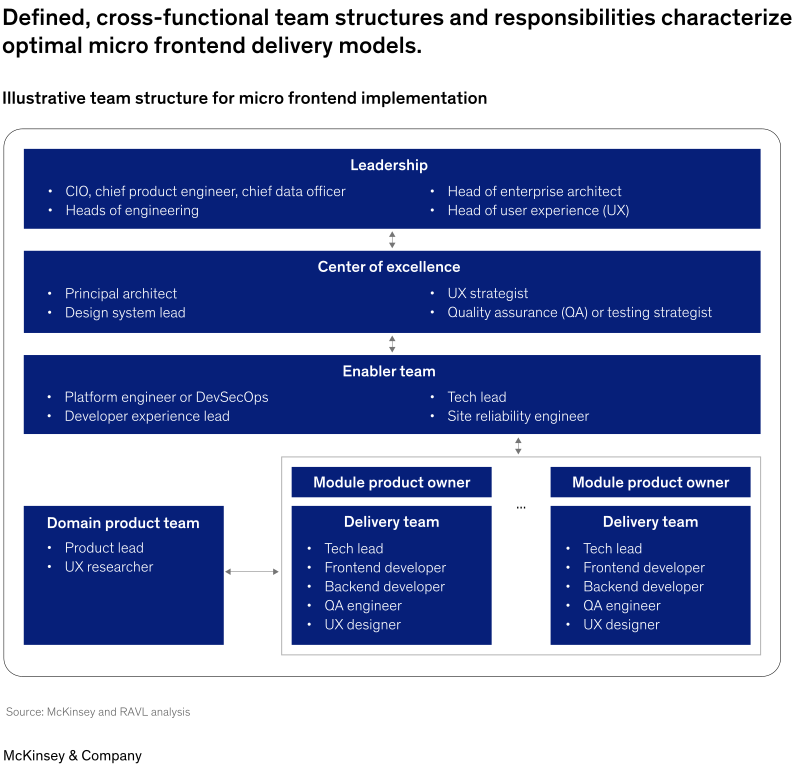
Specific structural differences between optimal micro frontends and monolithic frontend delivery model teams include the following:
- Center of excellence roles govern and administer shared standards and reusable assets centrally; in monolithic teams, standards are embedded locally.
- Enabler team engineers build and operate independent pipelines and runtime composition support per micro frontend, versus a single large and complex build pipeline in monolithic models.
- Domain product teams have deep domain expertise; in monolithic teams, product knowledge is not specialized.
- Delivery teams have exhaustive code base knowledge of their micro frontend, while monolithic delivery teams have varying levels of knowledge due to the sheer size of the code base (Exhibit 2).
Engineering practices. In monolithic operations, engineering practices are shared across teams (including CI/CD pipelines, test suites, and observability standards), while in micro frontend operations, engineering practices are decentralized to enable CI/CD for each micro frontend, fast feedback, contract tests between teams, and localized metrics for each micro frontend.
Design systems. In monolithic models, traditional design systems are centralized and evolve slowly; it can be difficult to propagate updates in such systems, so inconsistencies often grow over time. Micro frontend organizations use federated design systems with design tokens (the smallest units of design, such as a color code) and versioned components that teams can update consistently.
Assessing an operating model’s support for the full potential of micro frontends: Considerations for leaders
C-suite leaders needn’t question the technical viability of micro frontends but rather assess whether their operating models enable teams to realize micro frontends’ full potential. To begin building a case for change and lay the foundations for a successful evolution of their operating model, leaders can start with the following steps:
- Determining the limiting factor (architecture versus operating model). Consider whether teams can ship independently or must wait on others. Ask whether new features and teams can be onboarded without friction. Assess the design system to determine whether it is accelerating or hindering change. Last, consider whether engineering practices are optimized for modular delivery.
- Committing to a strategic shift toward modular delivery, domain ownership, and platform enablement. Align teams to product domains, ensure teams can deploy independently, design an architecture to support modular evolution, and decentralize delivery and distribute responsibility.
- Evaluating the health of the current operating model. Conduct a robust assessment of the current state to develop a targeted plan that accounts for current pain points, supports operational stability, and mitigates transition risks.
Micro frontends are a vital evolution in scalable technical architecture, but only an evolved operating model can empower organizations to realize their full potential. In our experience, this evolution entails replacing the monolithic model’s centralized control, shared pipelines, and rigid team structures with a distributed, modular operating model built for autonomy, speed, and cohesion.
Erez Eizenman and Rohit Bhapkar are senior partners in McKinsey’s Toronto office, where McGregor Faulkner is a partner, Alice Novak and Graham Bohm are consultants, and Thanou Thirakul is a senior expert. Oscar Villarreal is a partner in the Denver office.
The authors wish to thank RAVL CTO Dominic Wallace for his contributions to this blog post.