

Public-service delivery is undergoing its most significant redesign in more than a century. Early e-government initiatives digitized paper processes, mobile services made those processes easier to access, and then “smart city” efforts added data and dashboards. But while each of these steps improved efficiency at the margins, none fundamentally changed how cities operate day to day.
What is emerging now is different. Advances in sensing, data infrastructure, and AI are allowing cities to manage complex systems—such as transport, energy, water, health, and permitting—not as slow-moving bureaucracies but as continuously operating systems. In effect, parts of the city are beginning to behave like computing platforms: observing conditions in real time, making decisions automatically, and adjusting operations without waiting for human escalation.
Over the past decade, smart-city initiatives introduced sensors, dashboards, and analytics into urban management. These efforts improved visibility but rarely changed the underlying operating model of cities. Data informed decisions, but execution still depended on human workflows, budget cycles, and interagency coordination.
AI-native public infrastructure represents a structural break rather than an incremental evolution. The distinction is not the presence of data or the Internet of Things (IoT), but where intelligence sits in the system.
In smart-city models, technology observed and reported. In AI-native models, technology increasingly decides and acts—within explicit policy and regulatory constraints. Control loops move from monthly reviews to continuous execution. Risk is mitigated through simulation and automated safeguards rather than manual escalation.
In this sense, AI-native cities are not just smarter dashboards. They are cities where infrastructure behaves more like software: versioned, observable, testable, and capable of autonomous operation under defined rules.
These changes come at a crucial time for the world’s urban centers. By 2030, more than 60 percent of the world’s population will live in cities, adding more than 1.5 billion new urban residents within a decade.1 Cities already account for about 75 percent of global energy consumption and more than 70 percent of CO₂ emissions,2 and most municipal infrastructure was designed decades ago for far lower loads.
Operational inefficiencies are significant: Unplanned outages, congestion, and reactive maintenance cost large cities 2 to 4 percent of GDP annually3 through lost productivity, asset damage, and emergency response. A technological solution is increasingly within reach. Advances in AI, edge computing, and sensing have reached a tipping point: The cost of sensors has fallen by 80 to 90 percent over the past decade,4 while inference latency has dropped from seconds to milliseconds, enabling real-time control at scale.
This post describes what an AI-native public infrastructure looks like in practice, the technology stack behind it, and how large cities are likely to move toward more-autonomous operations over the next decade.
What does an AI-native public infrastructure look like?
There are five key changes that characterize the AI-native urban infrastructure (exhibit).
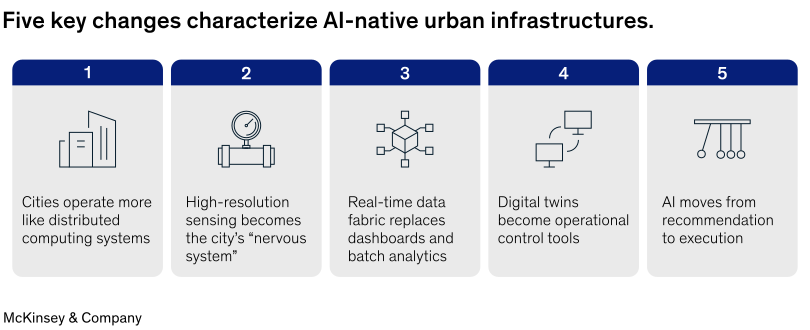
Cities operate more like distributed computing systems
Traditional urban infrastructure is rigid: Assets are fixed, failures are detected late, and responses depend on handoffs across departments. In an AI-native model, city systems behave more like distributed software platforms.
Individual subsystems—such as traffic control, power distribution, and water management—operate independently but are designed to coordinate, much like microservices in a cloud environment. A failure in one location does not trigger a cascade of administrative delays; instead, traffic is rerouted, loads are shifted, or service is throttled automatically. During predictable surges such as festivals, storms, and weather events, capacity scales dynamically rather than through emergency measures.
Cities such as Singapore and Barcelona have begun transforming monolithic urban platforms into modular services. Singapore’s traffic and utilities systems, for instance, increasingly operate through loosely coupled services that allow localized failures to be isolated rather than escalated citywide. Barcelona’s urban platform strategy emphasizes interoperability and API-first design across mobility, energy, and public services—reducing cross-department dependency and response latency.
In this model, the defining constraint is no longer paperwork or staffing cycles but latency: how quickly the system detects a change and responds. Governance shifts from managing processes to engineering systems that can run reliably in real time.
High-resolution sensing becomes the city’s ‘nervous system’
Autonomous operation depends on continuous perception. This represents a sea change from legacy systems, whose periodic inspections and manual reporting are too slow for a world in which systems must respond within seconds or minutes.
AI-native cities rely on dense, resilient sensor networks. Air quality, water turbidity, road strain, energy frequency, waste levels, and equipment temperature are monitored continuously. Computer vision systems estimate pedestrian density, detect road encroachment or illegal dumping, and flag safety risks before accidents occur.
Much of this processing happens at the edge—near the asset itself—so anomalies can be identified even if connectivity to the cloud is interrupted. Redundant routing and hardware-level identity help ensure that data streams remain trustworthy during failures or cyber incidents.
Copenhagen and Amsterdam have deployed dense environmental and mobility sensing to support real-time air-quality management and traffic optimization. Los Angeles has installed critical water and power assets with continuous monitoring to detect stress signatures before outages occur, shifting maintenance from reactive to predictive.5
The practical effect is that the city begins to detect stress in its systems before residents experience service breakdowns.
Real-time data fabric replaces dashboards and batch analytics
Most cities today still treat data as something to be collected, cleaned, and analyzed after the fact. Reports and dashboards summarize what already happened.
In an AI-native architecture, data is treated as a live signal. Physical infrastructure assets—such as traffic signals, pumps, transformers, and vehicles—continuously report changes in their operating condition. Downstream applications subscribe to these events, triggering actions automatically. Feature generation for machine learning happens midstream, not in offline batches.
New York City, for instance, has moved beyond static dashboards in areas such as emergency response and sanitation and now uses live event streams to dynamically route resources.6 Dubai has invested in citywide data platforms that enable agencies to subscribe to real-time events rather than rely on periodic reporting cycles.7
As a result, governance shifts from retrospective analysis to live orchestration. Instead of asking, “What went wrong last month?,” operators can ask, “What is changing right now, and what should respond?”
Digital twins become operational control tools
Digital twins are often described as digital, visual replicas of physical assets. In practice, their value lies elsewhere.
In advanced cities, digital twins become tools for managing and adjusting systems in real time. Entire networks—such as roads, pumps, transformers, and drainage systems—are represented in simulation and updated continuously with live telemetry. When conditions change, such as a sudden rainfall surge or an unexpected power draw, the system can test response options virtually before acting in the physical world. For example, Helsinki and Singapore uses digital twins not only for urban planning but also for operational stress testing—simulating flood events, traffic surges, and energy demand spikes before taking physical action.
Interventions that perform well in simulation can then be executed directly through control interfaces. Risk shifts from on-the-ground trial and error to computational testing, reducing both cost and public disruption.
AI moves from recommendation to execution
In many government applications today, AI produces insights that humans may or may not act on. In AI-native infrastructure, AI increasingly executes decisions within defined guardrails.
Forecasting models anticipate demand spikes in mobility, emergency care, or water usage. Reinforcement learning systems adjust traffic signals, power routing, or waste collection routes based on observed outcomes. Risk models prioritize maintenance, replacing pipes before leaks form, reinforcing bridges before cracks propagate, and targeting vaccination campaigns before outbreaks spread. The approach can be seen in places such as Pittsburgh and Hangzhou, both of which have demonstrated AI-driven traffic signal control that autonomously adjusts flows based on observed congestion patterns.
Generative systems are also reshaping administrative work. Permits can be reviewed, documents validated, and standard responses generated automatically, with human review focused on exceptions rather than routine cases. For example, in Seoul, AI-assisted systems already execute routine administrative decisions automatically.8
What changes across sectors?
These AI-native capabilities translate into tangible shifts across major city systems.
In mobility, traffic signals adapt over weeks rather than years, congestion pricing responds dynamically to demand, and public transport routes evolve based on real commuting patterns.
In utilities, pipelines report stress signatures instead of failing unexpectedly. Smart grids balance renewable supply with consumption spikes in real time. Water discharge adapts to soil moisture, rainfall forecasts, and tidal conditions.
In health systems, early outbreak signals emerge from pharmacy purchases, ambulance routing, and wastewater analysis. AI-assisted bed management reduces emergency department congestion, and regulated drone corridors extend medical reach to underserved areas.
In citizen administration, routine cases close without human intervention, fraud detection runs continuously, and resolution times fall sharply.
Across domains, reactive, on-demand action becomes continuous optimization.
What’s the way forward for leaders?
Most cities will not reach this state overnight. Progress tends to follow a predictable sequence.
In the first phase, cities focus on awareness: deploying sensors, integrating data across agencies, and automating limited workflows.
The second phase introduces predictive control: digital twins, semiautonomous adjustments in mobility and utilities, and real-time decision support for human operators.
In the third phase, selected systems become conditionally autonomous. Failures are anticipated, and decisions are executed automatically only where outcomes are well-defined, reversible, and socially accepted, such as water pressure management, energy balancing, or traffic signal coordination.
In domains with higher normative, political, or ethical stakes—such as policing, welfare eligibility, urban planning, and citizen enforcement—AI augments human judgment rather than replaces it. Human-in-the-loop governance is explicit by design, not an afterthought.
This transition is as much about architecture as policy. To be successful, cities must invest in new foundational capabilities:
- a unified API backbone connecting utilities and public workflows
- edge computing near assets to support sub-second inference and control
- event-stream architectures with built-in redundancy
- zero-trust identity across devices, services, and human roles
- strong governance over machine learning to manage drift, bias, and model failure
- treating infrastructure like software, with versioning, rollback, and observability
As these capabilities mature, governance itself begins to resemble continuous deployment rather than episodic reform.
The cities that succeed in the coming era will not feel futuristic to their residents. Rather, their defining characteristic will be the absence of disruption: outages that never happen, floods that never materialize, and emergency surges that are quietly absorbed.
When infrastructure behaves like software, public service becomes continuous. When AI becomes part of operational logic, governance becomes more stable. And when cities learn and adapt in real time, they become better equipped for an uncertain future.
Chandrasekhar Panda is a partner in McKinsey’s Riyadh office, Henning Soller is a partner in the Frankfurt office, and Saswat Swain is a knowledge specialist in the Gurugram office.
1 The sustainable development goals report, United Nations, 2022.
2 Empowering urban energy transitions, IEA, May 2, 2024; “Urban energy,” UN-Habitat, accessed February 10, 2026.
3 Banking on cities: Investing in resilient and low-carbon urbanization, World Bank, June 3, 2025; “Infrastructure productivity: How to save $1 trillion a year,” McKinsey Global Institute, January 1, 2013.
4 Internet of Things market size & share analysis: Growth trends and forecast (2025-2030), Mordor Intelligence, November 2025.
5 “Advanced metering infrastructure,” Los Angeles Department of Water & Power, accessed February 11, 2026.
6 Audit report on the New York City Office of Technology and Innovation’s MyCity system, New York City Comptroller, December 30, 2025.
7 “‘Dubai Live’ smart city platform launched,” Government of Dubai, October 13, 2025.
8 [Combining AI and RPA for ‘intelligent administration’: Seoul automated processing 2,000 hours per month], Seoul Metropolitan Government, November 13, 2025.