Humanoid robots don’t live in sci-fi movies only anymore. Agility Robotics’ creations are helping workers in real places—warehouses, shop floors, distribution centers—do their jobs more efficiently, safely, and precisely. On this episode of the At the Edge podcast, Agility’s CEO, Peggy Johnson, speaks to McKinsey Senior Partner Lareina Yee about the future of humanoid robots in the workplace, the steps required for the safe integration of these tools, and how leaders can embrace this evolution.
The following transcript has been edited for clarity and length.
Robots designed for human spaces
Lareina Yee: Physical AI, robotics, and robotics using generative AI are popular in the marketplace right now. But using robotics in the workplace has been gaining popularity for decades. What has changed in the past year or two that has generated more buzz?
Peggy Johnson: First, there needed to be a confluence of several technologies for humanoid robots to take off. One is AI. For instance, to build workflows for a humanoid, typically an engineer would write a program that would move the robot. With AI, we can teach the robot skills quicker than engineers programming them can.
Other technologies include actuators in the arms and legs that move the limbs. Those have become smaller and lighter. Advancements in those technologies, in addition to perceptive functions and computer vision, have been gleaned from the electric vehicle industry. Batteries have also become more useful in robots because they are becoming more dense.
The other big tailwind is an increased demand for labor in areas that are hard to fill, such as jobs that are repetitive, somewhat dirty, or injury prone. Robots and other types of automation can be used in those areas to alleviate the heavy manual labor.
Lareina Yee: You’ve used the word “humanoid” a few times, which could sound like something out of a science fiction movie. Explain what that means in this context.
Peggy Johnson: Most people’s introductions to robots that look like humans have been from science fiction movies—and many of them are scary. [At Agility], we like to say we are human-centric. We are not building a robot that is meant to look exactly like a human; we’re mostly building a business that is trying to fill a labor gap.
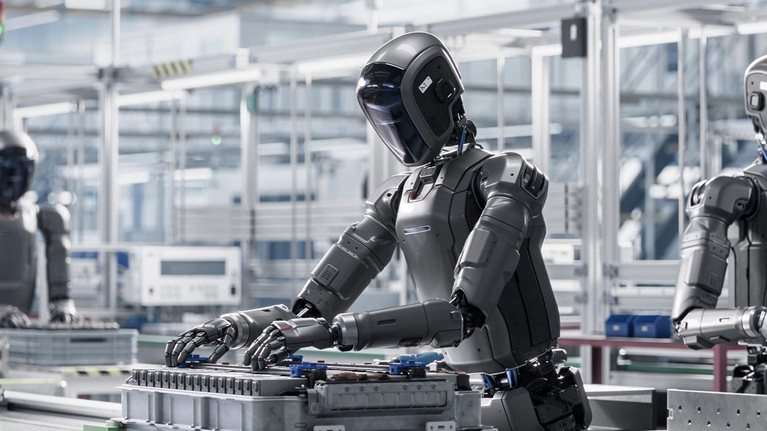
We say human-centric because the world is built for humans. So, for example, these devices will have to walk down narrow aisles to help stock shelves and be around the same height as an average-size human. Our humanoid currently is about 5’9”, about 160 pounds, and can lift about 35 pounds. Our next-generation robot will be a little bit taller, a little bit heavier, and can lift about double that weight.
Lareina Yee: So instead of redesigning our physical spaces, you design the machines to work in our environment and to be useful. That’s important. In March 2023, you released version 4.0 of a humanoid robot named Digit. Tell us about it.
Subscribe to the At the Edge podcast
Peggy Johnson: Digit is the culmination of a number of technologies. One of our founders is an expert on locomotion, or bipedal robots. The initial version of Digit had just the lower part of the body. It won a 5K [five-kilometer] race, but it did not have a torso, arms, or a head. As the company started to look at use cases, the most practical and necessary were in material handling and moving material from point A to point B in a facility. That meant Digit needed arms—and a head helps because you can put cameras in it. This version of Digit can step in and take on some of the tasks that humans don’t typically want to do, such as purely manual labor that can cause injuries.
Lareina Yee: What can Digit 4.0 do differently from 3.0?
Peggy Johnson: Digit 4.0 has a longer battery life. We’re optimizing our work-to-charge ratio, so for every 50 minutes of work, it charges for ten minutes, and then returns to work. Usually, two robots are working together. One of the big upgrades for version 4.0 is that it’s self-charging. It will walk over to a charging station when it senses its battery is getting low, hook onto the station, charge, and then come back out to the work floor and continue the job. It can do that continuously, so you don’t need someone overseeing the robots.
Lareina Yee: What are some of the science and engineering advancements you’re looking to make in the next edition?
Peggy Johnson: Obviously, a lot more AI. We already had classically trained robots working on factory and manufacturing floors. Now with AI, we can teach new skills quicker. Our robots are not 100 percent reliant on AI—but sometime in the future, we’ll likely have robots that are. AI can hallucinate, and we can’t allow a humanoid this big and heavy to act upon a wrong answer. So we are very focused on safety.
Maintaining a strict standard for safety
Lareina Yee: How do you think about safety, considering this is how we learn to trust these different robots in our workplace?
Peggy Johnson: Humans have to trust these robots if they’re going to be interoperating and interacting with them. There are different levels of safety that humanoids can operate in.
Right now, every humanoid has to operate inside what’s known as a “work cell,” which is like a safety cage. They’re about waist high, and they keep humans and devices separate. Any factory today typically has a line humans shouldn’t cross because some piece of automation may swing around unexpectedly. With robots, it’s similar.
The next step is called “cooperative safety,” which means the robot has to act safely when it is in the proximity to humans. For example, if I’m walking down an aisle and a humanoid robot is coming toward me, it needs to first recognize I’m a human, not a stone pillar, and then take appropriate action to power off parts of it and ensure that it can’t put me in any kind of danger.
The only way for humanoids to roam inside these facilities, let alone our homes, is if they are cooperatively safe. We’ve been working to ensure that. It’s a hard problem to solve, but we have solved it. Our next-generation robot, which we’re introducing at the end of next year, will be cooperatively safe. It can go down to the loading dock and pick something up. It can walk among humans, and it’ll do the right thing.
Lareina Yee: How do these early deployments feel for people in the factory?
Peggy Johnson: This is an entirely new piece of technology we’re introducing. At times, there is some skepticism. People wonder first if the robot will take their jobs. The answer is no. At this point, the robots are doing tasks; they’re not taking an entire end-to-end job. The human in the middle is still needed. Humans can offload tasks—such as stacking empty plastic bins, putting them onto a pallet, and rolling the pallet down to the shipping dock—freeing them up to do other things.
There is also now opportunity for new roles and skills development. For example, factories could need a robot manager that looks after the fleet of robots and makes sure they interact well with other types of robots and automation in those facilities. That can all be done digitally. So we have turned some purely manual jobs into digital-focused jobs, which is an upskilling opportunity that many of our factory workers didn’t have before.
We try to put ourselves in workers’ shoes because this is their livelihood. We hope that when we introduce these robots, we’re giving people choice. They can offload the parts of their jobs they don’t love, which frees them up for more time to learn new areas of the job, including becoming a digital manager of the automated equipment.
How leaders can incorporate humanoid automation safely into workflows
Lareina Yee: How can executives, such as HR leaders, think about this evolution in the near term?
Peggy Johnson: The number-one worry we hear from our customers is they want to keep their limited pool of human laborers as safe as possible. As an HR manager, you can see this as a tool, as a way to keep your injury numbers as low as possible and give your employees more choice going forward.
Oftentimes, manual laborers have longer days or careers because it’s difficult to find new employees, and factories are dependent on that manual labor. We want to offer humans the ability to focus on the creative side of things, move up and out into other positions, and leave the manual types of labor to the machines.
Lareina Yee: How should strategy officers think about this moment?
Peggy Johnson: I used to be the head of business development at Microsoft. Because we were involved in the creation of so many new technologies, we had to think about how the technologies evolve, how they can be rolled out to customers’ businesses, and, even more important, how we can empower them to deliver more with our tools.
As more humanoids and different types of automation get introduced, it’s good to stay abreast of all of those technologies and understand what they’re capable of today, what they can do for you tomorrow, and what they can do for you further in the future. It’s a trajectory. It’s going to take time to roll all of that out, and certainly time before they are in our homes, giving us that same freedom to offload tasks.
A leg up for manual laborers
Lareina Yee: Does the relationship or readiness we have for robots vary internationally by culture? How do you see adoption playing out differently in different geographies?
Peggy Johnson: Humanoids are used in China quite a bit, and many new robotics companies are coming out of China. In the United States, robotics companies have to meet certain criteria—OSHA [Occupational Safety and Health Administration], for example—and there are a lot of compliance and regulatory standards that any automation needs to meet to be incorporated into facilities.
We have, arguably, a higher bar for safety to meet because of the current regulations. With humanoids, those regulations are likely going to tighten even more, especially since they are so mobile and powerful. Current forms of automation in factories are stationary, but robots working among people is a different story.
Lareina Yee: What are the top five industries or use cases you think are most ready for humanoid robotics?
Peggy Johnson: First is logistics. Any company that’s moving product through their facilities, such as third-party logistics providers, is the first adopter. The need is very high there. Then, any industry that has a similar type of need, such as pharmaceuticals, which moves products within its facility in plastic bins or totes. Automotive is another one. Automotive tends to have much larger bins that carry parts down the assembly line.
In retail, stores bring in new inventory at night. Generally, humans have to offload the product from the truck, unpackage it, and then put it on the shelves. That’s another area where we’re seeing a lot of interest, because there is a shortage of human labor.
As skills build, you’ll start to see humanoids showing up in more industries and even moving into areas such as healthcare. With the population changes we’ve seen, we may rely more on devices like these to help with tasks in eldercare.
Lareina Yee: We’ve seen strides in ambient technologies that help in home health scenarios. With our aging population, you could imagine much more practical solutions available in our lifetime.
Peggy Johnson: I believe that. We’re starting to see the embodiment of AI in physical devices. In the beginning, we saw it with some of the voice-operated devices in our homes—for example, turning the lights off and on. Now, we can give commands to these mobile devices, and they can act upon those commands. Think about how helpful that will be, not just for elderly people who might need help but for all ages and ability levels. The AI can understand needs. It has the right context. It has perception capabilities. And it can execute on that command. We’re seeing that capability with Digit. It’s stunning to watch it execute upon a simple voice command.
The importance of being open and encouraging ideas
Lareina Yee: This is your second CEO experience, and you’ve had a long career forging new frontiers in technology. What lessons have you learned over your career that you’re applying to Agility?
Peggy Johnson: First, because I was not the founder—I was coming in to help commercialize the product—I wanted to ensure there was true product–market fit. You can come up with an exciting technical breakthrough, but if there’s not a product–market fit, it won’t go anywhere. You have to bridge the gap between technical innovation and solving a real-world problem. I saw that Agility had a product–market fit in the logistics space, which is why we focus on it. It’s how we’re building the business. Over time, we can solve other problems in other fields.
Another important lesson that I learned from Satya Nadella at Microsoft is how important culture is. The first time I spoke with him, we were talking about the changes he planned to make at Microsoft. He was only a month or so into his role [as CEO]. Rather than focusing on technical problems, he said, “It’s all about culture. If we can’t change the culture here, we’re not going to get new ideas.” He talked about having a growth mindset and letting ideas flourish. All ideas are good ideas. You might take some or all, or just think about them for a while, but it’s better to have the ideas than to shoot them down. Otherwise, you don’t grow.
Lareina Yee: You’ve always been a champion for women. To put a twist on it, what advice would you give men who want to see a fairer and more equal workplace?
Peggy Johnson: When I look at my own career and how I evolved, I learned the most from managers who understood my areas of interest and where I wanted to take my career and were supportive of that. I’m a manager now, and I have 100 people under me. It’s about understanding those 100 people, where they want to go, and then helping them get there.
I tend to be introverted, and I felt like I didn’t have much of a voice when I was early in my career. I think what I didn’t have was a manager who realized that. When I was at Qualcomm, I told my manager, “I feel like I’m not a part of the team. I have ideas, but it’s hard for me to break into conversations.” He said, “What can I do?” And I said, “Just throw me the ball every now and then. Say, ‘Peggy, what do you think?’ Allow that opening for me.” He took that advice to heart and started doing that, and I blossomed. Then I built the confidence that got me to where I am today. That’s a simple thing that any manager can do.