


The global energy landscape is evolving rapidly, shaped by rising power demand, net-zero commitments, and growing concern about energy security.1 As renewables account for an increasing share of the global energy mix, their profitability comes into sharper focus.
Solar photovoltaic (PV) is now among the lowest-cost sources of new power in many regions, supported by policy frameworks, rapid technological innovation, and robust cost competitiveness. Yet profitability across the sector is under pressure—in recent years, solar developers have faced a more challenging environment due to increasing competition, limited land availability in some regions, and grid congestion.2
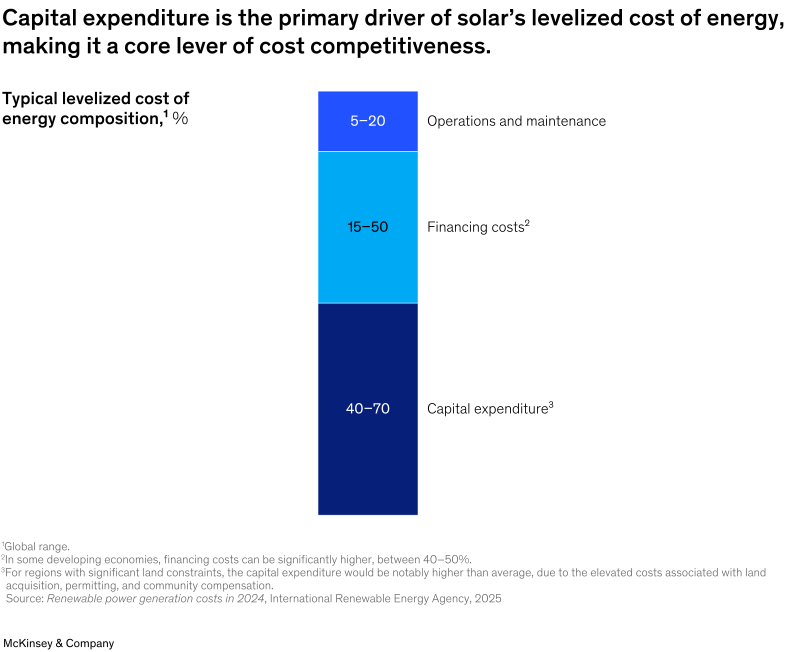
With capital expenditure (capex) accounting for roughly 40 to 70 percent of solar’s levelized cost of energy (LCOE), improvements in capital efficiency could be an important factor in keeping solar affordable and competitive.3
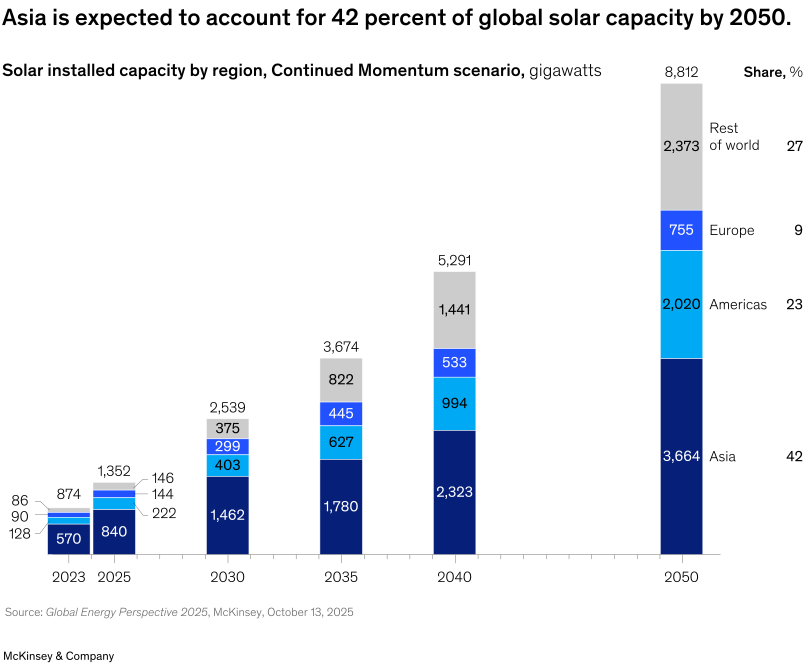
Advanced next-generation solutions make it possible for developers to reduce capex and accelerate delivery timelines across scheduling, sourcing, execution, and design. This is especially relevant in Asia, which is expected to account for around 42 percent of global solar capacity by 2050, positioning the region as one of the foremost destinations for solar capital investment, both now and in the future.4
Improving capital efficiency may be critical not only for developers in Asia, but also for the pace and affordability of the global energy transition.
Global solar capacity is expected to surge
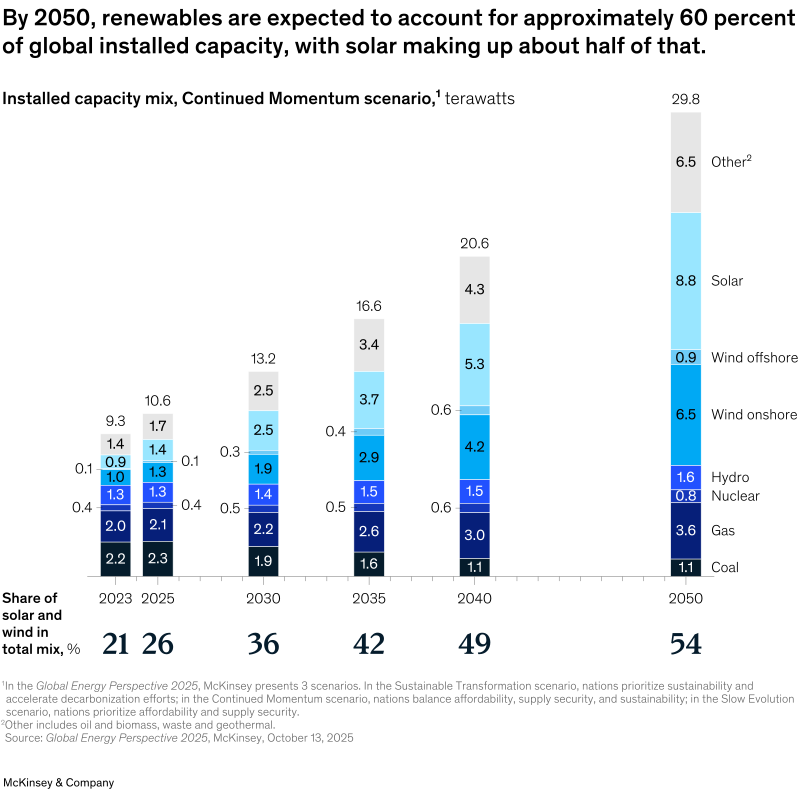
Globally, renewable energy sources are growing at a rapid pace, especially solar PV. McKinsey modeling suggests that solar’s share of the global power capacity is expected to rise from approximately 13 percent in 2024 to about 30 percent by 2050 (Exhibit 1). Moreover, this figure could be even higher as, historically, projections have consistently needed upward revisions to keep pace with the real-world scale of deployment.5
Asia is at the forefront of the solar revolution, with China, India, and Southeast Asian nations leading solar capacity expansion. By 2050, 42 percent of global installed solar capacity is expected to come from Asia, supported by policy frameworks, carbon neutrality commitments, abundant solar resources, and increasing energy demand (Exhibit 2).6
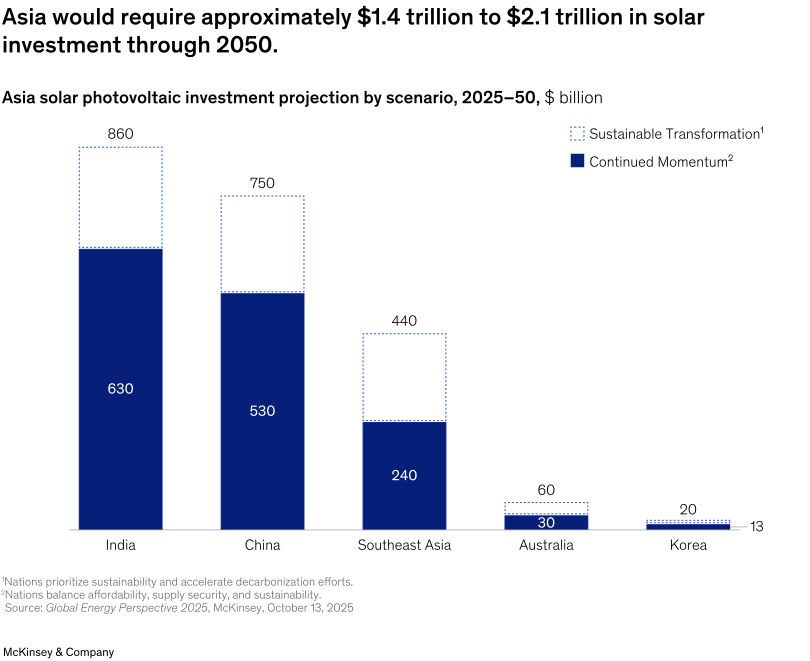
To achieve this projected scale, significant capital investment will be required from governments, corporates, and financial institutions. Estimates suggest that Asia alone will need between $1.4 trillion and $2.1 trillion through to 2050 to develop the required infrastructure (Exhibit 3). This range spans McKinsey’s Continued Momentum and Sustainable Transformation scenarios as set out in the Global Energy Perspective 2025.
These investments will be locked in for the entire lifespan of individual solar projects—25 to 30 years, on average.7 With capex accounting for 40 to 70 percent of the total LCOE for solar, efficient capex deployment is essential for achieving cost competitiveness (Exhibit 4).
Maximizing capital efficiency with next-generation tools
To deliver attractive returns at acceptable risk levels, solar developers could prioritize cost reduction and accelerated delivery timelines by adopting next-generation solutions, including AI-enabled ones. When integrated across scheduling, sourcing, execution, and design, these solutions can shift project delivery from manual and reactive to proactive and optimized (see sidebar “Additional solutions to maximize value”). McKinsey analysis shows that these solutions could deliver capex savings of between 5 and 20 percent, potentially translating into a 4 to 15 percent reduction in the LCOE from solar.
Generative scheduling: Parametric multiscenario planning
Traditional scheduling methods, such as critical path method (CPM) and program evaluation and review technique (PERT), are often linear and deterministic, leading to reactive adjustments when disruptions happen.
Generative project scheduling takes a different approach: It uses constraint-based modeling to explore a broad range of solutions and generate sequences that more accurately and quickly reflect physical and spatial realities. As an agile system, it automatically reoptimizes and reroutes schedules in real time when delays occur and can be fully integrated into current planning processes and systems. It can factor in thousands of variables simultaneously, including real-time equipment status, resource availability, and sustainability goals, reducing days of manual planning to minutes of AI planning. This helps teams:
- identify bottlenecks to flag likely delays, such as late deliveries of transformers or switchgear.
- simulate scenarios by evaluating hundreds of thousands of options in minutes to optimize cost, time, and resource allocation.
- analyze different ways to allocate labor, equipment, and materials across tasks, generating optimal schedules that reduce project time and resource conflicts.
Generative scheduling has been adopted widely across industries, with organizations using it in new ways, including planning for recovery, quantifying the impact of risk, defending against change orders and claims, and upskilling planning and scheduling teams.
McKinsey analysis shows that generative scheduling could reduce schedule update and optimization time by up to 90 percent, improve delay-prediction accuracy by up to 70 percent, and lower costs by up to 15 percent through better resource allocation—with typical outcomes depending on project complexity, data maturity, and implementation approach8 (see sidebar “How generative scheduling saved a developer millions”).
AI-based procurement: Intelligent sourcing, negotiations, and spend analytics
Traditional sourcing often relies on fragmented data and manual interventions, making it labor-intensive and error-prone. On the other hand, AI-based procurement approaches can improve performance by using decades of historical data and real-time pricing to optimize the sourcing process. This is achieved by:
- streamlining the request for proposal (RFP) process through intelligent RFP creation, supplier matching with attribute databases, and automated evaluation.
- recommending optimal pricing and contract terms by analyzing historical interaction data, supplier behavior, and market benchmarks.
- benchmarking contracts against a vast database of terms and conditions to identify hidden improvement opportunities instantly.
- transforming raw, siloed transactional data (invoices and purchase orders) into actionable intelligence by automating data cleansing and classification and by identifying hidden savings opportunities. These approaches can also identify patterns in high-volume, low-value tail spend (the bottom 80 percent of suppliers) to find consolidation opportunities and unusual buying patterns.
- analyzing enterprise resource planning (ERP) systems to audit active invoices against contract terms (for example, multitier discounts) in real time, flagging deviations immediately.
These approaches can help reduce drafting and review time by 30 to 50 percent and improve recovery of lost value by up to 10 percent through automated compliance (see sidebar “How AI uncovered $10 million per annum in potential spend savings”).9
Project intelligence: Real-time predictive insights for project execution
Solar PV projects generate a constant stream of data, spanning weather conditions, SCADA (Supervisory Control and Data Acquisition) telemetry, schedule performance, and supply chain logistics. To keep project delivery on track, teams need to convert this data into technical decision-making in real time.
Most traditional management models struggle with the volume, speed, and complexity of this information and cannot connect all the relevant variables fast enough to support timely action.
In contrast, AI-based management models generate both lessons learned and assessments to guide delivery (see sidebar “How an AI-based management model flagged thousands of at-risk hours”). These models synthesize diverse data sources, including requests for information (RFIs), nonconformance reports, purchase orders, and construction drawings, to:
- predict and prioritize risks to upcoming schedule activities well in advance.
- improve and speed up decision-making by synthesizing thousands of documents to identify root causes of performance deviation in real time.
- increase visibility by establishing a single source of truth across disparate project data streams to ensure organizational alignment.
Generative design: Rapid automated prototyping and real-time model iterations
Traditional methodologies such as design-to-cost (DTC) and design-to-value (DtV) are constrained by manual capacity. Designers typically test only a limited number of solar plant designs, such as standard south-facing rows, which may fail to capture a site’s full potential.
Generative design techniques change that by using parametric modeling to rapidly explore thousands of design permutations to identify optimal configurations (see sidebar “How an engineering, procurement, and construction company cut design time significantly”). They ingest project drawings, design criteria, specifications, and engineering logic to:
- incrementally improve energy yields by optimizing pitch, tilt, and azimuth across complex or nonuniform terrain to reduce shading and maximize output.
- cut design time by more than 80 percent, by using AI and light detection and ranging (LiDAR) capabilities to create 3D roof models and perform shading analysis remotely.10
- integrate cost directly into the design phase so that if material prices fluctuate or module dimensions change, the model can instantly update the entire site plan, preventing expensive late-stage revisions.
- optimize material use by identifying the shortest path for trenching and cabling (subject to constructability), reducing conductor waste and voltage drops.
McKinsey analysis shows that the potential impact is significant, including a 2 to 5 percent rise in annual energy production, a 3 to 8 percent reduction in cabling and racking materials, a 60 to 90 percent drop in layout iteration time, and 10 to 20 percent lower land grading costs from terrain-following modeling.11
As capital excellence becomes a defining advantage in solar, developers could look at how to use a range of generative AI solutions to derisk portfolios, accelerate delivery, and maximize returns. The opportunity is especially relevant in Asia, where significant investment is expected. By improving the cost-competitiveness of solar, developers could help accelerate the global energy transition.
Ashwin Balasubramanian is a partner in McKinsey’s Singapore office; Bevan Watson is a partner in the Sydney office; and Rahul Gupta is a capabilities and insights expert in the Gurugram office.
The authors wish to thank Katy Bartlett, Koen Vermeltfoort, Mathew Ricci, Rawad Hasrouni, Tim Drake-Brockman, and Qixin Liu for their contributions to this blog post.
1 Global Energy Perspective 2025, McKinsey, October 13, 2025.
2 “Renewable-energy development in a net-zero world,” McKinsey, October 28, 2022; “Renewable-energy development in a net-zero world: Land, permits, and grids,” McKinsey, October 31, 2022.
3 Renewable power generation costs in 2024, International Renewable Energy Agency, 2025.
4 Global Energy Perspective 2025, McKinsey, October 13, 2025; Continued Momentum scenario, where nations balance affordability, supply security, and sustainability.
5 “Renewable-energy development in a net-zero world,” McKinsey, October 28, 2022.
6 “Asia’s energy transition and the challenges of achieving the region’s net-zero goals,” McKinsey, September 27, 2024.
7 “End-of-life management for solar photovoltaics,” US Department of Energy, April 20, 2026.
8 Analysis of solar project performance data and expert interviews with solar developers and engineering, procurement, and construction contractors. Outcomes represent a range of observed results and vary by project context.
9 Analysis of solar project performance data and expert interviews with solar developers and engineering, procurement, and construction contractors. Outcomes represent a range of observed results and vary by project context.
10 Analysis of solar project performance data and expert interviews with solar developers and engineering, procurement, and construction contractors. Outcomes represent a range of observed results and vary by project context.
11 McKinsey analysis.