Asia is steadily reshaping the global economic landscape. The region is on a plausible trajectory to represent as much as 60 percent of Fortune 500 companies within the next decade and is already emerging as the world’s primary engine of trade.1 Its large population, advanced-manufacturing depth, and high levels of digital adoption and public–private collaboration create fertile ground for experimentation. But these structural advantages do not fully explain Asia’s rising global influence. What truly differentiates the region is the way companies build on these conditions to create new business models—architectures that unlock asymmetric growth and, increasingly, incorporate AI into their design.
Over the past three to five years, six archetypes have repeatedly surfaced in the region across markets, sectors, and companies of various sizes (Exhibit 1). These models—which are broadly focused on harnessing trust, emotional resonance, and personalization, with AI as an accelerant—represent strategic choices made by leaders, not outcomes unique to Asia’s context and environment. Thus, global leaders in any market can apply these lessons. For example, creator- and network-driven commerce has driven success for both mega-corporates such as Douyin and individual creators. The foundations for such commerce exist in Western markets, but the potential remains largely untapped.
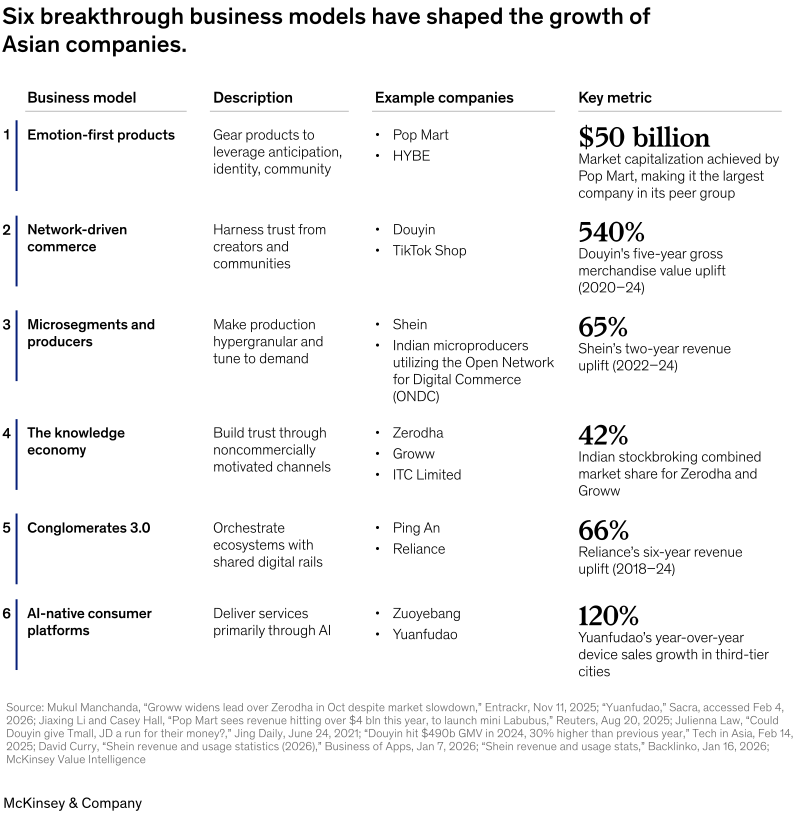
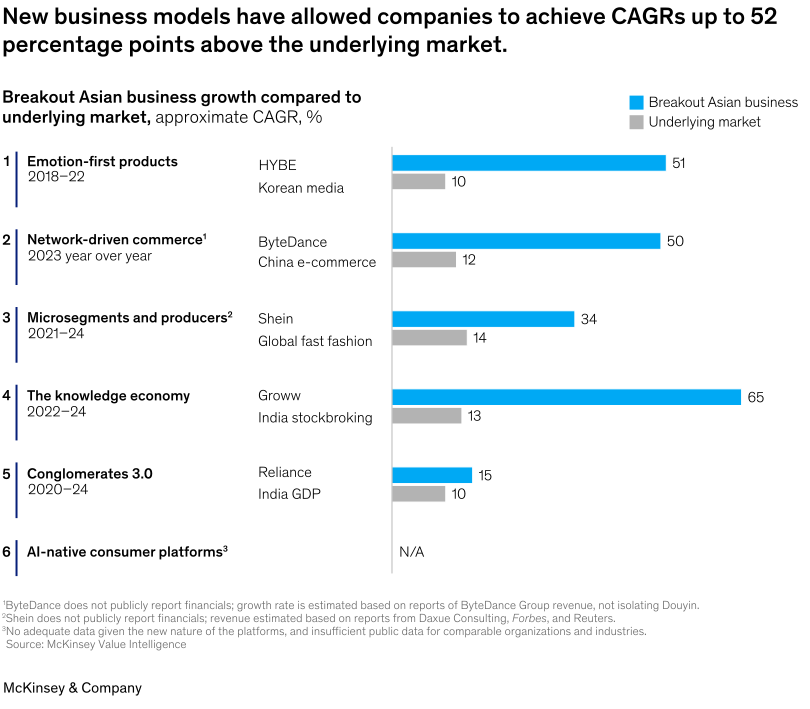
This article outlines the structural environment that has fostered these models, the six transferable business model archetypes (with examples of breakout successes in each), and the associated learnings global companies can take into their own contexts. The potential can hardly be overstated: Using these models, companies in Asia have achieved CAGRs above 15 percent and rapidly doubled their gross merchandise value (GMV). The first global media platform, retailer, or financial institution to harness this potential could define the next frontier of differentiation.
Asia’s foundations for breakthrough business models
The emergence of these novel business models is not accidental. Across markets, four structural dynamics created fertile ground for their development—though they are not required for applying them.
Scale and speed
Asian markets combine massive user bases with high levels of digital adoption. A livestream format, product concept, or digital service can reach tens of millions of users almost instantly, enabling new propositions to be tested at national scale within days.
System-level collaboration
Public–private digital infrastructure lowers friction and increases inclusion. For example, India’s Unified Payments Interface provides real-time payments for hundreds of millions of users. And the country’s Open Network for Digital Commerce (ONDC)—a government-led initiative to create an open e-commerce network—allows even the smallest merchants to access national demand. Similarly, China’s digital identity rails, Singapore’s Government Tech Stack, and Indonesia’s Quick Response Code Indonesian Standard (QRIS) network reduce marginal onboarding costs and raise digital participation.
Depth of digital services
Super-app ecosystems—which host hundreds or even thousands of mini apps—embed payments, identity, logistics, messaging, and credit into a single interface. This lowers the cost of adding new services and fundamentally changes how users interact with media, services, fraud detection, underwriting, fulfillment, products, and more.
Regulation as catalyst
Regulators in several Asian markets encourage digitalization while establishing clear rails for data use and identity security. This has enabled fast and responsible scaling of digital services, with examples ranging from financial inclusion to healthcare triage and logistics.
Six breakthrough business models
Across markets and sectors, six archetypes have helped spur growth for Asian companies of various sizes, resulting in CAGRs that far outpace the underlying market (Exhibit 2).
Emotion-first products: Turning affinity into recurring demand
Emotion-first products are engineered from inception to create anticipation, identity, and community. Rather than treating emotion as a brand-building by-product, these companies treat it as a core economic driver.
Across Asia, companies have industrialized the mechanics of emotional engagement: scarcity, drops, fan rituals, collection loops, live cocreation, and rich narratives for their intellectual property (IP). Pop Mart is a leading example. Its blind-box collectibles—especially the Monsters line, which features the plush Labubu toys—successfully translate anticipation into commercial success. In the first half of 2025, Pop Mart generated $1.9 billion in revenue, with its Monsters IP accounting for more than a third of that.2 As a result, the company grew to become the largest company in its peer group on the back of a 180 percent trailing 12-month revenue CAGR.3
The K-pop ecosystem illustrates a similar logic. HYBE, an agency best known for representing boy band BTS, surpassed $1.6 billion in revenue in 2023 by building communities that span offline concerts, digital content, livestreams, and fan-to-artist interactions on Weverse.4 Fans participate in rituals, cocreate content, and experience a sense of belonging that leads to highly predictable recurring spending across merchandise, albums, digital items, and tickets.
For global companies, the implication is clear: Emotional engagement can be designed, measured, and monetized at scale. Data on user-generated content velocity or community sentiment can complement traditional brand metrics, and this IP can become a multiproduct growth engine rather than a marketing asset.
Network-driven commerce: Scaling trust through creators and culture
The second archetype turns trust—particularly trust in creators and communities—into a primary distribution channel. In Asia, this model has evolved far beyond influencer marketing to become a complete retail system where consumers have embraced shopping within chat, livestreams, and short video to normalize creator-led commerce.
Livestream commerce in China illustrates the potential opportunity. Douyin’s e-commerce GMV grew approximately sevenfold in five years, from an estimated $75 billion in 2020 to $490 billion in 2024, with conversion rates and average order values that often exceeded traditional product pages.5 Southeast Asia mirrors this trend: TikTok Shop’s regional GMV grew nearly fourfold in a year, from $4.4 billion in 2022 to approximately $16.3 billion in 2023.6 Livestream hosts sell in local dialects, embed cultural context, answer questions in real time, and demonstrate product expertise—developing a personal touch beyond what infomercial channels in previous decades could have achieved. This creates an environment that feels more like community support than advertising.
In these markets, star hosts can create outsize returns. On the first day of the 2023 Singles’ Day shopping festival (an unofficial Chinese holiday for people not in a relationship, observed annually in November), Li Jiaqi, a Chinese influencer, drove an estimated 9.5 billion renminbi ($1.3 billion) in GMV in a single day7—more than 13 percent of total online Black Friday sales in the United States for the same year.8
For global leaders, the lesson is not to replicate Asia’s creators but to replicate their trust architecture: transparent claims, live Q&A, local cultural cues, fulfillment clarity, and authenticity. Specific aspects of the Asian model could also be adopted—for example, shifting budget from upper-funnel sponsorships to conversion-linked ones and using SKU-level contribution margins (post-returns) for host commissions and event calendars.
Microsegments and microproducers: Personalization at industrial scale
The microproduction archetype is about matching supply with demand at an extreme pace. Companies across Asia can deliver personalized or small-batch products at unit costs previously associated with mass production.
Shein exemplifies this model. The company’s revenue has been increasing at approximately 29 percent per annum between 2022 and 2024—roughly $23 billion in 2022, $32 billion in 2023, and $38 billion in 2024—while remaining profitable.9 Shein has a production model that enables it to test new designs in batches of 100 to 200 units, versus 300 to 500 for traditional fast fashion brands, such as Zara.10 As a result, the company can quickly reorder items that perform well, and designs can move from concept to production in as few as five days.11 Shein lists 2,000 to 10,000 new SKUs per day, offering up to 1.3 million new styles annually while minimizing unsold inventory—compared to H&M and Zara, which deliver an estimated 20,000 to 25,000 styles annually.12
India’s ONDC demonstrates how digital infrastructure enables microproducers to scale nationally. The company’s monthly transactions increased threefold within a year of its launch, rising from about five million in 2022 to 15 million in 2023.13 With more than 700,000 sellers, ONDC shows how local artisans, home businesses, and small retailers can access national demand through shared identity, payments, and logistics rails.14
Companies outside Asia can adopt this mindset by modernizing supply chains around small-batch experimentation, paying particular attention to niches where personalization can generate incremental demand and margin.
The knowledge economy: Using education to build trust and reduce customer-acquisition costs
In Asia, some companies treat education not as corporate social responsibility or marketing but as a genuine point of difference to bolster the acquisition channel toward their core product offerings. They use free, high-quality knowledge to build trust, reduce customer-acquisition costs, and deepen engagement.
Consider Zerodha, which became India’s largest stockbroker in 2019, just ten years after it launched.15 The company has accrued more than 16 million total customers to date,16 including seven million active users.17 The company built its growth engine on Varsity, a comprehensive, free, ad-free educational platform covering markets and investing. By tapping into the trend of self-education and making a natural link to the company’s broking platform, Zerodha was able to capture a large portion of high-value customers who were already interested in personal finance and investing.
In 2024, Groww overtook Zerodha as market leader for active retail clients, with more than 12 million users (approximately 27 percent share).18 Like Zerodha, Groww relies on education and transparent tools, with public filings indicating that roughly 80 percent of customers find the company organically19 and that customer-acquisition costs represent only 12 to 13 percent of revenue—compared with 20 to 23 percent for competitor AngelOne.20
In South Korea, Toss uses free financial tools—such as credit monitoring, budgeting, and investment education—to build trust before monetizing through financial products.
This trend is not just for finance companies. For example, the India-based conglomerate ITC Limited connects with farmers directly, bypassing traditional channels such as third-party brokers, through its e-Choupal initiative. For more than 20 years, e-Choupal has published daily prices to maintain transparency across agricultural commodities and shared useful agronomy advice and best practices via the internet. With a network across 35,000 villages in India, e-Choupal currently serves four million customers.21 The company has also launched a flagship extension program, Choupal Pradarshan Khet, which demonstrates the latest farming technology to help farmers enhance productivity. The 34,000 farmers who adopted the recommended practices saw their incomes double.22 The e-Choupal initiative is a significant factor in the continued success of ITC, which is one of the 20 largest companies in India by market capitalization,23 and has been a canonical example of how to use knowledge and market access to improve farmer outcomes and procurement economics.
The implication for global markets is that education is emerging as a differentiated acquisition channel, particularly in trust-sensitive sectors such as finance, utilities, healthcare, and insurance. Companies can treat education as a strategic growth asset and monetize adjacent services, rather than content itself.
Conglomerates 3.0: Ecosystems connected by shared digital infrastructure
Next-generation conglomerates are ecosystem-based organizations that move beyond pooling capital, common brands, and shared management expertise. Conglomerates 3.0 integrate multiple verticals through shared digital assets such as identity, payments, data, and loyalty to create a genuine incentive for customers to choose their products over competitors with singular or outdated offerings.
Ping An exemplifies this model by making cross-selling a systemic part of how it does business. The company tracks and reports customer contracts within its ecosystem, which spans financial services, healthcare, auto services, and smart-city solutions, all integrated through a unified identity and data platform. A quarter of retail customers hold four or more contracts. Ping An has also made a clear effort to invest in technological innovation; the cumulative number of patent applications was about 55,000 by 2024, reflecting a 10 percent increase year over year for at least the past two years.24 Many of these applications are in AI and digital capabilities, allowing the group to create a system in which customers move seamlessly between services, with each interaction enriching the data set that powers personalized recommendations, risk assessments, and service automation. This has resulted in both an increase in the number of customers (242 million as of the end of 2024, up 11 percent since 202025) and strong retention (about 72 percent of customers have been with Ping An for five or more years, and the year-to-year retention rate is about 95 percent26).
Another example is Reliance in India, which has built a multifaceted ecosystem across telecommunications, content, commerce, payments, and offline retail. Its digital assets enable cross-vertical bundling and personalized loyalty. Reliance nearly doubled its annual revenues over the past eight years to more than $100 billion, becoming one of the largest companies in the world.27 Similarly, Thailand’s CP Group uses shared logistics, data, and loyalty networks to scale services across agri-food, retail, and adjacent categories.
For leaders outside Asia, the lesson is to understand when shared customers across different parts of the business provide shared digital assets such as data, attention, and access—not just traditional physical shared assets. These assets can then be used to further improve experience while allowing for cross-selling into other parts of the business.
AI-native consumer platforms: Services built without human labor constraints
Across education, entertainment, commerce, and customer service, Asia is leading the shift to AI-native consumer platforms—services delivered primarily or entirely by AI rather than by human labor (see sidebar, “AI as an accelerant and enabler”).
AI tutors are mainstream in markets such as China, India, and South Korea. Platforms such as Tencent Education, Yuanfudao, and Zuoyebang offer millions of personalized practice sessions daily, with Zuoyebang alone reporting more than 170 million monthly active users.28 Yuanfudao—valued at more than $15 billion in 202029—is continuing to expand, growing device sales by 120 percent year over year in third-tier cities.30 These systems adjust difficulty, explanation style, and content based on student behavior, approximating one-to-one tutoring at near-zero marginal cost.
Another form of native-AI services has also gained traction. “Virtual humans”—AI-generated digital entertainers that look and act like human celebrities—are becoming increasingly popular. China’s A-SOUL and South Korea’s MAVE attract millions of followers and produce abundant content that can be monetized through merchandise, concerts, and collaborations.31 On Douyin and Xiaohongshu, AI influencers drive meaningful GMV through short videos. AI-generated hosts, such as Alibaba Cloud’s Digital Human, can maintain consistent personas and adapt scripts based on audience sentiment. AI concierges embedded in livestreams can answer product questions instantly, recommend bundles, and provide sizing or usage advice; algorithms can sequence product showcases based on real-time engagement, and personalized follow-ups replicate the tone and style of each viewer’s preferred host. For brands, this approach enables nuanced message control, unlimited output, and no reputational risk from human behavior. But the approach can also create distance and alienate consumers, so brands need to find the right balance between AI and human interaction.
The economics of this archetype are powerful. For a near-zero marginal cost, businesses get infinite scalability and the ability to personalize for every user. For global companies, AI-native frontline services—whether tutors, advisers, stylists, representatives, or influencers—could rapidly become a competitive necessity. Asian firms are ensuring they have the compute required to support this wave of AI use by being at the forefront of building, planning, and funding data centers.
Lessons for companies in the rest of the world
While these archetypes evolved in Asia, their many success stories suggest that they are transferable. Leaders in other parts of the world can draw five lessons from Asia’s successes.
Customer: Build trust through creators, community, and education
Customers respond to authentic voices; cultural fluency and transparency in the sales channel can help companies scale far more effectively than reach-based marketing approaches. And in categories where customers have much less information than providers—such as finance, healthcare, and energy—free, high-quality educational content can drive acquisition and loyalty more effectively than traditional advertising. While AI can enhance trust, it can only do so when balanced with human signals from the brand.
Product: Create products that balance scale with emotional resonance
Asian innovators demonstrate that emotional connection can be engineered without sacrificing efficiency. Leading firms are combining character-driven narratives and culturally attuned designs to create products that feel personal through microproduction, which is now economically viable through advances in supply chain digitalization and demand sensing. This allows a level of personalization previously limited to small-scale and luxury lines.
Channel: Shift to network-driven distribution
Marketing in Asia has moved decisively away from top-down messaging toward network-driven distribution. This enables an entirely different way for customers to engage with shopping and purchasing: Creators and community figures now play the role of trusted advisers, while AI-generated hosts, personalized concierges, and adaptive recommendation engines engage consumers in real time. These channels convert because they feel intimate and relevant, even when delivered to millions. Leading companies design participatory environments in which the lines between shopping, community, and entertainment are blurred.
Operating model: Share capabilities and assets across the entire business
Asia’s leading firms succeed not by accumulating businesses but by integrating capabilities across them. Ecosystem leaders such as Ping An and Reliance show that value comes from building systems and process that use shared assets so that each new service amplifies the others. This operating model replaces siloed optimization with cross-journey economics and requires redesigning processes for speed, experimentation, and continual iteration.
Technology: Use AI and digital rails across all dimensions
Asian firms that leverage advancements in technology to build new methods for customers to engage and use AI-native services to redefine customer engagement have already created significant value across all breakout models. AI tools can be used to either accelerate existing processes or completely redefine offerings, and both cases can support global leaders in applying these breakout models to their own contexts. However, these tools cannot substitute for the trust between creators and communities. Companies building these systems should find the right balance between AI and credible human anchors and put the highest priority on maintaining trust.
Business models emerging from Asia illustrate new dimensions of global growth—emotionally resonant, trust-driven, personalized, educational, real-time, and AI-enabled. They show that breakthrough growth relies on more than structural advantages; it requires new ways of designing experiences, orchestrating supply chains, and aligning incentives across networks. AI accelerates every dimension of these models. It compresses creative cycles, strengthens trust, enables microproduction, personalizes education, orchestrates ecosystems, optimizes logistics, and powers entirely new categories of AI-native services.
Asia offers a preview of what the next decade of commerce will look like. The strategic question for global leaders is no longer whether these models will spread but how quickly they can be adapted to unlock the next wave of disproportionate, sustainable growth.