Artificial intelligence can write, design, code, and complete tasks at breakneck speed. It can help business leaders draft emails, create agendas, and quickly prepare for important meetings and difficult discussions.
It can do all of that with just a few voice commands—but it still can’t do the hard work of leadership itself. Generative AI cannot set aspirations, make tough calls, build trust among stakeholders, hold team members accountable, or generate truly new ideas.
That work remains deeply human—and more important to get right than ever before, given the scope of change and uncertainty with which today’s organizations are dealing.
The leaders who end up thriving in the AI era will be those who blend human depth with digital fluency. They will use AI to think with them, not for them. And they will treat this AI moment not as a threat to their leadership but as an opportunity to focus on those elements of their portfolios that only humans can excel at.
The core shift: From “command” to context
Recent McKinsey Global Institute research on skill partnerships in the age of AI suggests that people, agents, and robots will increasingly be working side by side to facilitate workflows. In this environment, CEOs and other C-suite leaders will not always be the smartest people in the room. As a result, traditional command-and-control approaches are likely to fall flat. It will be much more important, instead, for these leaders to create the context in which their teams can successfully navigate AI-informed process changes, role changes, and other internal and external business disruptions.
Leaders will need to give teams a set of guardrails (clear values and decision rights) and establish new definitions of quality while fostering a sense of trust and collaboration as new challenges emerge and business conditions evolve. There are three areas, in particular, where only humans can provide the type of leadership and guidance required in today’s organizations:
1. Setting the right aspiration—and enrolling others to own it
Aspirations are uniquely human; a robot cannot set an ambitious goal for an entire organization, whether targeting high performance, innovation, or growth. Leaders can “read the room” and anticipate and interpret emotional reactions to change, which is critical for understanding how best to mobilize people and enroll them in the organization’s strategic plans. Only an empathetic leader can identify preferences and map the right people to the right projects. Leaders can of course use agents and machines to help draft their messaging, but they cannot delegate aspiration setting.
2. Demonstrating judgment—aligning choices to values
The ability to show good judgment is a distinctly human trait. AI can summarize rules or outline risks, but its role is advisory, not authoritative. And while AI models can analyze and create structure around arguments, they don’t ultimately bear any responsibility for their outputs. By contrast, leaders in the physical world must be accountable to their employees, boards, investors, business partners, and other important stakeholders. They must make the hard calls when an organization’s values are in conflict and time is short. McKinsey’s research on organizational health shows that leaders’ decisiveness, accountability, and demonstration of good judgment can not only unlock trust and loyalty across teams but are also a key predictor of companies’ ability to create long-term value.1
3. Designing for nonlinear outcomes—not 20 percent, but 10 times better
In a world where global, societal, and technological forces are changing so dynamically, the ability to foster novel and creative ideas is becoming a critical leadership muscle: Leaders must continually review, revise, and create new architectures, narratives, and conditions for their organizations. This is the antithesis of “playing not to lose.” The AI models that leaders are using are inference engines, optimized to generate the next most probable continuation of patterns the models have seen. But only human leaders can recognize when AI outputs will lead to actual breakthroughs for an organization. They must do the hard work of framing—that is, set an audacious brief, define the guardrails, invite dissent, and then hold the creative line when early iterations are messy.
Identifying and developing your high potentials
Aspiration, judgment, and creativity are “only human” leadership traits—and the characteristics that can provide an irreplaceable competitive edge, especially when amplified using AI. It’s therefore incumbent upon organizations to actively identify and develop the individuals who demonstrate critical intrinsics like resilience, eagerness to learn from mistakes, and the ability to work in teams that will increasingly include both humans and AI agents. As McKinsey explored in its research on the CEO as elite athlete, these characteristics are strongly linked to sustained performance and are a better predictor of long-term success than credentials alone.
While identifying high-potential employees, senior leadership teams may need to tear through the “paper ceiling” in their organizations—that is, where the lack of formal credentials prevents individuals from being hired or advancing. This will require looking beyond academic degrees and certifications when vetting candidates and emphasizing skills-based hiring, relevant real-world experience, and the intrinsics that travel across roles and technologies.
Best-in-class companies are already focusing more on the skills that a job requires and that a candidate possesses. They are implementing a fundamentally different assessment system, one that is more audition than interview: live scenarios with incomplete information, structured questions that test value-based judgment, and rapid stretch-role moves that reveal trajectory.
Building the next generation of leaders
If the role of the leader is evolving, then so must organizations’ approach to building their leadership bench. The goal here should not just be to develop leaders who have technical fluency; mastery of the human condition is just as critical in a world where models can draft, reason, act—but cannot lead.
Previous McKinsey research on the art of 21st-century leadership and the importance of building and scaling a robust leadership factory points to four imperatives for leaders in the age of AI:
Know what attributes you’re looking for. Make explicit the leadership attributes your company needs right now and the behaviors you will reward. If economic and competitive shocks are particularly frequent or particularly acute in your industry, for instance, you may want to focus on resilience and optimism as the key character attributes to find and build in your high-potential employees.
Create a step-change in learning culture—learn a little, test a little, learn a lot. Establish a culture in which premortems, after-action reviews, and other feedback mechanisms are the norm rather than the exception. This has long been the standard approach in the software industry and the medical community: achievements are celebrated, failures are painstakingly reviewed, and lessons are codified. Former Intuit CEO Brad Smith would schedule regular meetings with employees who were several levels down in the organization and would ask them: What’s getting better, what’s going in the wrong direction, and what’s something you’re afraid no one is telling me that I need to know right now? “It was incredible,” he recalls, “because you skip levels and go right to the front lines of the area you’re trying to learn about. You cut everybody else out and eliminate the filter.”2
Senior leaders can show their commitment to creating learning environments by engaging directly with high-potential employees, in forums or town halls, to share questions and crowdsource answers to some of their biggest management challenges.
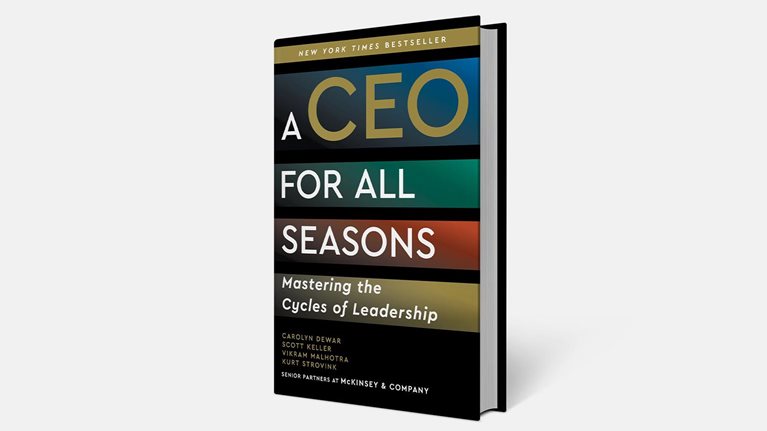
Invest in building trust and servant leadership. Organizations must actively cultivate core leadership qualities such as wisdom, empathy, and trust—and they must give the development of these attributes the same attention they do to the development of new IT systems or operating models. That will mean providing time for leaders to do the inner work required to lead others effectively—that is, reflecting, sharing insights with other C-suite leaders, and otherwise considering what success will mean for themselves and the organization. How can they build and sustain organizations that can remain viable long term? In A CEO for All Seasons (Scribner/Simon & Schuster, 2025), Microsoft CEO Satya Nadella recalls an important lesson from his father, a civil servant in India, who emphasized the importance of mentoring and meaningful transitions: “I feel that if the next CEO of Microsoft can be more successful than I am, then maybe I’ve done my job right.” Indeed, as a sign that the leadership journey is just as important as the outcomes, organizations should publicly celebrate or promote leaders who demonstrate a commitment to the organization’s broader mission rather than self.
Protect your time and energy for sustained performance. The highest-performing leaders create conditions that allow them to reach their personal best at peak moments; they recognize that, over the course of their leadership tenures, some moments are simply more important than others—so they optimize for those critical inflection points. They fiercely protect their calendars, so they can focus on tasks that only they can do, and they carve out time explicitly for recovery and regeneration. For instance, one global tech CEO keeps 20 percent of his calendar empty so he can catch his breath and respond appropriately to situations as they arise.3
Leadership is ultimately a uniquely human endeavor.
AI may transform how we work, but only human leaders can determine why we work and what we’re trying to achieve.
Indeed, the ultimate competitive advantage for organizations in this AI era won’t be based solely on the algorithms they create—it will also be based on the authentic, adaptive, and accountable leaders they develop.