| This week, the dog days of summer come early for travel and hospitality. Plus, we look at how companies can tailor their approaches to remote working, and McKinsey partner Ana Mendy on how diversity goals shouldn’t be put off. |
|
|
|
| Ah, summer vacation. The sweet anticipation of a comfortable place to stay, a great pool for the kids, and all those dinners out at the beach. Or ... maybe not. Amid global uncertainty about how safe it is to travel, many have opted to delay, reschedule, or outright cancel long-awaited trips. |
| Bumpy road ahead. The travel and hospitality industry, already facing disruption from waves of consolidation, pressure to digitize services, and a growing public awareness of sustainable flying, is now suffering huge losses in its peak travel season. According to a recent industry estimate, the US tourism industry will lose more than $500 billion by year’s end. |
| A chance for renewal. How can travel and hospitality leaders weather this period? First, they should address immediate concerns about the ability to travel safely: new protocols for cleanliness and hygiene, such as contactless check-ins, matter in a pandemic. But more broadly, industry leaders can use this time to make travel better, not just safer. For some, the romance that travel used to inspire was already wearing thin before the crisis, with crowded flights, crowded museums, and other annoyances. |
| Authenticity is key. Travel companies need to excite and attract customers. Companies should reassure their existing customers—and engage with new clients—by focusing on personalization and authenticity. They should give travelers more control over their itineraries by making it easier to change or cancel their plans—such as by sending updates on the health stats of a destination city. In uncertain times, travelers respond to being treated with care and empathy. These small touches along the customer journey can help a brand distinguish itself now and into the future. |
| Vacancies aplenty. Recovery may take a while for the hospitality industry, with its millions of layoffs, plunging occupancy rates, and bankruptcies. In our more optimistic scenario, McKinsey analysis shows that the earliest possible recovery for US hotels may be no sooner than 2022, after a projected decline of more than 50 percent in revenue per available hotel room in 2020. |
| A brighter future. While those numbers are sobering, there are reasons to be optimistic that travelers will turn a corner. In our latest global economic survey, respondents were more upbeat about consumer trends than they have been in months. And don’t forget that travel is about the desire to build memories, connect with people, and see new places, which drove 1.4 billion of us to travel internationally in 2019. We’ll be back. |
|
|

|
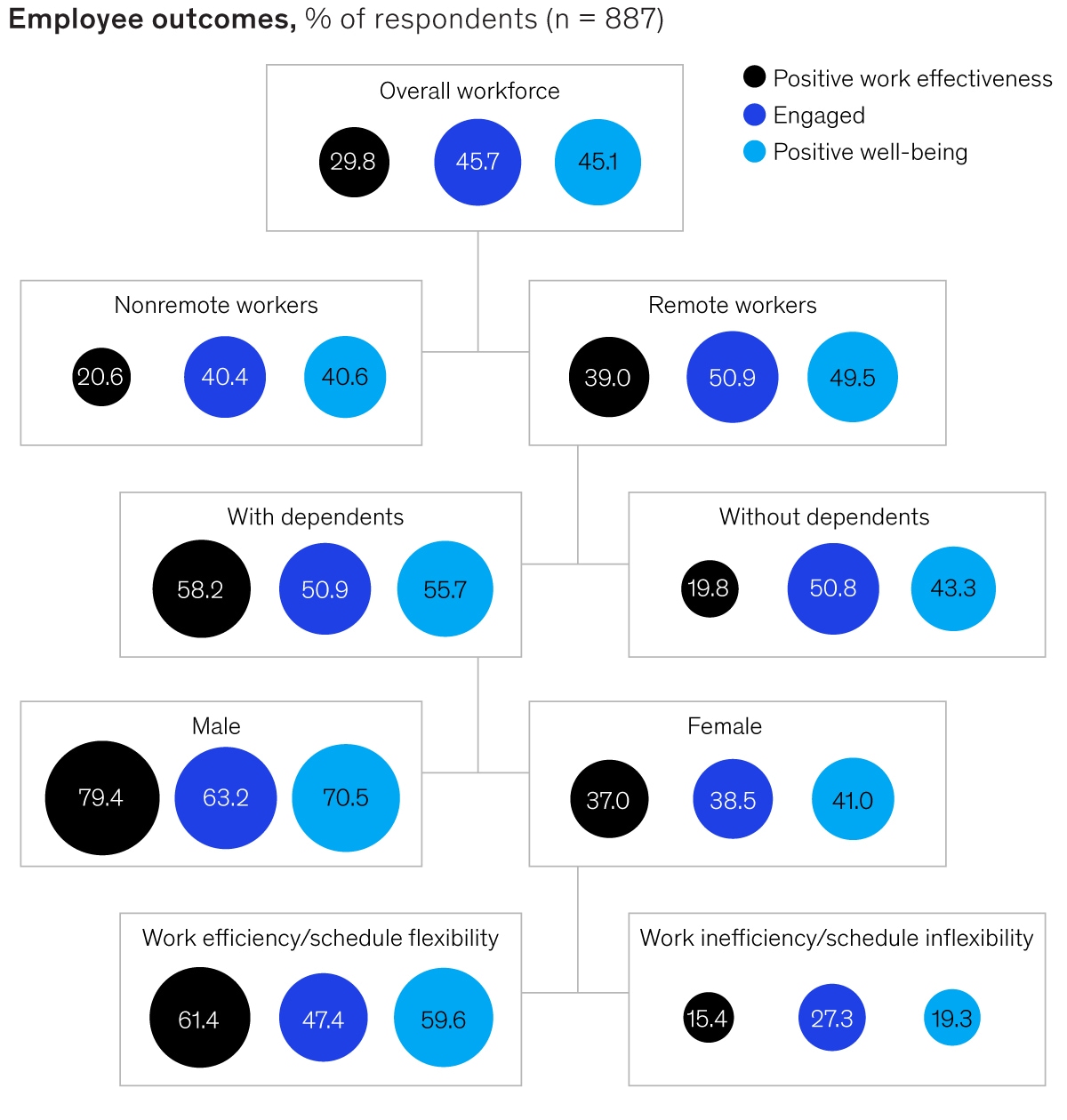
| OFF THE CHARTS |
| Employee needs are changing … |
| … and organizations should evolve with them to build on the positive marks they earned early in the pandemic. Companies can create more tailored responses to workplace challenges to show they understand that the range of remote-work experiences is wide, from the very positive to the very negative. |
|
|
|
|
|
|
|
|
| INTERVIEW |
| Helping patients where they are |
| Alan Lotvin, the president of CVS Caremark, has a unique vantage point from which to survey the US healthcare system. He spoke with McKinsey recently about his company’s efforts to serve patients during the COVID-19 pandemic and the opportunities to strengthen healthcare, including a shift to in-home models. |
|
|
|
|
| MORE ON MCKINSEY.COM |
| Generation Z in Asia–Pacific is different | Brands need to be both agile and stable, regionally aware and locally focused, social-media savvy and respectful of privacy, all while being able to tell a compelling story. It’s complicated, but as Generation Z’s influence rises, it’s well worth the effort. |
| European happiness takes a hit | The average life satisfaction in Europe, which has consistently led the world in well-being, has fallen to its lowest level since 1980. The drop shows why leaders can’t afford to ignore another critical consequence of the pandemic: the toll on happiness. |
| Five priorities for corporate India | The COVID-19 crisis has highlighted the weaknesses and the strengths of India’s large businesses. Now executives have an opportunity to make changes that will see their companies through the downturn and position them for long-term success. |
|
|
|
|
|
| THREE QUESTIONS FOR |
| Ana Mendy |
| Ana Mendy, a partner in McKinsey’s Southern California office, helps organizations with crisis response, diversity, inclusion, culture, and change management. She is a member of GLAM, McKinsey’s worldwide network of LGBTQ+ colleagues.
|
|
|
|
|
| Many organizations around the world are moving to strengthen their commitments to diversity and inclusion. What are the benefits? |
| First of all, our latest report on diversity, Diversity wins: How inclusion matters, reveals the strongest correlation yet between diverse organizations and better financial performance. Companies with greater levels of diversity on their executive teams are more likely to financially outperform their peers. |
| Yet progress has been slow overall. To change that, companies should focus on advancing diverse talent into executive, management, technical, and board roles. They also need to set the right data-driven targets for the representation of diverse talent. |
| Despite signs of progress, the business case for inclusion has not translated into solid gains for the LGBTQ+ community at work. How can that change? |
| To engage a new generation of workers and consumers—many of whom choose careers and products based on diversity and inclusion—companies must move beyond public gestures of support for LGBTQ+ issues to create a more positive work experience. |
| To make meaningful progress for LGBTQ+ employees, companies can start with a few basics, including stamping out inappropriate behavior and reducing the “only” experience during recruitment by broadening their pools of diverse candidates and proactively providing them with feedback after their interviews. They can adopt blind résumé screening—removing names, gender signifiers, and affinity-group affiliations—to reduce the role of unconscious bias in hiring decisions. They can also strengthen employee-resource groups by offering dedicated resources for LGBTQ+ employees. |
| Trans people face especially sharp barriers to advancement in the workplace, and their experiences are distinct from those of cisgender people who also identify as lesbian, gay, bisexual, or queer. People who identify as trans in our research set are roughly the same age as cisgender people, but they are much more likely to be in entry-level positions and less likely to have management, evaluation, or hiring responsibilities. And they’re more likely to view their gender or sexual orientation as a barrier to advancement. |
| While not all headwinds can be corrected by companies, they can take clear steps to improve the experience of trans people. These include making health coverage inclusive of trans people, supporting leave for transitioning colleagues, and ensuring that HR systems are inclusive of all employees’ genders and pronouns. |
| Additional efforts are needed now in the coronavirus era, with the added isolation of remote working. Proactively highlighting the company’s support for the LGBTQ+ community, as well as establishing direct lines of communication with all remote workers to see what support they need, can help ensure that all employees feel safe. |
| How can organizations create change that not only has an impact but also is sustainable? |
| I’m encouraged by the recent conversations I’ve had on diversity. We’re starting to hear from clients across industries—for example, companies in food and beverage wondering how they can drive diversity through their supply chains and companies in financial services asking how they can tailor their product offerings to broader, more diverse populations. We’re also seeing clients who had, frankly, deprioritized their diversity and inclusion efforts during COVID-19 because they were just trying to survive. And now they’re roaring back and saying they’ve made a mistake—that this is as important as anything else, and we need to get this right. |
| I think the question for companies is, how do we keep up this momentum? How do we maintain the intensity we feel about this to make long-term change? If we’re willing to put so much time and effort into standard business initiatives, then we need to be willing to make an even longer and bolder commitment to equity. |
|
|
|
| BACKTALK |
| Have feedback or other ideas? We’d love to hear from you. |
|
|
|
|
|
Copyright © 2020 | McKinsey & Company, 3 World Trade Center, 175 Greenwich Street, New York, NY 10007
|
|
|
|