| This week, we focus on the task ahead for Europe as economies there gingerly reopen. Plus, how the pandemic is speeding up five key trends in China’s economy, and questions for Ian Lyons, a doctor with the UK’s NHS and McKinsey expert who is returning to the front lines of medicine to help patients with coronavirus. |
|
|
|
| As millions across Europe emerge from quarantine amid one of the greatest economic and humanitarian shocks of our time, the stakes are, needless to say, high. The EU is now in its worst recession as a bloc, with its economy expected to contract by 7.4 percent this year—significantly more than in the global financial crisis in 2009, when it shrank by around 4.5 percent. European consumer confidence has fallen to its lowest level in more than a decade. |
| The road to recovery will be thorny. With European businesses at a virtual standstill, unemployment will likely rise, even as countries take their first tentative steps to reopen. According to McKinsey analysis, up to 59 million employees in the EU and UK could be at risk of losing their jobs. Still, governments and businesses that plan ahead are in a better position to respond to these challenges. Sponsoring reskilling initiatives; expediting hiring processes, particularly in critical sectors; and shifting employees in response to changes in demand are some ways that leaders can protect workers. |
| Not the same workplace. McKinsey estimates that one-fifth of the workforce in the EU and the UK are working remotely in the age of COVID-19 (particularly in the information and communication, professional-services, and financial-services sectors). Teleworking may even become a permanent fixture of working life. As employers discover that workers are just as productive, or even more so, while working from home, demand for office space may decrease. |
| A shift to online channels. As one example of the digital shift, online sales accounted for 22 percent of all the UK’s retail transactions for the month of March—a record high. The migration to digital, however, extends way beyond retail. Doctors are seeing patients remotely, schools have shifted to online classes, and McKinsey surveys on consumer sentiment indicate that Europeans expect to increase spending on online entertainment. |
| Public health in the spotlight. As Europe “returns to life,” leaders will need to assess the strength of their public-health systems, including the ability to test for the novel coronavirus rapidly and accurately, educate the public, and secure needed medical resources (including personal protective equipment). It is critical that governments slow the spread of the virus and prevent a potential second surge of infections. |
|
|

|
| OFF THE CHARTS |
| Factors for a safe restart |
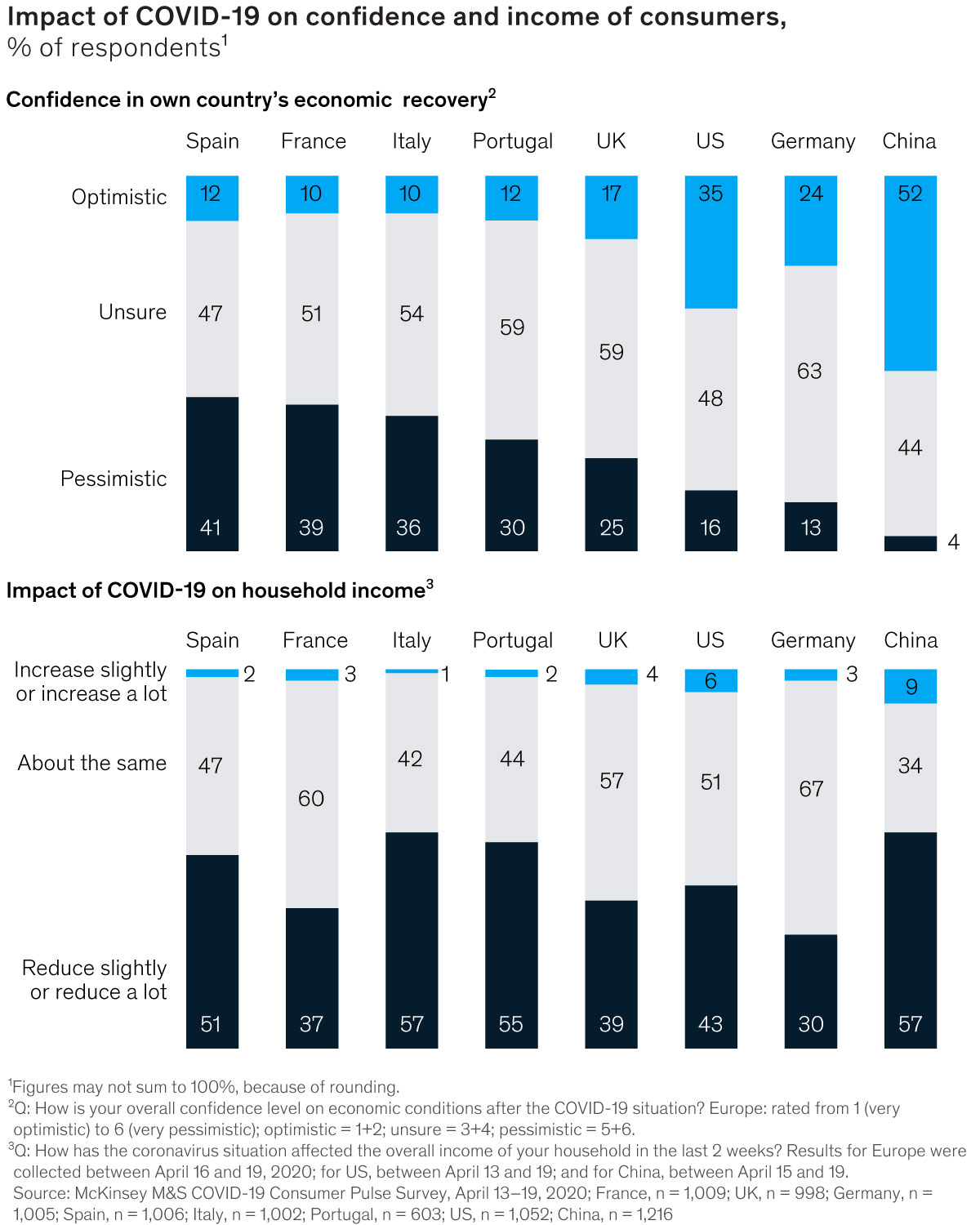
| As restrictions are loosened in many countries over the next few weeks, companies are grappling with questions that a return to business raises. For B2C companies, it will be essential to understand the impact of the crisis on household purchasing power and to gauge the level of confidence people have in the economic future of their country and of their own household. Companies that serve clients in several sectors will need to take into account the highly variable level of exposure of industries to the crisis. |
|
|
|
|
|
|
|
|
| INTERVIEW |
| General James Mattis on leading under pressure |
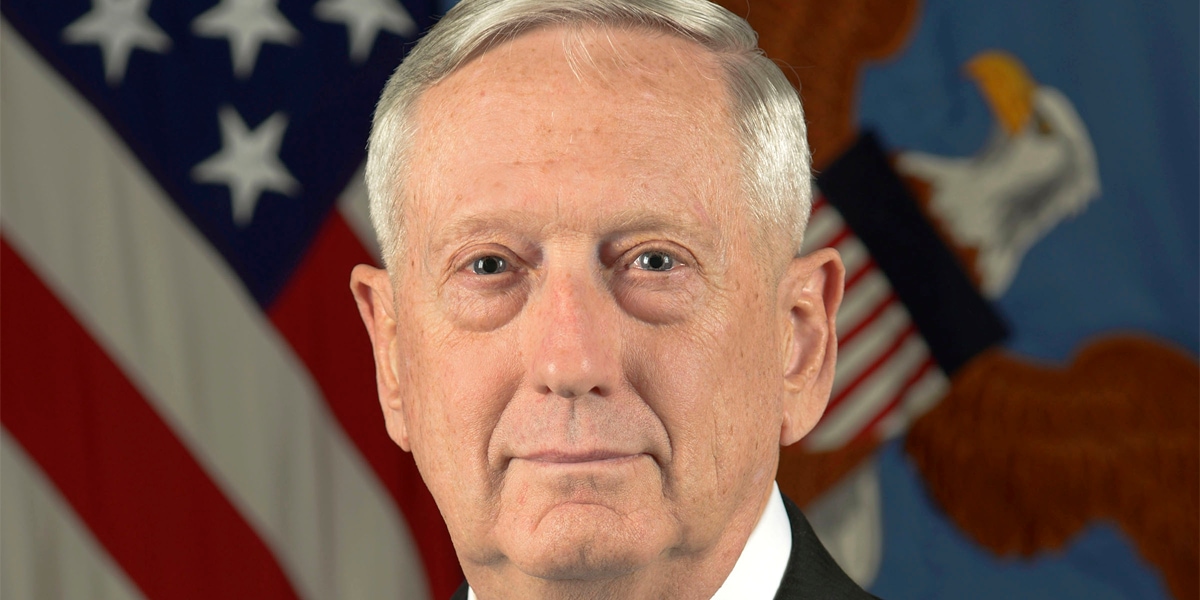
| Over his distinguished military career, General James Mattis has dealt repeatedly with tough situations that require leaders to react to “cascading dilemmas” while planning for a range of future scenarios. He recently spoke with McKinsey global managing partner Kevin Sneader about how to emerge from the pandemic and prepare for what comes next. “You have to start with data. If you can only quantify 10 percent of the problem right now, then start there. As more data comes in, you replace assumptions with knowledge. Then you need to apply your judgment.” |
|
|
|
|
|
|
| THREE QUESTIONS FOR |
| Ian Lyons |
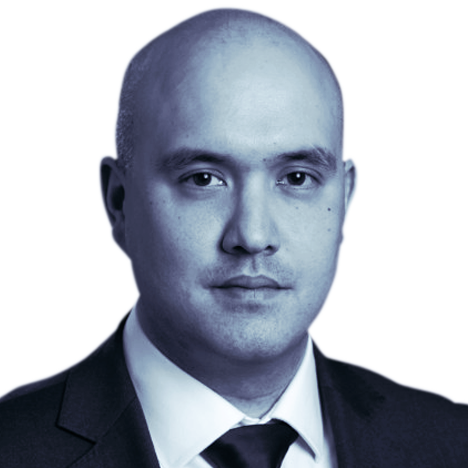
| Hundreds of former doctors, nurses, and other healthcare professionals now work at McKinsey. As the coronavirus pandemic strains healthcare systems, many of them have returned to the front lines to help. Ian Lyons, a doctor turned expert in our Healthcare Systems & Services Practice, is one of them.
|
|
|
|
|
| Can you tell us a little about your background? |
| I took a fairly circuitous route in medicine. I was in medical school for about nine years and eventually specialized in anesthesiology. I then practiced as an NHS England doctor for about seven years in the Midlands, mainly in intensive-care medicine. |
| My work was hugely rewarding at the patient level. Over time, I began to see the underlying issues that drove people to hospitals in the first place. These included poor access to care, poor care coordination, and other inadequacies at the system level. |
| It wasn’t an easy decision to leave medicine, but in joining McKinsey, I’m trying to address some of the same health-system challenges I encountered as a doctor—but from a different angle. |
| What will you be doing for NHS? |
| Early on in the current crisis, NHS asked former doctors who left the service fewer than three years ago to return and help alleviate the national doctor shortage. I talked it over with my fiancée, who is a pediatric surgeon, and we agreed that I would return to the front line. |
| I’ll be going back to work in the intensive-care unit of my old NHS England hospital in the East Midlands. There, I’ll be dealing with incredibly sick patients to ensure they get the care they need. |
| I’m worried about getting sick—as anyone would be. But I find that I’m worried a lot more about the patients, who are suffering and dying, and about my fellow healthcare workers, all of whom are trying to deliver the best care under unprecedented circumstances. |
| How are you preparing? |
| For me, there are personal, clinical, and professional aspects to it. On the personal side, I’m doing all the things you’d expect someone to do when they get ready to live away from home and the person they love. As a doctor, I’ve been studying as much as possible and taking NHS training courses in the evening to brush up on my skills. And as a firm member, I’ve been making sure that I’m leaving all my work in a good place with my teams and our clients. |
|
|
|
| BACKTALK |
| Have feedback or other ideas? We’d love to hear from you. |
|
|
|
|
|
Copyright © 2020 | McKinsey & Company, 3 World Trade Center, 175 Greenwich Street, New York, NY 10007
|
|
|
|