| This week, The State of Fashion 2020 reveals how this era of intense competition and economic uncertainty is forcing fashion companies to sharpen their decision making while also catering to local tastes across multiple markets and cultures. Plus, rewarding hard and soft skills, and questions for Kevin Carmody, a McKinsey senior partner, on the role of balance sheets in building resilience. The Shortlist team is taking a quick break to celebrate the US Thanksgiving holiday; we’ll see you back here in December. |
|
|
|
| “Challenging,” “disruptive,” “uncertain” ... these are the words business leaders most frequently chose to describe today’s global fashion industry. In The State of Fashion 2020, our fourth annual report in partnership with The Business of Fashion, industry execs largely expressed pessimism about the coming year’s economic climate. |
| In last year’s report, nearly half of survey respondents suggested that industry conditions would improve. This time around, only 9 percent were willing to say the same. |
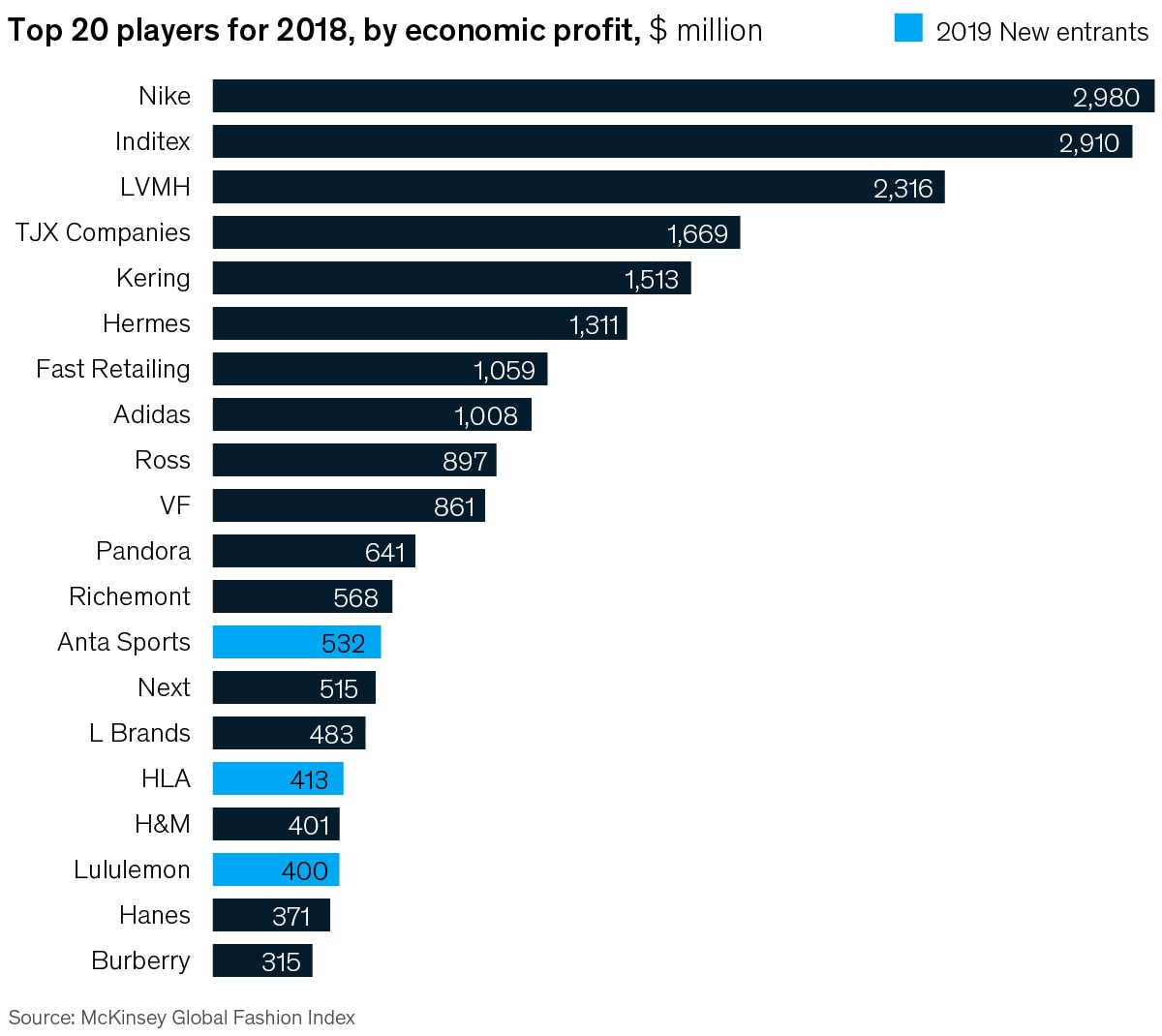
| Against a backdrop of a global economic slowdown, we are forecasting that, in fashion, growth will slow to 3 to 4 percent in 2020. One notable exception: the industry’s “Super Winners”—the top 20 most profitable companies. |
|
|
| What are these Super Winners doing right? In addition to being obsessed with customer service and experience, they are big and global, innovative, and crucially, able to attract both financing and talent. |
| To succeed in these uncertain times, fashion execs will have to act quickly and decisively. They’ll need to be clever, strategic users of social media and digital technologies. And in increasingly connected markets, they should be prepared to address both consumer and employee concerns related to environmental and social issues like sustainability, gender equality, and diversity and inclusion. |
|
|

|
|
|
| PODCAST |
| When scaling AI, don’t forget people and processes |
| By now, it’s common knowledge that artificial intelligence (AI) holds immense promise across a wide range of applications. But how far along are most companies on the road to adoption at scale? When you look at the organizations furthest ahead, how did they get there and what are they doing differently? In this McKinsey Podcast, we speak with partners who know. |
|
|
|
|
| MORE ON MCKINSEY.COM |
| Are hard and soft skills rewarded equally? | Companies should encourage employees to acquire new skills—both hard and soft—but there have to be rewards too. |
| Disruption 2.0 is here | New technologies are transforming industrial, technology, and consumer companies. How can these companies improve their margins and growth while funding innovation? Here’s a smart three-step approach. |
| A new focus in shale’s quest | Production from shale wells declines quickly, but operators can cushion the fall. Sustaining base production is often the best use of capital, a quick way to generate cash, and a key pillar for producers seeking to transform their operations. |
|
|
|
|
|
| THREE QUESTIONS FOR
|
| Kevin Carmody |
| Kevin Carmody, a senior partner in Chicago, specializes in corporate restructurings and transformations, and has been a senior adviser to management teams, boards of directors, and distressed investors.
|
|
|
|
|
| As the global economic picture remains uncertain, a new mantra echoing in many C-suites is resilience. What makes a company resilient? |
| Companies looking to build resilience today can take three important steps. First, they can enhance the role of the CFO and finance team in strategic planning, business analytics, and decision making at all levels of the organization. The best way to do this is to embed finance managers alongside business-unit leaders and empower them to be true partners in running the business. |
| Second, companies can pressure-test their capital structure and cash flows using a range of scenarios, from an economic crisis to other disruptive events, and then use this information to build solid resilience plans. |
| Finally, companies can take immediate action to harvest hidden value from their balance sheets by employing a disciplined approach to managing assets and liabilities. With some foresight, these three steps can fortify the balance sheet and strengthen a company’s position relative to its peers. |
| What role can the finance organization play in building resilience? |
| While most CFOs have a role in setting company strategy, the rest of the finance organization is sometimes viewed as passive scorekeepers. Best-in-class organizations, in contrast, expect their finance professionals to play a substantial role with business-unit leaders to set strategic business priorities. In these organizations, finance teams utilize innovative performance-management tools to help determine how the business is actually performing and suggest the steps that management could take to optimize results. |
| These tools provide deep insights into the business, beyond the traditional metrics grounded in the income statement. They help communicate to the entire organization the importance of return on invested capital, cash-conversion cycle, and other capital-structure ratios. In some cases, the finance function must also advocate against aggressive (and popular) growth plans. When done well, engaging in performance dialogues creates a cultural change throughout the enterprise in which every line manager understands how his or her actions will strengthen the company. |
| How can companies manage the assets and liabilities on their balance sheet better? |
| Our research shows that the management of working capital is surprisingly variable, even among companies in the same industry. In the consumer discretionary sector—which includes travel, entertainment, and apparel—we have seen cash-conversion cycles vary from 13 to 101 days. In healthcare, it ranged from 49 to 179 days. We find that large companies that make a focused effort can typically free up more than $100 million from working capital and redeploy it to other priority projects. |
| We see a similar upside with companies that consistently track cash returns on an asset level. By analyzing metrics such as P&L at a granular level, companies can more effectively identify where to divest underperforming assets and where to redeploy capital to strengthen the balance sheet or invest in higher-yielding opportunities. |
|
|
|
| BACKTALK |
| Have feedback or other ideas? We’d love to hear from you. |
|
|
|
|
|
Copyright © 2019 | McKinsey & Company, 3 World Trade Center, 175 Greenwich Street, New York, NY 10007
|
|
|
|
| |