| This week, why business building is the new priority for growth. Plus, China’s executives lead the world in optimism, and Kate Smaje, the global leader of McKinsey Digital, on why digital is crucial for business leaders to grasp on the path to the next normal. |
|
|
|
| Fresh start. Companies that prioritize business building—creating new products or services outside a company’s existing footprint—tend to grow faster than their peers do. They also respond with greater resilience to volatility and economic shocks and, as they gain experience in building businesses, see higher returns. |
| A recent McKinsey global survey of more than 800 executives across a range of industries and geographies showed that business building has been the top priority for organic growth at companies during the COVID-19 pandemic and that incumbents are launching new businesses with ever-greater frequency. Of the surveyed executives, 52 percent told us they considered business building a top three (or higher) strategic priority for growth in 2020, up from just 30 percent between 2017 and 2019. Those companies are allocating, on average, one-third of their organic-growth capital to business building—more than twice as much as others do. |
| Upward mobility. More companies adopting successful business-building practices might well prompt a new wave of innovation that could boost organic growth and improve the prospects of companies looking to jump into the top tier of performance. |
| Necessity is the mother of … innovation. The COVID-19 crisis has accelerated and intensified the business-building trend as companies search for more innovative business models, products, and services to meet the challenges and opportunities of a digitizing world. In many industries, the crisis has upended assumptions while diminishing or threatening to diminish existing revenue streams. Replacing lost revenues, of course, requires finding new forms of growth. And while M&A remains an essential part of the growth playbook, organic growth often creates greater excess returns to shareholders than deal making does, even in noncrisis times. |
| The scaling-up problem. But not all companies succeed: only 24 percent of new businesses launched in the past ten years are viable large-scale enterprises today. Businesses that can’t scale up their operations encounter a range of barriers to success, from insufficient resources to a lack of operational freedom from the core business. The two reasons cited most often by business builders still struggling to succeed were a lack of adaptability and inadequate strategy for scaling the business. |
| Big incentive. Low as the new-business success rate might be, our survey results show that companies that have launched at least four new businesses in the past ten years were more than twice as likely to generate returns of five or more times their investment than less frequent business builders were. |
| Focusing on leadership helps. To get there, companies must deliberately develop new capabilities: structuring, leading, and staffing new ventures; building a deep, nuanced understanding of the market opportunities; and creating successful long-term strategies for acquiring—and keeping—customers. CEOs of parent companies must also counter the familiar arguments against business building, as well as the internal doubts that organizations can progress beyond their traditional operating models and ways of thinking. |
| When done right, business building offers a remarkable potential payoff to incumbents: the chance to marry a start-up’s agility and rapid growth potential with the resources and wisdom of an established company. That is a powerful combination. |
|
|

|
| OFF THE CHARTS |
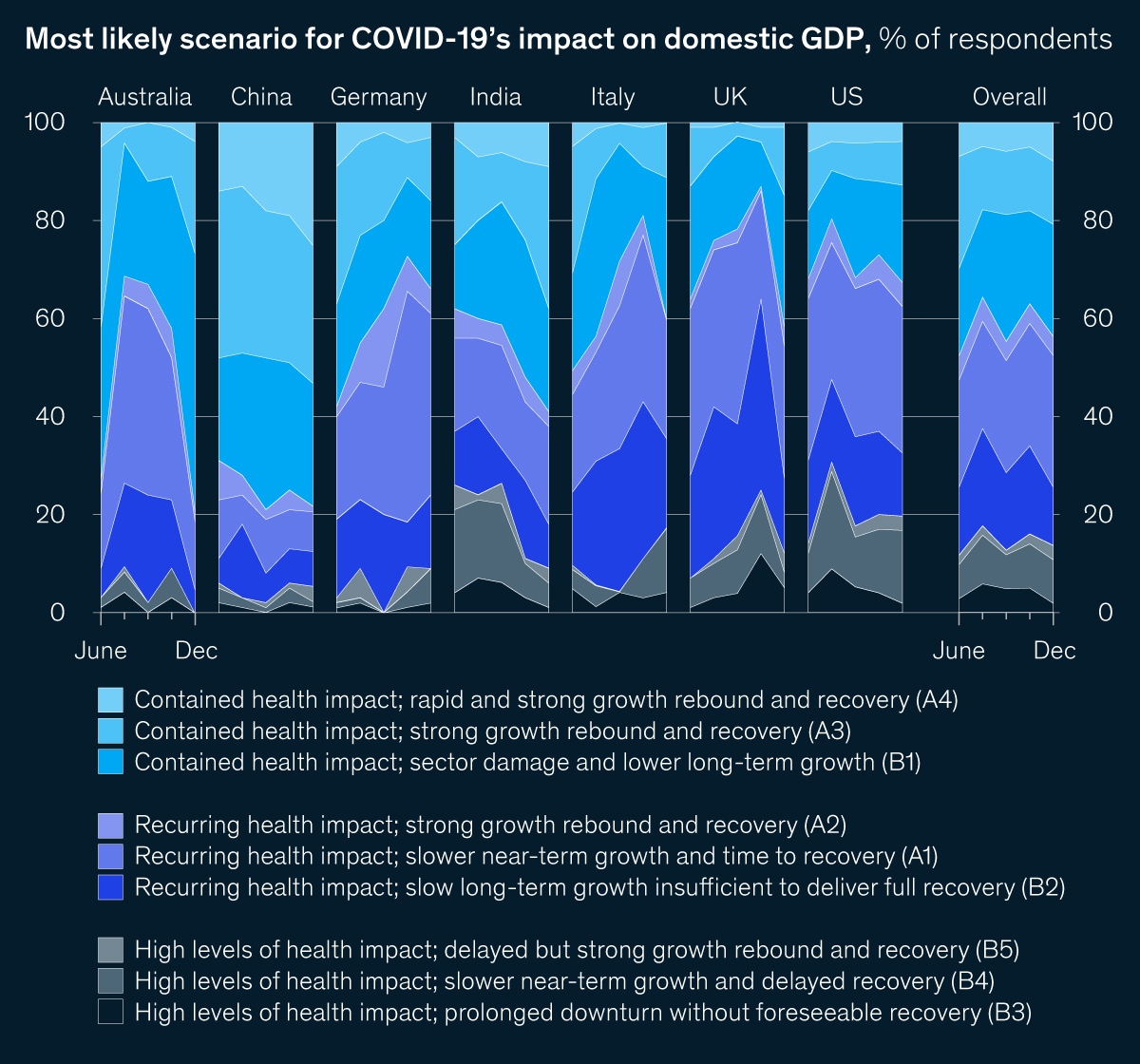
| China’s executives: The world’s most optimistic |
| Since June, we have surveyed thousands of global executives on what the COVID-19 crisis’s impact would be on domestic GDP, based on the likelihood of nine economic scenarios. Throughout that time, respondents in China have reported a consistent—and consistently more optimistic—outlook compared with other regions. |
|
|
|
|
|
|
| MORE ON MCKINSEY.COM |
| More than a mission statement | A framework called “the 5Ps” can help organizations make purpose real for their employees, steer clear of potential vulnerabilities or blowback, and answer the question, “What would the world do if your company disappeared?” |
| Stronger, fitter, faster: The rise of the Asian corporation | Leading CEOs in Asia explain how the COVID-19 crisis has accelerated five business trends in the region and why they’re confident that unprecedented opportunities lie ahead. |
| Chemicals and capital markets | The global chemical sector has trailed the market over the past five years. Research shows that the fundamentals—ROIC performance and revenue growth—are the metrics that investors reward the most. |
|
|
|
|
|
| FOUR QUESTIONS FOR |
| Kate Smaje |
| Kate Smaje, the global leader of McKinsey Digital, works with consumer-facing companies on digitally enabled strategies and marketing, operational, and organizational initiatives that will help the digital transformation of their businesses.
|
|
|
|
|
| Why is digital absolutely critical for business leaders to understand on the path to the next normal? |
| It’s really hard to join any company board meeting right now and not talk about how important technology is—as both an opportunity and a threat—in reshaping their business system. The impact of COVID-19 has only made this more relevant as companies have increased service to their customers, both B2B and B2C, through digital channels. |
| Leaders have had to make high-stakes decisions fast to ensure the resilience of their operations as these shifts have taken place, highlighting the importance of good, accessible data. It’s hard to believe that businesses will emerge from this crisis stronger by reverting to earlier ways of operating, so digital, technology, and data are only going to become more important. |
| Only one or two companies in each sector are significantly outpacing competitors. Why is that the case? |
| Digital business models often bring together huge volumes of customer data to get momentum going. They are able to tempt customers earlier with a great experience, then learn more and faster about what customers really want to make it better, and then use that information to identify looming threats and the best partners in defending value chains under digital pressure. |
| It’s a virtuous cycle and hard to break. Take, for example, how you buy your groceries digitally. Once you’ve done it a couple of times with one brand—you’ve saved your shopping lists and set up your credit card—it’s hard to imagine why you’d go somewhere else, unless someone is paying you to do so through a discount voucher or another incentive. So if a digital business has managed to lock in a great customer experience from the start, it snowballs. |
| What are telltale signs that an organization is ready for a digital transformation? |
| I’ll give you some questions I’d ask the CEO. First, can they see an opportunity to create more value in their industry than the way in which they currently do, or are they perhaps concerned someone else is going to see an opportunity first? Second, are they on a digital journey where some things are going well, but nothing is really scaling—in other words, are they in pilot purgatory? This is a common sign that they may have already started a digital transformation by name but are not really transforming the core of the company, so they need to reset. |
| What advice do you give to CEOs to drive that cultural shift you’re talking about? |
| As a CEO, you have to have a laser focus on where the value is going to be created in your industry—not necessarily how it’s created today, but how it’s going to shift over time. Once you have that “North Star” vision, you have to be able to tell that story and genuinely excite your team. The minute I hear a CEO say, “I have to convince my organization,” something’s wrong. You don’t need to convince them—you have to excite them. Then you’ve got to figure out how to rewire the way your organization works so it can make better decisions faster. |
| And keep in mind, there are always going to be naysayers who don’t believe in digital or that it’s going to make your organization better. You can spend a majority of your time changing their minds. But I’ve found that if you can find the little fires of excitement burning elsewhere, it’s more effective to find a way to help them burn brighter, whether through funding or resources—or frankly, confidence. |
|
|
|
| PARTING THOUGHT |
 |
| — Edited by Barbara Tierney |
|
|
|
|
|
| BACKTALK |
| Have feedback or other ideas? We’d love to hear from you. |
|
|
|
|
|
Copyright © 2021 | McKinsey & Company, 3 World Trade Center, 175 Greenwich Street, New York, NY 10007
|
|
|
|