| DELIVERING ON DIVERSITY, GENDER EQUALITY, AND INCLUSION
|
| Click to get this newsletter weekly |
|
|
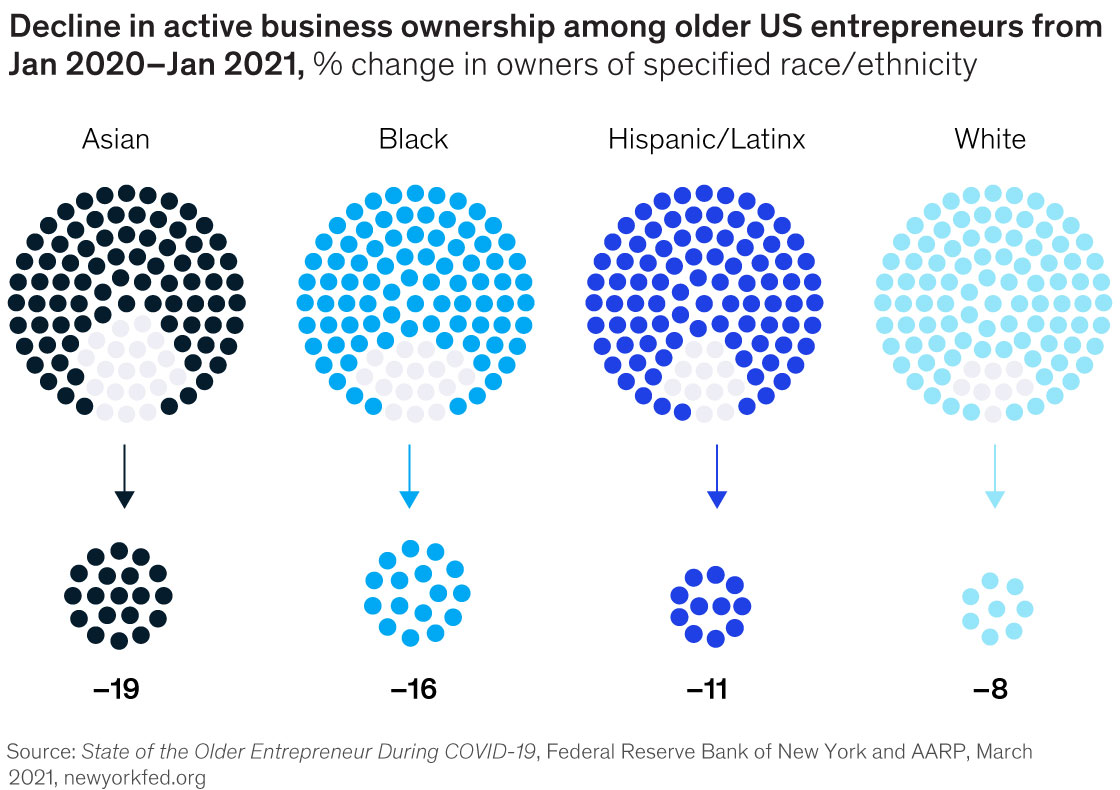
| In this issue, we look at a bold move by Asian American executives, the origins of Asian American and Pacific Islander Heritage Month, and the pandemic's outsize toll on older entrepreneurs of color. |
|
|
| • |
Laying the foundation. Last week, a group of leading Asian American executives launched the Asian American Foundation, an organization aimed at increasing opportunities for Asian Americans and Pacific Islanders (AAPI) and putting a stop to anti-AAPI violence and discrimination. The foundation's board pledged $125 million—the biggest philanthropic commitment ever made in support of AAPI groups and causes—and a range of partners (including McKinsey) together pledged another $125 million. A 2019 McKinsey analysis showed that Asian leaders made up just 3 percent of Fortune 500 CEOs—half the Asian American share of the US population. To advance workplace equity, organizations should start by tracking representation along the promotion pipeline, identifying where there are drop-offs, and asking why those drop-offs are occurring. Experiences can vary significantly across subgroups—which means collecting disaggregated data can yield important insights. |
| • |
A month years in the making. Asian American and Pacific Islander Heritage Month started when one woman saw a problem: in 1976, Jeanie Jew attended the US Bicentennial and found that AAPI contributions, achievements, and history were not recognized. This mattered to Ms. Jew on a personal level; her grandfather, M.Y. Lee, had immigrated to the United States from China and had helped build the first transcontinental railroad. He was later killed during a period of heightened attacks on Asian Americans. Ms. Jew came up with the idea for a heritage month and cofounded an organization to push for its establishment. More than a decade later, in May 1990, Ms. Jew finally achieved her goal. Today, AAPI leaders are renewing the call for their history to be taught and for their communities' diversity to be recognized. One potential starting point for those looking to learn more: Asian Americans, a film series on how Asian Americans have shaped—and are continuing to shape—the history of the United States. |
|
|
| — Edited by Julia Arnous, an editor in McKinsey's Boston office |
|
| Click to subscribe to this weekly newsletter |
|
|
Did you enjoy this newsletter? Forward it to colleagues and friends so they can subscribe too.
Was this issue forwarded to you? Sign up for it and sample our 40+ other free email subscriptions here.
|
|
|
Copyright © 2021 | McKinsey & Company, 3 World Trade Center, 175 Greenwich Street, New York, NY 10007
|
|
|