The future of jobs in America
nbsp;

|  | | | | |
| Click to get this newsletter monthly |
| |
|
|
| | Brought to you by Alex Panas, global leader of industries, & Becca Coggins, global leader of functional practices and growth platforms
| | | | | | |
|
| | | | |
| | | |
| The US economy could have more jobs in 2035 than it does today. Also true: Only about one in seven workers who need a new occupation can make the move with little retraining and no pay cut.
That challenge could be especially acute for Gen Z. A new report from McKinsey Senior Partner Kweilin Ellingrud and her coauthors finds younger workers are about 60 percent more likely than prime-age workers to need to change occupations entirely over the next decade. Millions of Zoomers have barely finished onboarding to their new—or even first—job, yet for some of them, it may already be time to think about plan B.
The research estimates 11 million US workers may need to move into a new occupation entirely by 2035. Their paths to get there will vary: Some can make the jump with little retraining and no pay cut; others will need significant reskilling and new credentials and may need to take a pay cut. And nearly half of these workers face even higher barriers such as greater skill gaps and credentialing requirements.
Here’s the upshot: Many of the jobs in fields that are expected to grow also come with better pay. These “growing” fields include healthcare, construction, and management.
So, what are some of those skills that get you in the door, lead to higher pay, and help you to keep growing? According to the research, which tracked how often specific skills showed up in millions of US job postings between 2022 and 2026, skills such as curiosity, adaptability, resilience, and comfort working alongside AI are increasingly in demand. The last one is accelerating at a rapid clip: In job postings, demand for AI fluency is up 11-fold since 2022. Meanwhile, demand for adaptability grew fivefold, and demand for curiosity and resilience tripled. (Fortunately, plenty of Gen Zers are thinking about what comes next: Nearly eight in ten young adults ages 18 to 24 said advancing their career or earning more income was among their top aspirations over the next one to two years, nearly twice the rate of respondents overall.)
None of this is on Gen Z alone (read: an ambitious 22-year-old trying to figure out their LinkedIn headline). Instead, companies, schools, and governments can build these pathways together. Employers, for their part, can hire for skills rather than job titles, while credentials can become “stackable,” meaning someone’s existing certification counts toward the next one instead of making them start the whole process over.
There will be enough jobs in 2035. Whether Gen Z can actually step into them is a different question—and not one Gen Z should be left to answer alone.
| | | |
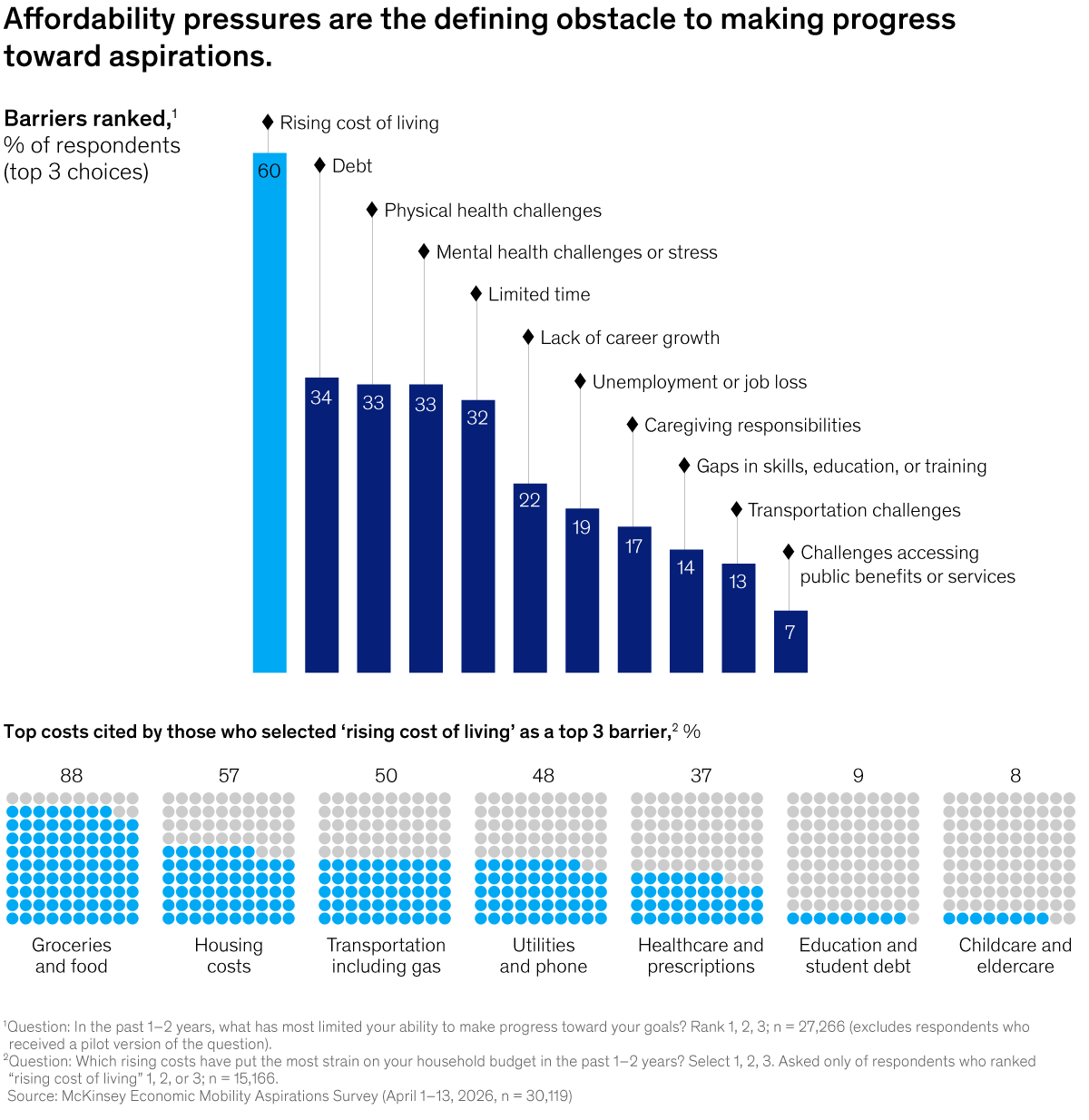
| | | When it comes to achieving their aspirations, US survey respondents most frequently cite the squeeze on household budgets as a barrier to economic mobility.
| | | | | |
| | | | | |
| | | The long game. A new McKinsey Health Institute report finds that eliminating preventable health risks—poor diet, air pollution, and inactivity—could add 12 years to the average healthy life expectancy and $16.4 trillion to the world economy by 2050. | | | Franchise flex. Sports team ownership used to be a billionaire’s hobby. Now it’s private equity’s favorite new asset class. | | | Fear itself. What looks like resistance to change is usually fear of losing status, credibility, or belonging. | | |
| | | |
| | | Grounds for rejection. Is bringing an iced coffee to a job interview a red flag, or just Gen Z refusing to fake formality? [Fortune]
| | | Diss-ruptive tech. While adults are still debating what AI means for the future, ten-year-olds have already turned the word itself into an insult for anything fake. [The Guardian] | | |
|
—Edited by Alexandra Mondalek, editor, New York
| | |
|
|
|
| Click to get this newsletter monthly |
| | |
|
| | Have feedback or other ideas? We’d love to hear from you. | | | | |
|
| | |
| |
|
|
|
Copyright © 2026 | McKinsey & Company, 3 World Trade Center, 175 Greenwich Street, New York, NY 10007
|
|
|
|
|