Corporate-approved cheat sheet

|  | | | | |
| Click to get this newsletter monthly |
| |
|
|
| | Brought to you by Alex Panas, global leader of industries, & Becca Coggins, global leader of functional practices and growth platforms
| | | | | | |
|
| | | | |
| | | |
| College textbooks come with answer keys. Jobs never have. Until now.
On-the-job learning at the entry level has always been about vibes (that is, hard to measure consistently). Years of tedious or unglamorous work—plus manager feedback, paying attention to what senior colleagues are saying and doing, and learning to read a room—is how expertise would develop for junior colleagues. It might have been inefficient, but it turned green hires into great ones.
As many Mind the Gap readers know by now, AI is removing many of the tasks and roles that once trained early-career workers, making it challenging for those workers to build expertise.
Some organizations are using AI to solve for this and create something new: an answer key. In a recent article, McKinsey Partner Bryan Hancock and Associate Partner Charlotte Seiler describe a simple exercise. A junior employee completes a piece of work independently, then compares it with what AI produces for the same assignment (this model also assumes that the AI output may contain some mistakes of its own). The junior employee learns from this exercise, and the side-by-side comparison makes it easy to see whether an employee is progressing.
Several organizations are already running with this model. One real estate firm asks junior employees to walk neighborhoods and build market assessments from scratch before comparing their work with AI-generated analyses. Clinical research points in the same direction: Simply giving physicians an AI tool barely moved the needle on their diagnostic skills in the long term, but requiring doctors to reach their own diagnosis first—and then reconcile it with the AI’s reasoning—enhanced their performance.
The answer key model is one piece of a larger argument that Hancock and Seiler make in their article. They also contend that expertise needs to become more portable. As more routine work disappears, the knowledge transfer between senior and junior colleagues that usually happens through osmosis has to become intentional. It’s no longer enough to document what your strongest performers know; organizations also need to capture how they think.
That changes entry-level jobs, too. If AI handles more routine tasks, junior role requirements can’t become whatever work is left over. Increasingly, they’ll revolve around supervising, interrogating, and improving AI outputs. Several organizations are already broadening their hiring profiles, placing greater weight on reasoning, adaptability, and systems thinking than on narrow technical specialization.
None of this works without coaching. As junior employees engage senior stakeholders and tackle more complex work earlier in their careers, the distinctly human elements of judgment—reading a room, exercising discretion, explaining not just what the data says but why it matters—become more valuable. Some organizations are borrowing from the medical-residency model, replacing informal mentorship with structured, supervised development and a clear progression toward independence.
The AI conversation has largely revolved around which jobs will disappear. Hancock and Seiler push it in a more useful direction: Once the work that built the expertise is gone, how do you build expertise?
| | | |
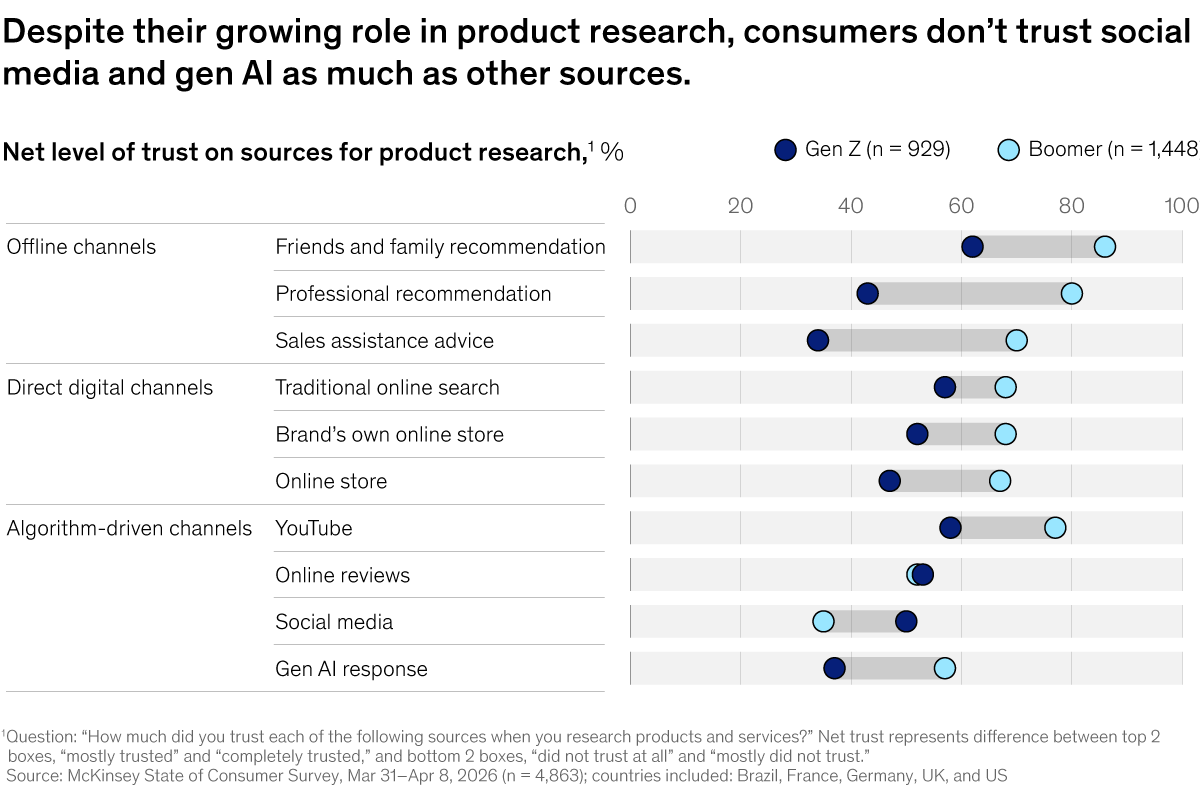
| | | AI is becoming part of the shopping journey, but not the final authority. Gen Zers place more trust in friends and family than in AI when it comes to purchase decisions, at least for now.
| | | | | |
| | | | | |
| | | | | | | Rite on cue. When “we have outsourced ourselves to algorithms,” one author makes the case for finding connection through a “ritual renaissance.” | | |
| | | |
| | | Sell side to sidelines. Is there a budding investment-banker-to-influencer pipeline? [Bloomberg]
| | | ‘Boomerasking.’ The more senior you are at work, the more questions you ask. But are they good ones? [Economist] | | |
|
—Edited by Alexandra Mondalek, editor, New York
| | |
| |
| | |
| | | | | Explore McKinsey’s annual book recommendations—a curated collection of nearly 100 thought-provoking titles to inspire fresh ideas and new perspectives. | | Browse the collection  | | | |
|
|
| Click to get this newsletter monthly |
| |
|
| | Have feedback or other ideas? We’d love to hear from you. | | | | |
|
| | |
| |
|
|
|
Copyright © 2026 | McKinsey & Company, 3 World Trade Center, 175 Greenwich Street, New York, NY 10007
|
|
|
|
|