| This week, upgrading your C-suite to a D-suite—a design suite, that is. Plus, why global consumer sentiment is a tale of two segments, and Bryan Hancock, a McKinsey partner and talent guru, on new ways to spur sales performance. |
|
|
|
| Strong design is at the heart of commercial success in both physical and digital settings. Companies that excel at design increase revenues and shareholder returns at nearly double the rate of their industry peers. |
| So why aren’t more companies among the strong? To answer that, we interviewed 200 senior design leaders and 100 top executives. Then we analyzed the answers of more than 1,700 respondents to the McKinsey Design Index survey. What we found was striking: some 90 percent of companies weren’t reaching the full potential of design, even as more companies add senior design roles. |
| The problem: a lack of clarity about where and how senior design leaders can contribute, and uncertainty about how much to expect of them. Less than half of design leaders feel their CEOs fully understand what they do, and only one in ten CEOs say their senior designer plays a meaningful role in strategy development. That’s a lost opportunity. |
| It’s abundantly clear that the lines among products, services, and user environments are blurring. The ability to craft an integrated customer experience opens up enormous opportunities, and design leaders, by nature, embrace user-centric strategies. |
| So let’s get down to business. To elevate your organization’s design ambition—and to clarify the leadership needed to deliver it—embed your senior designer in the C-suite and make the most of user data. In an era when data-driven cultures are becoming a source of competitive advantage, the effective use of metrics is a vital and still underutilized way to elevate and further clarify design’s role and ambitions. |
| We’re not saying that design leadership should usurp the chief strategist’s role—only that design has a unique role to play in strategy. |
| The bottom line is this: a marriage of strategists and design leaders brings fresh, user-based understanding to companies looking to rise on a power curve of performance. The design-thinking approach also helps companies keep their eyes out for coming disruption. And we know that’s always on the horizon. |
|
|

|
| OFF THE CHARTS |
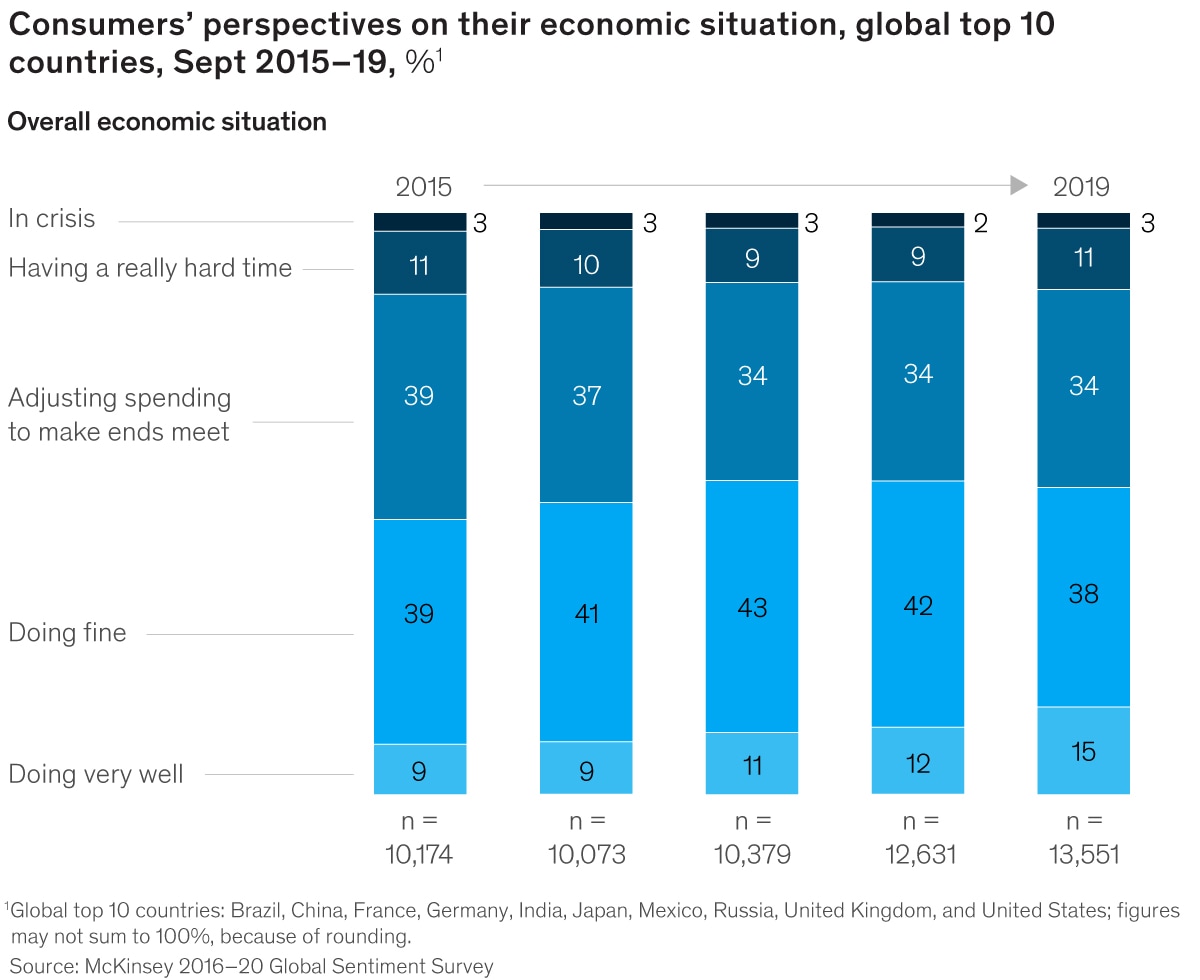
| Global consumers feel good, mostly |
| More consumers are positive about their current financial situation and the future, especially in fast-growing economies. At the same time, a growing number of middle- and lower-income households are struggling to make ends meet. The latest wave of McKinsey’s Global Consumer Sentiment Surveys, conducted in 19 countries, explores the impact of these developments on shopper behavior in a wide range of categories. (Please note, these surveys took place before the coronavirus outbreak.) |
|
|
|
|
|
|
| MORE ON MCKINSEY.COM |
| Building resilience in transport and logistics | Globalization, the evolution of supply chains, and the rise of e-commerce have all helped the sector grow. But in a period of economic shocks, here’s how to prepare operations for a smoother ride. |
| A 2040 vision for the US power industry | To get a sense of how far and how fast the United States is likely to reduce power-sector emissions, watch PJM, the country’s largest system. |
| A government blueprint for the future of work | Digital and artificial-intelligence technologies are expected to have substantial economic and social impact. Governments can act now to create shared prosperity and better lives for all citizens. |
|
|
|
|
|
| THREE QUESTIONS FOR
|
| Bryan Hancock |
| Bryan Hancock is the global leader of McKinsey’s talent work. He has served a wide range of talent-intensive businesses in retail, transportation, logistics, healthcare, banking, asset management, and oil and gas.
|
|
|
|
|
| How can taking a data-driven approach to managing talent in your sales force step up top-line growth? |
| What you’re saying is, HR can help sales make more money. And that’s something every salesperson likes to hear. There’s a reason for Alec Baldwin’s famous line, “Put that coffee down. Coffee’s for closers only.” Because you can know analytically what a closer is. There are lots of levers to improve sales—your coverage model, the selling proposition, the pricing. But when other elements are constant, the better salesperson closes the deal. |
| It comes down to the people. And who supplies the people? HR. This is one of the few times HR gets to say to the CEO and the head of sales, “I can help you make more money.” The results are real, and they’re not hard to achieve if you apply analytics to the problem. |
| What kind of data tells you a performer will be star talent over the course of a lifetime? |
| The data varies and comes from lots of different sources. Take work we did with a fast-food chain. At the start, its leadership said, “We think our burgers, chicken, and fries are about as good as everybody else’s. We want to look at the people.” That requires a broad understanding of who your employees are, not just a pencil-and-paper assessment. |
| We asked employees to wear smart badges, which tracked how much listening and talking they did and when they were talking to coworkers, managers, or customers. We analyzed a lot of different data—tenure, education level—and conducted a robust segmentation of the workforce. And we discovered the segments expected to drive the most sales were exactly the ones that weren’t. |
| Performance in sales is so quantifiable, but now we’re talking about assessing the value of employees over the course of a career. How does that work? |
| Improving sales through people, improving revenue through people: at the front end, they’re about selection. Are we getting the right people in the door? Next you need to think about that salesperson, that revenue generator, over the course of a lifetime. |
| Take that critical first six months. The difference between a newcomer and a longtime performer is huge. And many sales organizations churn through the frontline sales force. Getting newcomers up to speed faster drives impact. Some of this is good, old-fashioned early-stage sales management. And some is applying new tools and techniques and thinking about who your revenue generators are—a cashier at a fast-food restaurant, a call-center worker, a traditional insurance sales force. They all have different flavors, but what they have in common is a ramp-up period. We should be very intentional about shortening time to impact, using science and new techniques. |
| Often people worry that analytics and assessment are to the detriment of workers. What we see is that they’re to the benefit of the broader set of workers. Turnover goes down. People are happier, more fulfilled. Analytics can give a good frontline worker a home that intuition-based assessments may not have. You give a broader set of the population a fair shot to do its best. And when you do, your company gets a financial reward. This can be good and inclusive and can, overall, help us match people with jobs better than by intuition and feel. |
|
|
|
| BACKTALK |
| Have feedback or other ideas? We’d love to hear from you. |
|
|
|
|
|
Copyright © 2020 | McKinsey & Company, 3 World Trade Center, 175 Greenwich Street, New York, NY 10007
|
|
|
|