|
July 6, 2018 |
|
 |
| Weekly need-to-know content |
|
|
|
|
| Welcome to the Shortlist: new ideas on timely topics, plus a few insights into our people. Get it in your inbox every Friday. This week, scroll down to meet McKinsey’s new global managing partner, Kevin Sneader. |
|
|
|
| By 2030, 60 percent of the world’s population will live in cities. In both developed and developing nations, municipal leaders are fighting to make sure their cities are competitive and their urban populations are thriving. A big part of that fight is figuring out how to deploy smart technologies. |
| Until recently, municipal governments thought of these technologies primarily as tools for becoming more efficient behind the scenes. Now, they are realizing that “smartness” is also about using technology and data to make better decisions and deliver a better quality of life. Smartphones have become the keys to the city, putting instant information about transit, traffic, health services, safety alerts, and other community news into millions of hands. |
| Quality of life has many dimensions, of course, from the air residents breathe to how safe they feel walking the streets. The McKinsey Global Institute recently analyzed how dozens of digital applications address these practical and very human concerns. It found that some key quality-of-life indicators could improve by 10 to 30 percent—numbers that translate into lives saved, fewer crime incidents, shorter commutes, a reduced health burden, and carbon emissions averted. |
| For just one example of how urban life can be made healthier (and less frustrating), we can look at how smart-city technologies make daily commutes faster. Tens of millions of people in cities worldwide begin and end every workday fuming in traffic or piling into overcrowded buses and trains. By 2025, cities that deploy smart-mobility applications have the potential to cut commuting times by 15 to 20 percent on average, with some people enjoying even larger reductions. In a dense city with extensive transit, smart technologies could save the average commuter almost 15 minutes a day. In a developing city with more grueling commutes, that improvement might rise to 20 to 30 minutes daily. |
| In Moscow, for instance, the launch of an intelligent transport system using large amounts of commuting data reduced the load on roads, and by one measure the city dropped from the most congested out of nearly 400 cities globally in 2010 to 13th by 2016. |
|
|
| OFF THE CHARTS |
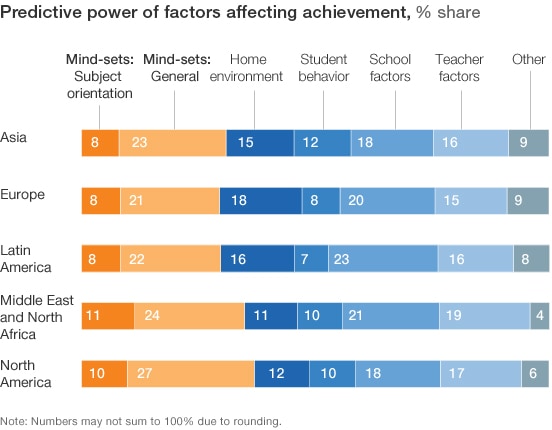
| In the classroom, mind-sets over matter |
| A well-educated citizenry is an economic and social necessity. Policy makers, educators, and parents all over the world want students to understand and be able to apply their knowledge of math, reading, and science. But what are the factors that improve educational outcomes? Number one is mind-set, or a student’s attitudes and beliefs. Mind-set even eclipses home environment in predicting student achievement. |
 |
|
|
| MORE ON MCKINSEY.COM |
| Still learning from Lincoln | Readers in the United States may think they know everything about the country’s 16th president, Abraham Lincoln. But Nancy F. Koehn, a professor at Harvard Business School, argues that studying Lincoln’s leadership skills is more important than ever. The early 21st century, while not as turbulent as the decades leading up to and including the American Civil War, still demands leaders who, like Lincoln, understand that complex problems can’t be solved with a single definitive answer. |
| Solving global health challenges together | Jaak Peeters, head of global public health at Johnson & Johnson, discusses the role pharma can play in addressing big challenges, such as fighting diseases like HIV and tuberculosis. |
|
|
| INTERVIEW |
| Kevin Sneader: First Glasgow, now the globe |
| Kevin Sneader succeeded Dominic Barton as McKinsey’s global managing partner (FT.com paywall) on July 1st. Most recently a senior partner and McKinsey’s regional chairman for Asia–Pacific, Kevin joined McKinsey in 1989 from Glasgow University and later earned an MBA from Harvard Business School. |
|
|
| In this interview, he discusses his upbringing in Glasgow, being known as “the Scottish business analyst,” and what he looks for in a hire. Plus, he reveals his deep love of rugby and how he “even learned to like American football.” |
| In these brand-new videos, Kevin discusses what’s next for McKinsey, including a strengthened commitment to women and diversity, ongoing changes to the way McKinsey works, and what we’ve learned from our mistakes in South Africa. He also talks about tackling several challenges such as balancing the tension between transparency and client confidentiality, recruiting great talent, and innovating in the face of increased competition. |
|
|
| BACKTALK |
| Have feedback or ideas? We want to hear from you. |
|
|
|
|
| |