| DELIVERING ON DIVERSITY, GENDER EQUALITY, AND INCLUSION
|
| Click to get this newsletter weekly |
|
|
| In this issue, we look at a way to make diversity targets count, the costs of incarceration, what's going on outside the US banking system, and why accessible design means better design. |
|
| • |
Making it official. BlackRock, the world's largest asset manager, has agreed to pay certain lenders more to borrow money if it falls short of its own diversity targets. Starting next year, some of BlackRock's borrowing costs will be tied to its share of female directors and Black, Hispanic, and Latinx employees, as well as the company's level of sustainability investing. BlackRock also plans to undergo an independent racial-equity audit on how its strategy affects stakeholders. The financial-services sector has an important role to play in advancing racial equity, given its control of capital and assets and its power over markets, entrepreneurship, and the business landscape. But people of color hold just one in ten C-suite positions at US financial-services companies—and women of color make up only 2 percent of the sector's C-suite. |
|
|
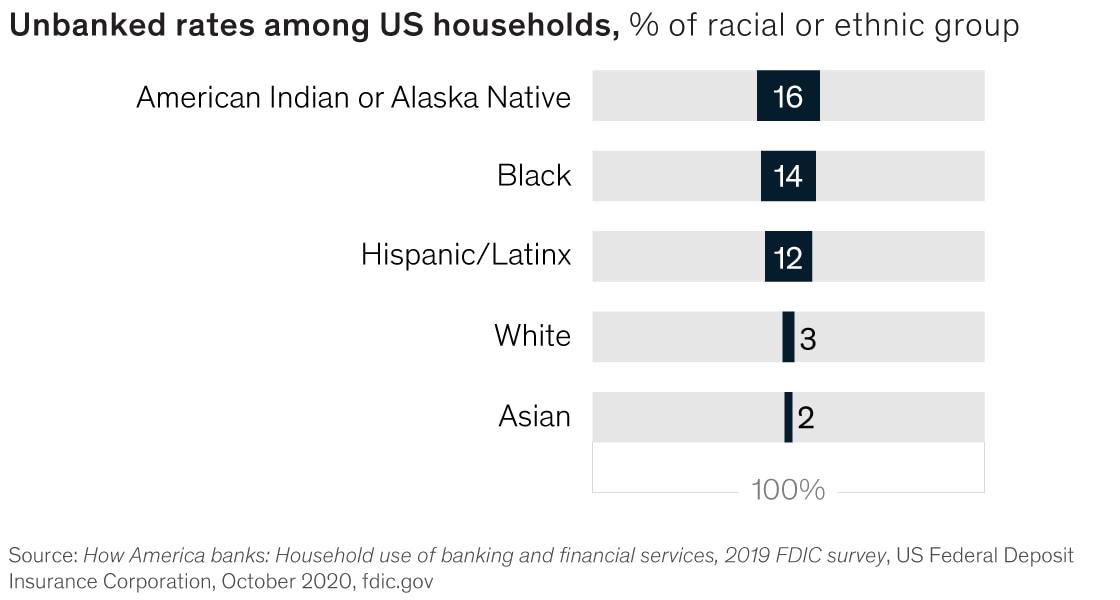
More than seven million American households are unbanked, which means that no one in the household has a checking or savings account. Federal data show that people of color experience unbanked rates that are up to 6.5 times that of white Americans, and that one in six Indigenous households is without a bank account. The situation has a high cost: unbanked Americans are far more likely to rely on pawnshops, rent-to-own services, nonbank money orders, and check-cashing services, which can be extremely expensive. And millions more are underbanked, meaning that they use such services despite having a bank account. McKinsey research shows that US financial institutions could realize an additional $2 billion in annual revenue if Black Americans had the same access to financial products as white Americans. Boosting financial inclusion will help enable Black, Hispanic, Latinx, and Indigenous Americans to build wealth—and as they do, the financial institutions that serve them and the economy as a whole will continue to benefit. |
|
| Many companies treat accessible design as an afterthought—and some business leaders may see it as a burden. They worry that applying accessible-design principles will slow down product development, so they start looking for a way around it: “How many people are really disabled? And will they really use our product?” |
| Accessible design makes for better design, including for people without disabilities. Designing with all users in mind brings rigor and creativity to the design process and results in products that are more robust, effective, and intuitive. Accessibility can't be an afterthought or extra step; it should be factored in from the get-go, and plans should reflect the needs and perspectives of people with disabilities. |
| How can companies and teams make that happen? By including people with disabilities throughout the design process. Without their input, the finished products won't be as inclusive—or as innovative—as they might have been. |
| — Edited by Julia Arnous, an editor in McKinsey's Boston office |
|
| Click to subscribe to this weekly newsletter |
|
|
Did you enjoy this newsletter? Forward it to colleagues and friends so they can subscribe too.
Was this issue forwarded to you? Sign up for it and sample our 40+ other free email subscriptions here.
|
|
|
Copyright © 2021 | McKinsey & Company, 3 World Trade Center, 175 Greenwich Street, New York, NY 10007
|
|
|