


Outsourcing is a core component of the biopharma operating model. Across biologics manufacturing, cell-line development, and fill-and-finish services, biopharma companies can expect to increase their reliance on contract development and manufacturing organizations (CDMOs) through 2030, despite rising costs.
In a recent McKinsey survey of more than 300 biopharma leaders, respondents reported that batch prices have risen by 7 percent since 2020, and they expect further increases over the rest of the decade. Yet demand for outsourcing continues to expand, particularly in areas where speed, flexibility, and specialized capabilities are increasingly important.
For years, many CDMOs competed by having readily available and regulatory compliant capacity. Today, customer expectations are evolving. As outsourcing becomes more deeply embedded in biopharma operations, customers are placing greater emphasis on reliability, execution, and cost competitiveness. Quality remains essential, but it is increasingly seen as a baseline requirement rather than a differentiator.
Our research points to three developments reshaping the competitive landscape:
- Rising cost sensitivity among customers
- Persistently low customer advocacy across much of the industry
- Growing pressure to improve operational performance and productivity
Together, these trends suggest that the next phase of competition will be determined less by who has the most capacity and more by who can consistently deliver superior operational performance that improves productivity and enables efficient pricing.
Companies are increasingly relying on outsourcing
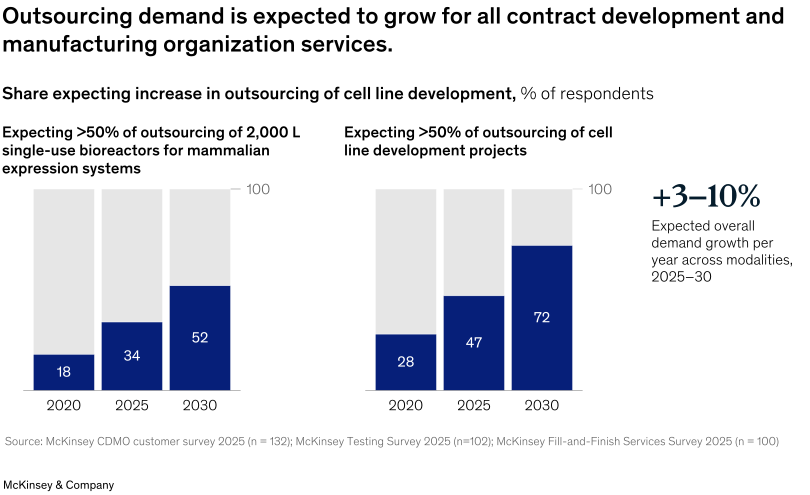
In every category, biopharma companies expect their reliance on external partners to deepen through 2030 (Exhibit 1). The shift is particularly pronounced in mammalian biologics manufacturing. Respondents to our survey expect the outsourced share of 2,000-liter (2kL) single-use bioreactor work, for both clinical and commercial supply, to soon exceed 50 percent.
The pattern holds throughout the value chain:
- Cell line development: Outsourcing rates are rising as customers seek integrated providers to bridge internal capability gaps.
- Fill-and-finish: Markets are expanding by 3 to 10 percent annually, led by complex formats such as autoinjectors.
Operational performance is now the price of admission
Customers are becoming more selective about the companies they partner with. They prioritize reliability, increasingly treating it as a baseline requirement.
Buying factors that drive purchasing decisions are now overwhelmingly operational. In biologics, drug substance, quality, compliance, reliability, and speed account for four of the top five selection criteria. Fill-and-finish follows the same pattern: quality, regulatory track record, and execution reliability are top priorities, while environmental, social, and governance (ESG) performance and digital maturity are less critical.
The data on cell-line development confirms this trend. Customers are desperate to reduce operational complexity by consolidating their vendor lists, and are actively seeking integrated partners capable of managing multiple development stages.
Capacity alone is no longer a differentiator. If a CDMO cannot execute flawlessly, ensure consistent compliance, and maintain baseline quality, its physical square footage doesn't matter.
With quality assumed, cost is the primary differentiator
As operational baselines are increasingly taken for granted, cost has shifted from a secondary consideration to the primary factor in supplier selection (Exhibit 2).
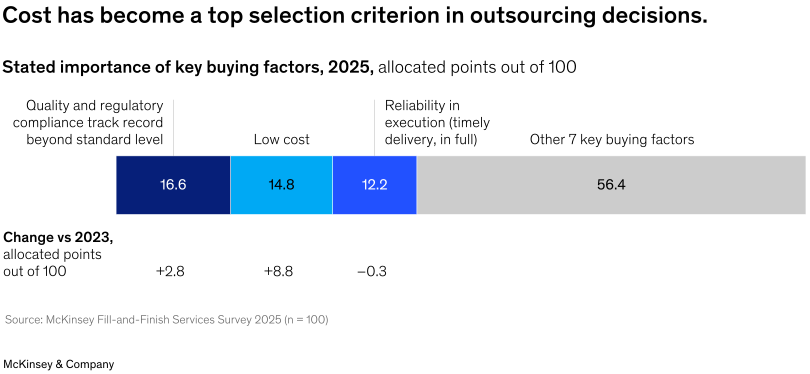
In fill-and-finish outsourcing decisions, low cost now ranks second among all buying factors, with an importance score of 14.8—more than doubling its weight in supplier selection decisions over the past two years.
Cost also ranks among the most critical selection criteria for other services. In biologics manufacturing, it ranks as a primary selection criterion, alongside reliability and speed.
This shift poses a fundamental challenge for CDMOs. Because quality and compliance are nonnegotiable baselines, providers cannot simply lower their standards or cut corners to offer lower prices. Instead, meeting aggressive cost expectations requires a step-change in productivity. Cost competitiveness is won or lost on the factory floor.
Customer advocacy remains weak across much of the industry
Despite robust market demand, customer loyalty in the CDMO sector is surprisingly thin. This suggests that many CDMOs are failing to bridge the gap from physical capacity and baseline execution to the productivity needed for competitive pricing.
In fill-and-finish, the average customer advocacy score is a disappointing –14 (Exhibit 3), at the low end of typical B2B benchmarks. Only three of the top 15 providers would be recommended by customers. The story is similar elsewhere:
- Biologics: in mammalian expression systems, most providers have more detractors than promoters, resulting in a negative net advocacy position.
- Cell-line development: Only five of 21 providers achieved a positive advocacy score.
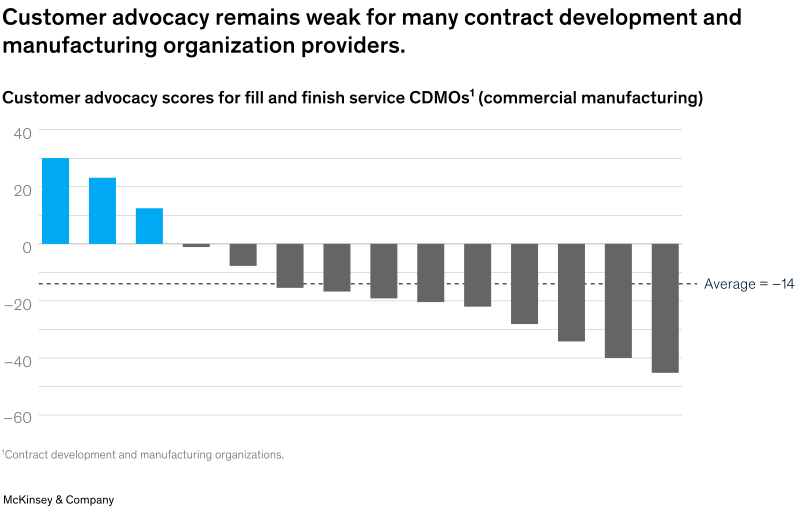
Even in a high-stakes market characterized by long timelines and complex technology transfers, incumbency is no longer a defense. If a provider cannot deliver baseline operational reliability and cost productivity, customers will seek alternatives.
Mastering the invisible economics of operations
To close the advocacy gap and remain profitable in a cost-sensitive market, CDMOs must master the invisible economics of day-to-day operations; that is, the factory-floor efficiencies and inefficiencies that don’t appear on requests for proposals or pricing sheets but that dictate a provider’s unit cost and reliability. Cost competitiveness is achieved by eliminating operational waste, quality deviations, yield losses, and utilization gaps that quietly inflate the cost of every run.
The largest cost driver is quality. Quality issues, including deviations, failed batches, and rework, can be 15 to 20 percent of the cost of goods sold. This is especially true as regulatory pressure intensifies: FDA Form 483 observations surged 33 percent per inspection in 2025 compared with pre-COVID-19 levels.1 A warning letter can trigger a remediation program that might cost between $10 million to $50 million, erasing years of margin and customer trust.
CDMOs are also leaving substantial value on the table through structural inefficiencies, including:
- Utilization gaps: Biologics utilization typically stalls at 60 to 75 percent. Suboptimal scheduling and planning leave expensive, installed capacity idle.
- Yield losses: Downstream purification yields in biologics typically range from 60 to 80 percent. Every incremental improvement directly lowers the unit cost per gram and expands effective capacity without requiring new capital expenditure.
By targeting these hidden operational inefficiencies, CDMOs can reduce their cost structures and execute more reliably.
Three core capabilities for the new CDMO model
To thrive in this environment, successful CDMOs will master three interdependent capabilities:
- Reliable execution (the baseline): Predictable timelines and right-first-time delivery are expected. Underperformance will result in vendor reassessment.
- Cost productivity (the differentiator): CDMOs will have to meet aggressive price expectations through lean manufacturing, scrap reduction, and improved yields.
- Digital and AI-enabled operations (the accelerant): AI and advanced analytics are becoming essential tools for reducing planning variability, managing deviations, and optimizing yield. Over time, these capabilities will confer structural cost and reliability advantages.
The CDMO market is no longer just a race for scale. As customer expectations outpace market growth, the advantage will shift to providers that can serve as integrated operational partners. By mastering reliable execution, boosting productivity on the factory floor, and adopting digital accelerators, CDMOs can finally bridge the industry’s advocacy gap. Those that improve transparency, responsiveness, and cross-functional engagement alongside these operational capabilities will be best positioned to capture market share, drive repeat business, and achieve sustainable commercial growth.
The authors would like to thank Miriam Stricker for her contributions to this article.
1 FDA inspection database.