




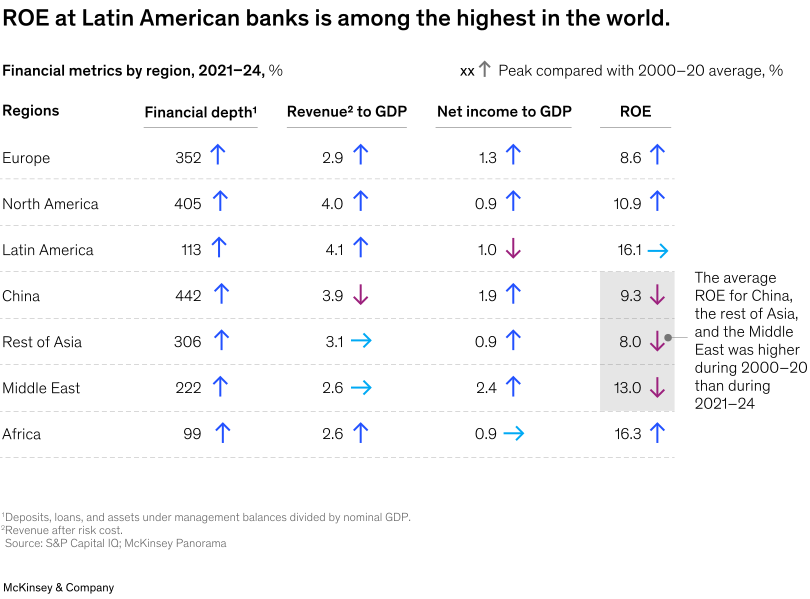
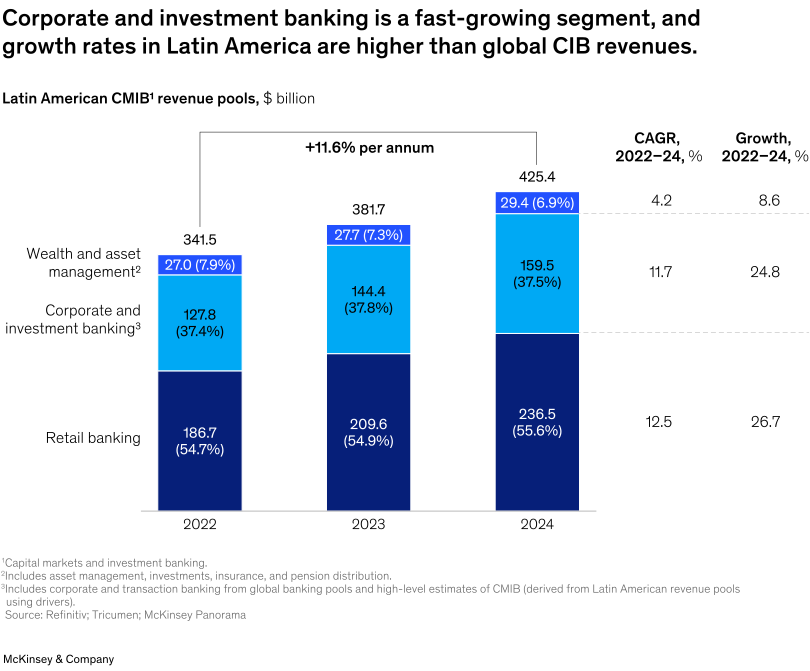
Despite macroeconomic volatility, Latin America’s banking sector has delivered strong performance in recent years. Latin America’s overall banking system delivers high returns, with a 16.1 percent average ROE from 2021 to 2024, compared with 8.6 percent in Europe and 10.9 percent in North America in the same period (Exhibit 1). Corporate and investment banking (CIB) accounts for more than 37.5 percent of banking revenue in the region, contributing to a strong performance by the region’s financial-services sector. Top performers, moreover, have sustained profitability of about 20 percent over the past several years.
This outsize performance reflects operating models in Latin America that are explicitly designed for volatility, structural complexity, and uneven financial intermediation. Leading wholesale banks treat instability as a baseline condition, shaping balance sheets, credit structures, and client engagement accordingly. McKinsey’s 2025 CIB Survey in Latin America, which captured the perspectives of 370 large corporate decision-makers, reinforces this view and explains the mechanisms behind the region’s sustained outperformance.[1]
Latin American banks convert volatility and opacity into a durable advantage by combining active portfolio management with concentrated transaction flows, relationship depth, and sector-engineered project finance and recovery expertise.
While other emerging markets consider some of these factors, leading Latin American banks are distinctive because they deploy all these factors simultaneously. Their resulting success offers lessons for institutions expanding into the region and for banks seeking to strengthen resilience and operating discipline elsewhere in the world.
Managing credit portfolios through volatility
Banks across much of the region play a central role in corporate funding because capital markets remain shallower and private credit is still developing. This dynamic is reflected in revenue pools. Recently, CIB has been a fast-growing segment in the region, expanding by roughly 12 percent a year between 2022 and 2024—faster than the global average (Exhibit 2).[2] This underscores the central role of banks in financing the real economy in Latin America.
Wider spreads increase potential returns, but in volatile environments, they also reflect higher underlying risk. Latin America stands out because leading banks actively manage that risk—reducing loss severity and capital consumption—so that higher margins translate into superior returns on capital. Loans are typically secured, leverage is conservative, and maturities are shorter. These factors allow banks to rebalance exposure, reprice risk, and adjust structures dynamically, which reduces loss variability and limits the capital required to support exposures. The rewards from wider spreads therefore go to those with disciplined portfolio management.
Leading institutions have further strengthened this discipline in recent years through greater portfolio granularity and early-warning systems. More segmented credit monitoring and data-driven alerts allow banks to identify stress signals earlier, intervene more precisely, and reduce downside volatility.
This discipline is visible in asset performance. Across major Latin American markets, wholesale lending represents a substantial portion of corporate credit while maintaining comparatively stable delinquency levels. Brazil’s wholesale credit portfolio, for instance, is slightly larger than the nation’s loan book of small and medium-size enterprises (SMEs), yet SME delinquency levels are more than 15 times higher. This example highlights how structured lending and active monitoring help contain risk—even at scale.
Flows and relationship depth reinforce one another
Client concentration is a key regional dynamic. For example, the Latin American CIB Survey found that in Brazil, the region’s largest market, roughly 75 percent of large corporations channel a significant share of their operational flows with a small number of banking partners. This concentration gives banks deep visibility into cash management, payments, receivables, payroll, and trade flows generated by clients.
Coverage teams at senior banks can remain close to client decision-makers, and credit decisions are often made locally. During periods of volatility, engagement between banks and clients deepens rather than retreats, enabling institutions to restructure exposures and expand share of wallet selectively.
This dynamic, however, is increasingly being challenged by specialized competitors and digitally native players that are aggressively investing in digital capabilities and client experiences. The Latin American CIB Survey results reflect this shift: Roughly two-thirds of respondents across segments say their ideal relationship model is becoming more digitally focused. Maintaining a competitive advantage, therefore, requires continuous innovation in how flows are captured and integrated.
Long-term credit is engineered, not commoditized
Long-term financing, particularly in project finance and other capital-intensive sectors—is governed by different principles than the short-term credit that dominates Latin American wholesale balance sheets. Long-term exposures are structured around sector-specific cash-flow models, regulatory frameworks, and, in many cases, participation by public or development banks. Concession structures, regulated revenue streams, and blended financing arrangements are common features.
In this context, local institutions benefit from accumulated sector depth. Wholesale banks in the region frequently organize around industry verticals such as infrastructure, energy, agribusiness, and transportation, where financing structures are often linked to regulation, subsidies, or public frameworks. Latin American banks tend to operate with sector teams that are more deeply embedded than banks elsewhere. These teams are led by senior staff and industry specialists, leading to stronger integration of industry expertise within banking teams. This approach strengthens underwriting and improves the alignment of structures with sector realities. Findings from the Latin American CIB Survey indicate that sector specialization is the primary decision factor for large corporate clients when selecting credit institutions, often outweighing price considerations in capital-intensive and regulated industries.
The payoff is tangible. Banks with strong sector franchises can structure risk more effectively and manage long-term exposures with greater precision, reducing loss volatility while sustaining attractive returns.
Greater standardization in documentation and technical features may further enhance an already growing global investor appetite for long-term credits and other Latin American assets, enabling more-scalable originate-to-distribute models without sacrificing structuring depth.
AI is enhancing value-chain intelligence
Algorithms and machine learning have been a growing presence in wholesale-banking risk processes, and AI is now accelerating that growth. Latin America’s operating model—anchored in concentrated transaction flows and sector-specific structuring—generates dense, high-frequency data that can be systematically analyzed.
Leading Latin American banks are increasingly deploying machine learning models for dynamic credit underwriting, fraud detection, and early-warning portfolio monitoring, embedding AI directly into risk and credit decision processes.
AI enhances signal extraction from unstructured data such as financial statements, collateral documentation, and client interactions—and it accelerates decision cycles in environments characterized by incomplete disclosure, fragmented registries, and manual processing related to guarantees and bespoke credit structures. The same transaction intelligence can also support targeted cross-selling into trade finance, foreign exchange hedging, and commodities solutions by identifying flow patterns, sector exposures, and risk concentrations.
These capabilities expand the perimeter of control beyond the individual client. By integrating transaction flows, banks can analyze entire value chains, identify stress propagation, and anticipate liquidity needs before they surface on balance sheets. In certain concentrated value chains, leading banks may have visibility into 60 to 85 percent of commercial transaction flows, according to McKinsey analysis of collective data from client studies. This reinforces the concept that the ability to translate data into faster, more precise credit and commercial decisions is a defining source of competitive advantage.
Recovery as a structural capability
Volatility inevitably produces stress cycles. In Latin America, wholesale banks have developed a distinct capability to originate credit and to actively manage and recover credit when conditions deteriorate.
In Latin America, leading institutions operate dedicated special-situation capabilities that combine credit, legal, restructuring, and sector expertise. While banks globally have similar capabilities, they tend to play a more central and systematic role in the region, reflecting the frequency of stress cycles and the complexity of restructuring environments. These teams deploy instruments such as debtor-in-possession financing, structured bridge-to-equity solutions, and asset-backed strategies designed to preserve enterprise value while protecting downside risk.
For example, the addressable special situations market in Brazil alone is estimated in the range of 150 billion to 200 billion Brazilian reais. For established banks, these activities can contribute up to 15 percent of total profits. Recovery, in this context, is a defensive function and an additional lever of value creation.
A defining feature of this model is structural flexibility. Transactions may be allocated directly to the balance sheet or structured through dedicated vehicles, depending on capital, regulatory, and tax considerations. This ability to combine credit judgment with structuring creativity enhances recovery outcomes and reduces the severity of losses.
Turning constraint into advantage
Strong profitability in Latin American banking is supported by operating models that enable leading institutions to navigate complex and constrained environments.
Foreign investors evaluating expansion into the region should understand that high returns are not guaranteed. Instead, the sector’s performance depends on adopting a more integrated operating model—one combines origination, balance sheet allocation, distribution, and transaction banking. For global players, the region offers a laboratory filled with operating levers that may be transferable beyond Latin America.
As competition intensifies and markets evolve, this operating model is becoming harder to replicate. Winning institutions will be those that treat volatility not as a challenge to be managed but as a condition to be mastered.
Andrea Cristofori is a partner in McKinsey’s Miami office, and Heitor Martins is a senior partner in the São Paulo office, where Paula Castilho is a partner, Roberto Marchi is a senior partner, and Bárbara Castro is an associate partner.
[1] We surveyed 370 companies with revenues of more than 100 million Brazilian reais, including large universal banks, global banks, challengers, midsize and corporate banks, and M&A boutiques.
[2] CIB in an era of volatility, AI, and nonbank challengers, McKinsey, December 11, 2025.